Introduction
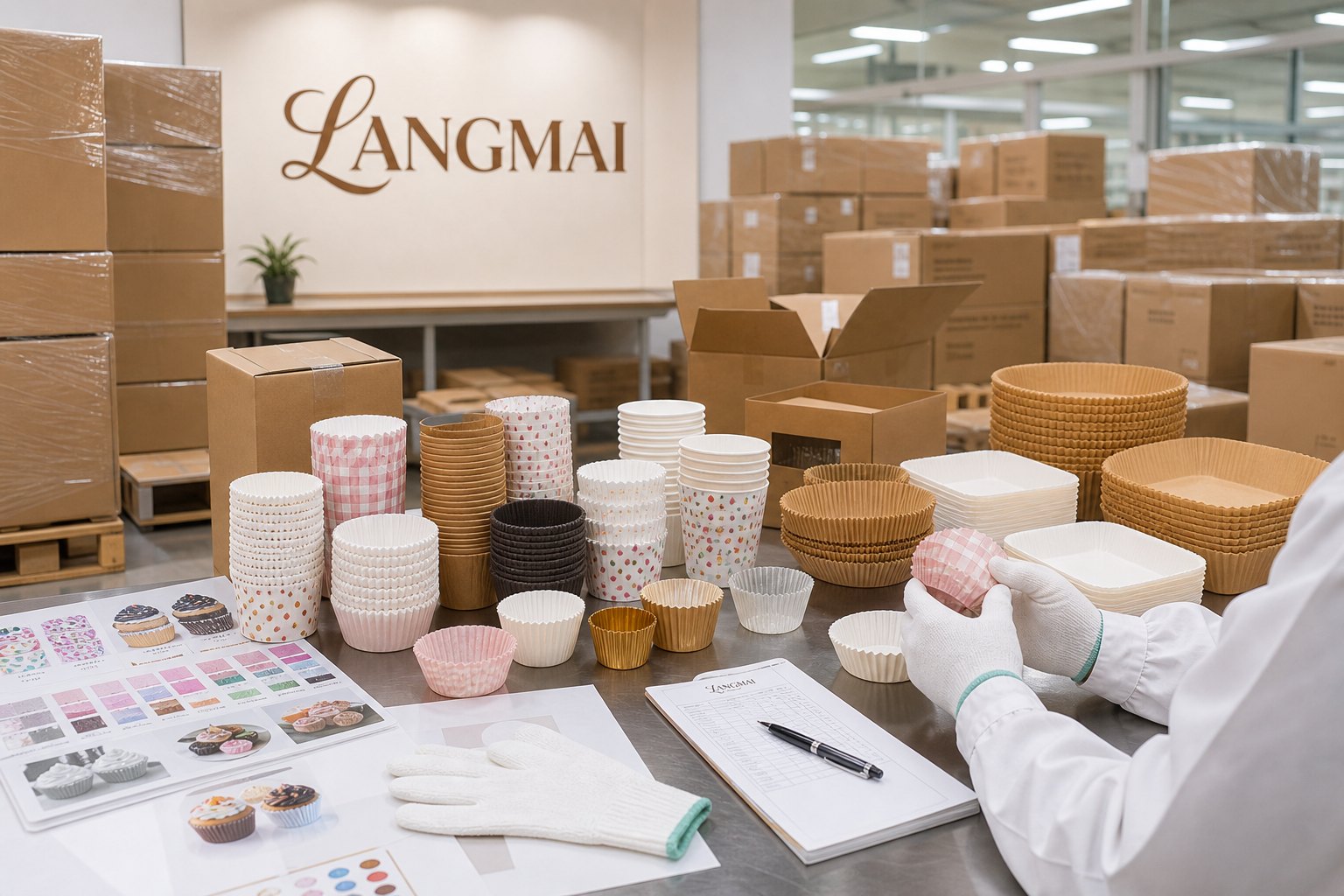
The best muffin baking cups for commercial bakeries are not selected by a name such as “standard,” “large” or “cafe size.” Buyers should match a measured cup profile to the bakery's pan, batter portion, oven process, finished-product presentation and packing line. Then they should approve a production-representative sample after a real bake, cooling and handling trial. The purchase specification should carry those approved dimensions, materials, artwork, pack counts and inspection points into every order.
That is the direct answer because two cups sold under the same size name can differ in base diameter, top opening, wall height, taper, rigidity and nesting. Those differences affect how the cup sits in a pan, how much batter it can receive, whether its wall deforms, how the muffin rises and how efficiently the empty cups can be separated and packed. A price comparison made before those variables are aligned is not a like-for-like comparison.
This guide is for bakery chains, central kitchens, cafe groups, bakery-supply distributors, importers and foodservice packaging buyers. It focuses on the purchasing work that determines repeatability: building the specification, testing samples with the actual process, reviewing food-contact evidence, protecting cups in transit and comparing suppliers on controlled evidence rather than sales descriptions.
1. Define the Bakery Application Before the Cup
Start with the job the cup must perform. A muffin sold warm from a cafe counter, a wrapped product distributed to stores and a decorated item packed in a gift box can use different cup profiles even when the nominal product weight is similar.
Create a one-page application statement before requesting quotes. It should identify:
- muffin or cake type, including whether the surface is oily, moist, sticky or dry;
- target batter portion by weight or by the bakery's controlled depositor setting;
- baking pan cavity dimensions and whether the pan supports the full cup wall;
- oven type, set point, residence time and any cooling step relevant to the trial;
- expected service, display or wrapped-storage period before consumption;
- manual or automatic cup denesting and filling method;
- desired finished height, colour visibility and release behaviour;
- consumer pack, foodservice sleeve or bulk case requirement; and
- destination market and buyer-specific documentation.
This statement creates repeatable comparison conditions. If a bakery uses several recipes or oven lines, identify the most demanding foreseeable cases instead of assuming one bake represents every product.
2. Specify Dimensions That Can Be Measured
Nominal labels are useful for browsing but weak for purchase orders. A quote-ready specification should record the top diameter, base diameter and vertical wall height in millimetres, together with the cup profile or drawing. If a cup has petals, rolled edges, pleats or another shaped rim, define where each measurement begins and ends.
Match the cup to the pan cavity
Measure the bakery's pan rather than relying on a pan name. Record the cavity's top opening, base, depth and taper. Also note any radius or transition that affects how the paper sits. A base that is too small can move during depositing; one that is too large can wrinkle or fail to seat. Excessive wall height can fold under handling, while insufficient height can change the intended presentation or expose the pan.
LANGMAI's current local product data lists two muffin-cup examples at 60/50/45 mm and 70/60/55 mm for top diameter/base diameter/height. These are supplier examples, not international standard sizes. Buyers should confirm the current drawing, measurement method, material and pack configuration in the quotation and approved sample. The muffin baking cups product page provides a starting point for that discussion.
Control the functional profile, not only three numbers
Three dimensions do not describe every behaviour. Ask the supplier to identify the paper construction, forming style, surface treatment or coating, print position and nesting direction. Do not copy a material value from another cup without considering the finished construction.
| Specification point | Why the bakery needs it | How to verify before ordering |
|---|---|---|
| Top diameter | Influences pan fit, presentation and finished opening | Measure sample at the agreed reference point |
| Base diameter | Controls seating and stability during filling | Compare sample with the actual pan cavity |
| Wall height | Affects support, portion headroom and appearance | Measure unfilled cup and inspect after baking |
| Taper/profile | Changes nesting, fit and sidewall contact | Approve drawing plus physical sample |
| Material/construction | Influences rigidity, release and intended-use evidence | Match specification to supplier documents and trial sample |
| Print and colour | Affects brand appearance and possible set-off review | Approve artwork/proof and baked appearance |
| Count and nesting | Affects line handling and inventory accuracy | Conduct count, separation and line-feed checks |
For broader dimensional terminology, use LANGMAI's cupcake liner size guide, then add the process controls specific to the commercial bakery.
3. Run a Production-Representative Baking Trial
A visual check of empty cups is not enough. Test samples with the bakery's real pan, recipe, batter portion, depositing method, oven and cooling process. Record the test so purchasing, quality and production teams can compare suppliers using the same conditions.
Prepare a controlled trial
Code candidates and store them consistently before use. Use the same batter batch where practical, place candidates in comparable pan positions and record oven variation. If edge and centre positions differ, rotate or repeat the trial.
Record at least:
- sample and specification revision;
- pan identification and cavity measurements;
- recipe or internal recipe code;
- deposited batter amount or machine setting;
- oven type, set point and actual process time;
- cooling time before inspection;
- cup seating, wall deformation and colour change;
- grease staining or moisture effects after cooling;
- release behaviour at the planned eating or packing time; and
- finished muffin appearance and dimensions relevant to packing.
Release, staining and shape can change with fat, sugar, moisture, temperature, time and storage. A result with one recipe should not be treated as a guarantee for another.
Test the real workflow after baking
Commercial suitability also depends on handling. Check whether staff or equipment can separate nested cups without double-feeding, whether the cup remains centered during depositing and whether baked products can be removed from pans without damaging the wall. After cooling, run the product through the intended tray, clamshell, flow wrap or carton. Confirm that the cup does not catch, crush or obscure required presentation.
For a multi-site bakery, repeat the trial where pans, ovens or operators differ materially. The goal is evidence that the specification works under foreseeable production conditions.
4. Compare Cup Formats by Commercial Use
Buyers often compare fluted liners, tall muffin cups and more rigid formed cups as if they were interchangeable. They are different specification families. The appropriate choice depends on pan support, product presentation, handling and distribution.
| Format | Typical purchasing reason | Trial priority | Common specification risk |
|---|---|---|---|
| Fluted paper liner | Familiar bakery format with pan support | Cavity fit, release and grease appearance | “Standard” name hides dimensional differences |
| Tall muffin cup | Higher sidewall and cafe-style presentation | Wall stability, portion level and pack clearance | Height or taper conflicts with pan and package |
| More rigid formed cup | Greater shape support for selected products | Direct-bake suitability, rigidity and intended-use evidence | Buyer assumes self-support without a validated trial |
| Printed branded cup | Shelf or counter differentiation | Print approval, odour, colour after baking and set-off controls | Artwork is approved without a production bake |
Do not infer oven suitability from appearance. Match the supplier's intended-use information for the finished construction to the bakery process. If baking without a supporting pan, state and test that requirement explicitly.
5. Review Food-Контакты and Printing Evidence by Intended Use
Compliance review should connect the finished cup to the actual food, temperature, time and destination market. It should not stop at a certificate name or a logo in a sales deck.
For EU-bound orders, Regulation (EC) No 1935/2004 requires food-contact materials under normal or foreseeable use not to transfer constituents in quantities that could endanger health, unacceptably change food composition or deteriorate organoleptic characteristics. It also establishes traceability requirements. Regulation (EC) No 2023/2006 requires good manufacturing practice supported by quality assurance, quality control and records. Its printing provisions address transfer through the substrate or by set-off from a printed non-food-contact surface.
For US projects, FDA's food types and conditions of use distinguish bakery foods with and without free fat or oil and identify cooking above 250°F as a condition of use. The practical procurement point is that an authorization or test basis must match the relevant substance, finished construction and intended use. A generic statement that paper is “FDA certified” is not a substitute for that review.
Ask for documents identifying the tested or declared article, construction, market basis, conditions, date and issuing party. Compare them with the specification and sample. If a report covers unprinted paper but the order is printed and formed, resolve that gap. The food-contact testing guide for paper baking cups provides a detailed workflow.
Discuss Your Bakery Application
6. Approve Artwork and Finished Appearance Together
Artwork and performance approval should use the same construction. Colour on flat paper can look different after forming, nesting and baking. Approve a controlled artwork file and a physical or production-representative proof.
During the bake trial, check colour, registration, scuffing and unexpected odour. Confirm which surface contacts food and how printed cups are stacked. Keep critical logos and small legal text away from areas made unreadable by forming.
Record the artwork revision on the purchase order. Decide whether changes to colour, paper, coating, components or print coverage require a new proof, bake or document review.
7. Design Packaging for Counting, Protection and Line Use
Empty muffin cups are lightweight but sensitive to compression, moisture and poor nesting. Packaging should protect shape while allowing staff or equipment to handle cups efficiently.
Define the unit count, inner packaging, sleeves or bags per case, case quantity, carton dimensions, gross/net weight fields, lot identification and pallet requirements where relevant. LANGMAI's local product data shows example case configurations for its listed muffin-cup sizes, but buyers should treat those as quotation inputs, not permanent promises. Confirm current counts and dimensions for the selected SKU.
Run a pack-out trial if cups will be repacked or distributed to multiple stores. Check opening, stack alignment, quantity handling and protection of partly used packs.
For imported orders, inspect cartons after agreed handling or transport trials. Look for crushed rims, ovalized bases, leaning stacks, torn inner bags, moisture exposure and count errors. Stack orientation, clearance and pallet pattern can matter as much as carton strength.
8. Build an RFQ That Makes Suppliers Comparable
Send every candidate the same controlled request. If one supplier prices a plain stock cup in bulk and another prices a printed cup in protected sleeves, the quotations do not support a useful decision.
Use this RFQ checklist:
- intended product, recipe characteristics and destination market;
- pan top/base/depth measurements and drawing or photos;
- required cup top/base/height and profile drawing;
- intended batter portion and pan-supported or self-supporting use;
- oven and cooling conditions for the sample trial;
- material/construction and performance priorities;
- plain or printed design, artwork stage and colour references;
- unit, inner and case counts plus labelling and pallet needs;
- estimated order quantity and forecast pattern without demanding an invented MOQ;
- sample type, quantity and whether it represents proposed production;
- food-contact, printing and traceability documents to review;
- change-control expectations for materials, dimensions and artwork; and
- shipment inspection scope and agreed acceptance method.
Ask suppliers to mark assumptions and exceptions. A professional quotation should reveal what is included, what requires confirmation and what changes after sample approval. Lowest unit price is not necessarily lowest total cost when a cup causes double-feeds, line stops, rejected bakes, repacking or freight damage.
9. Control the Approved Sample and Production Order
After the bakery trial, record the sample code, specification and artwork revisions, test date and approved use. Retain reference samples as defined by the buyer's quality system.
The purchase order should reference the same documents and state which changes require approval. These may include paper, coating, dimensions, forming, printing, artwork and packing. Silence should not permit an unreviewed substitution.
Where practical, use a pilot order to confirm consistency, packing and line behaviour before a wider rollout.
10. Inspect What Matters Before Shipment
Pre-shipment inspection should be tied to the approved specification and order risk. Do not copy a fixed AQL value from a generic checklist. The buyer and supplier should agree the sampling plan, defect definitions and acceptance method for the order.
Inspection can cover:
- SKU, artwork and revision identity;
- top diameter, base diameter, wall height and visible profile;
- material or construction identification against order documents;
- print placement, colour reference and obvious contamination or odour;
- deformation, sticking, tearing, nesting and separation behaviour;
- unit, inner and carton counts;
- bag seals, labels, lot codes and carton marks;
- carton condition, dimensions and gross weight checks; and
- retained samples or records needed for traceability.
A shipment inspection cannot replace the earlier baking trial. It confirms production against agreed characteristics; it usually does not recreate every recipe and oven condition. For higher-risk or first orders, buyers may add a defined functional bake check using a retained method and representative samples. LANGMAI's baking paper quality-control guide explains how to connect defects, sampling and corrective action without presenting one acceptance level as universal.
11. Score Suppliers on Evidence and Repeatability
Use a weighted scorecard based on the buyer's operational risks. Possible categories include specification clarity, sample match, trial performance, document relevance, artwork control, packaging protection, change control, communication quality and landed cost. Record the evidence behind each score.
Be careful with claims such as “food grade,” “heat resistant,” “eco-friendly” or “premium.” Each needs a defined meaning in the context of the ordered cup and market. Ask what document, test or specification supports the claim and whether it applies to the finished printed article. Similarly, a factory audit or management-system certificate can inform supplier evaluation but does not by itself prove the food-contact suitability or baking performance of every SKU.
The strongest supplier is the one that can preserve the approved combination of product, evidence and packaging across repeat orders—and communicate before making a material change. That capability is more valuable than a polished sample that cannot be traced to production.
FAQ
What size muffin baking cup does a commercial bakery need?
Measure the actual pan cavity and define the required top diameter, base diameter, height and profile. Then validate batter portion, rise and finished presentation in a controlled bake. Size names are not reliable across suppliers.
Should muffin cups be tested with the bakery's own recipe?
Yes. Use the intended pan, batter, portion, oven, cooling and packing process. Fat, moisture, sugar, temperature and time can change release, staining and shape, so a generic sample bake is insufficient for approval.
Can a commercial muffin cup bake without a pan?
Only if the exact finished cup is intended and validated for that use. Do not assume a tall or rigid-looking cup is self-supporting. State the requirement in the RFQ and test the proposed construction with the real batter and process.
Which documents should an importer request?
Request evidence relevant to the finished article, construction, food type, temperature/time conditions and destination market. Review product identity, scope, dates and test conditions rather than accepting a certificate name alone.
How should printed muffin cups be approved?
Approve controlled artwork and a physical or production-representative proof, then include the printed cup in the bake and packing trial. Record the approved revision and require review of relevant changes.
What should be checked during shipment inspection?
Check identity, dimensions, profile, print, visible condition, nesting, counts, inner packs, lot labels and cartons against the approved specification. Agree sampling and defect rules for the order instead of applying an unsupported universal AQL.
Conclusion
Buying muffin baking cups for commercial bakeries is a process-control decision, not a catalogue colour choice. Define the bakery application, measure the pan and cup, test the exact sample through baking and packing, match documents to intended use, protect nested cups in transit and carry the approved specification into inspection. This sequence produces quotations that can be compared and repeat orders that production teams can use with fewer surprises.
For a useful supplier discussion, send the pan dimensions, cup profile, recipe characteristics, oven conditions, quantity, print requirement, pack format and destination market together. LANGMAI can then review a relevant muffin-cup option and sample route without treating a nominal size as a complete specification.