Introduction
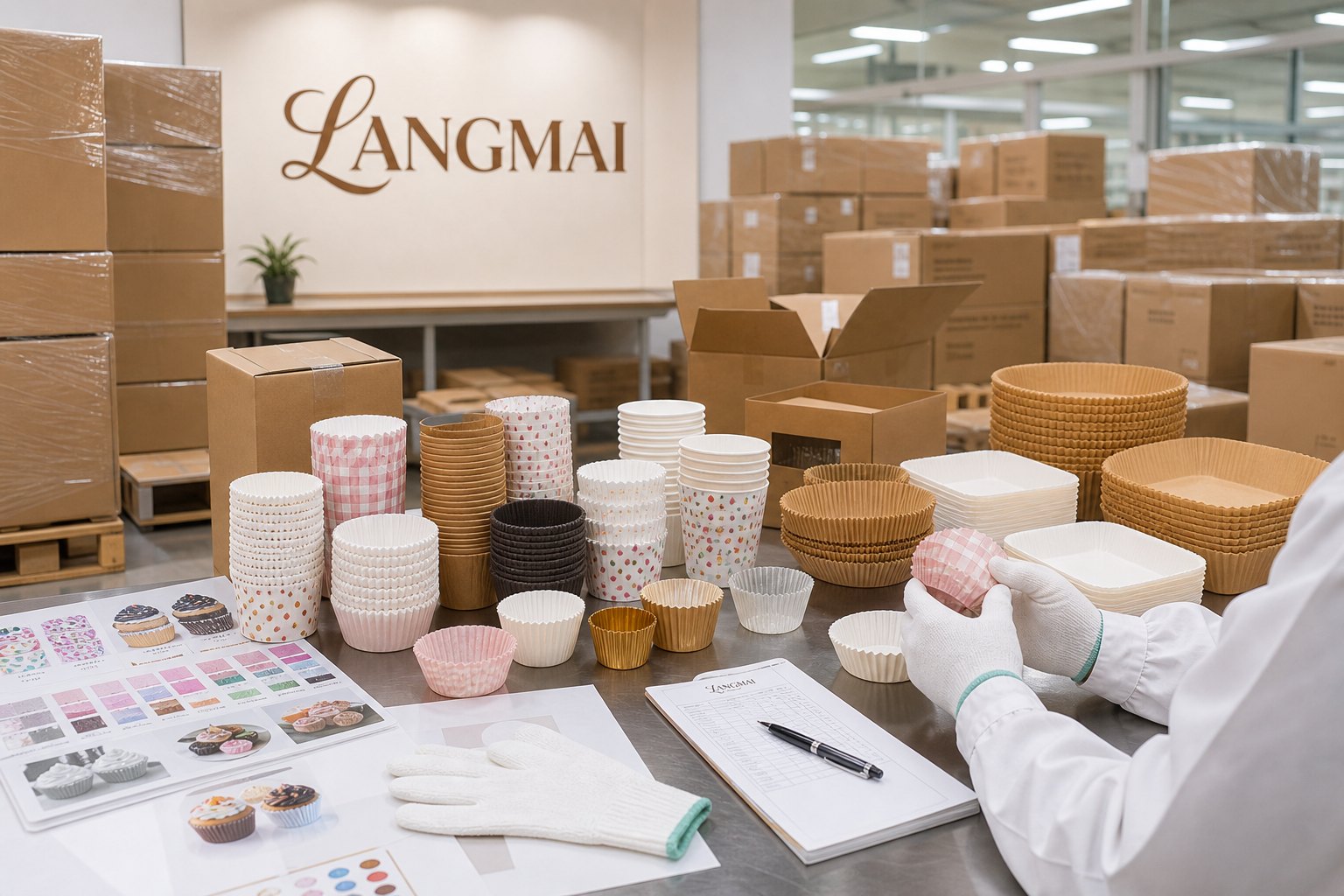
Food contact testing for paper baking cups is not a single pass-or-fail certificate that covers every recipe, temperature, market and product construction. A useful compliance file connects the exact finished article to its paper, grease barrier, print and other relevant components; identifies the intended food and baking conditions; states the test methods and limits used; and shows that the tested sample represents the item being purchased.
The direct answer for buyers is simple: review a report by matching five things before accepting it—product identity, material construction, food type, time and temperature, and destination-market basis. Then confirm that the approved sample, purchase specification, production lot and carton labels preserve that match. A report for unprinted flat paper, room-temperature dry food or another supplier's coating should not automatically be treated as evidence for a printed cupcake liner used with a fatty batter in a hot oven.
This guide explains how importers, distributors, bakery chains, foodservice packaging buyers and private-label teams can review evidence without pretending to be a laboratory or legal adviser. It focuses on procurement decisions: what to define before testing, what to look for in a report, when a gap needs clarification, and how to carry the approved specification into production and shipment inspection.
1. Start With Intended Use, Not a Certificate Name
The safety question is always tied to foreseeable use. The same paper article can face very different exposure depending on the food, contact time and temperature. A dry decorative liner placed around a finished confectionery product is not the same use as a cup filled with high-fat batter and baked. A paper cup for a chilled dessert is not the same as one reheated or used in a microwave.
Before asking a supplier for documents, write an intended-use statement that covers:
- the finished product type and construction;
- whether food touches the paper, a coating, or both;
- whether printing is on the food-contact or non-food-contact side;
- representative foods, including whether their surfaces are moist, acidic, fatty or dry;
- maximum contact temperature and duration;
- baking, reheating, freezing or room-temperature storage steps;
- single-use or repeated-use status; and
- the countries where the finished article will be marketed.
The US Food and Drug Administration's reference tables separate food types and conditions of use. Bakery products are divided according to moisture and whether the surface contains free fat or oil, while cooking above 250°F is a separate condition of use. This is a practical reminder that “for food contact” is less informative than “for moist, fatty bakery food under the stated baking conditions.” See the FDA food types and conditions of use tables.
For EU sales, the general principle is similar even though the regulatory structure differs. Regulation (EC) No 1935/2004 applies under normal or foreseeable conditions of use. It requires food-contact materials not to transfer constituents at levels that endanger health, cause an unacceptable change in food composition, or deteriorate taste and smell. Buyers should therefore avoid treating an abstract material declaration as a substitute for a use-specific assessment.
2. Identify the Exact Finished Article
A report is useful only when the tested sample can be linked to the commercial item. Record the product code, dimensions, paper grade, barrier or release treatment, ink system, print coverage, forming method and relevant secondary components.
For custom printed baking cups, the most demanding representative construction may not be the plain white sample. Heavy ink coverage, a different pigment set, a changed coating or a new paper mill can alter the compliance assessment. That does not mean every artwork automatically needs a new full test program. It means the buyer, supplier and qualified laboratory should document why the selected test sample represents the ordered variants.
Ask these identity questions when reviewing a report:
- Does the sample description match the supplier's quotation and specification?
- Is the tested item a finished formed cup or only a raw paper sheet?
- Is the sample printed, coated and converted in the same way as production?
- Are report photographs clear enough to connect the sample to the product code?
- Does the report name the applicant, manufacturer or submitter consistently?
- Is the issue date relevant to the current material formulation?
- Have any paper, coating, ink or production-site changes occurred since testing?
3. Understand the EU Evidence Path
All food-contact materials placed on the EU market fall under the general framework of Regulation (EC) No 1935/2004 and must be manufactured under Commission Regulation (EC) No 2023/2006 on good manufacturing practice. The GMP regulation is particularly relevant to printed cups: it requires controls intended to prevent substances from printing inks on the non-food-contact side transferring to food through the substrate or by set-off.
Paper and board do not have a single fully harmonised EU-specific measure equivalent to the broad plastics measure. The European Commission's food-contact legislation overview explains that Member States may maintain or adopt national provisions where no specific EU measure exists. This makes the destination country, material construction and customer specification important parts of the review.
German BfR recommendations are frequently referenced in paper and board supply chains, but buyers should describe them accurately. They are recommendations, not an EU-wide certificate. BfR Recommendation XXXVI/2 specifically addresses paper and paperboard for baking purposes. Its scope is more relevant to baking cups than the general paper recommendation, which points baking applications to XXXVI/2. Buyers should confirm the current version and discuss the applicable test program with a competent laboratory rather than copying a recommendation number from another product.
4. Understand the US Evidence Path
In the United States, the regulatory status of the finished food-contact material depends on the status and permitted use of relevant components. The FDA explains that a component reasonably expected to migrate must be covered by an applicable regulation, an effective Food Контакты Substance Notification, a Threshold of Regulation exemption, a prior sanction, or another valid basis. Paper and paperboard components are primarily addressed in 21 CFR Part 176, with other parts potentially relevant to coatings, adhesives, polymers and production aids.
The FDA guidance on determining the regulatory status of food-contact material components makes two points that procurement teams often miss. First, an authorization includes the substance identity, specifications and limitations on conditions of use. Second, an effective Food Контакты Substance Notification is specific to the named manufacturer or supplier and its stated use. A buyer should not assume that a similar chemical from an unrelated source is covered by another company's notification.
For paper baking cups, ask the supplier to identify the basis for relevant paper additives, grease barriers, release treatments, inks, coatings and adhesives as appropriate. Then verify that the use conditions cover the intended bakery food and thermal exposure. FDA's inventories can help confirm citations, but a citation should still be linked to the actual component source and limits.
“FDA approved” is often used too loosely in packaging sales. A more defensible statement identifies what is covered and on what basis—for example, that specified components are used in accordance with applicable authorizations for the stated food type and condition of use. Procurement teams should have regulatory counsel or a qualified specialist review uncertain or high-risk cases.
5. Read the Laboratory Report Beyond the Result Column
A report can display “Pass” while leaving the buyer with unanswered questions. Review the entire document, including sample description, methods, test conditions, detection limits, applicable limits, deviations, subcontracted work, photographs and authorized signatures.
Use this review table during supplier comparison:
| Report field | What to verify | Common gap |
|---|---|---|
| Sample identity | Product code, construction, print and coating match the order | Raw paper tested instead of finished cup |
| Applicant and manufacturer | Parties can be connected to the supply chain | Unrelated company named with no explanation |
| Intended use | Food type, contact time and temperature reflect real use | Room-temperature scope used for baking |
| Test basis | Current law, recommendation, standard or customer protocol is named | Vague “international standard” wording |
| Methods and limits | Methods, units, limits and reporting thresholds are clear | Pass result with no visible acceptance basis |
| Result interpretation | Each reported result is compared with the correct limit | Screening result presented as complete compliance |
| Dates and changes | Report remains representative of current materials | Coating or ink changed after testing |
| Laboratory status | Issuer, location and relevant accreditation scope can be checked | Logo-only report or unverifiable laboratory |
6. Select Tests Against the Construction and Risk
There is no responsible universal test list for every paper baking cup. The program should follow the materials, additives, printing, intended food, thermal exposure, destination law and customer requirements. A qualified laboratory may consider migration or extraction, purity, sensory effects, colorant transfer, metals, PFAS or other relevant parameters.
The key procurement rule is not to demand the longest test menu. It is to demand a justified one. Ask the laboratory or compliance specialist to explain:
- why each parameter applies to this construction;
- why the selected food simulant or extraction medium represents the food;
- how the time and temperature conditions represent baking and subsequent contact;
- whether the finished article or a representative component was tested;
- which legal or customer limit is used; and
- what the report does not assess.
For printed articles, include the ink and substrate interaction in the risk review. The EU GMP rules specifically address transfer through the substrate and set-off from printed non-food-contact surfaces. Practical controls may include adequate curing or drying, stack handling, rub checks, odor assessment and packaging conditions, but these process checks do not replace chemical compliance evaluation.
If PFAS-free performance is part of the specification, keep that claim tied to a defined scope and method. A fluorine screening result and a targeted list of individual PFAS answer different questions. Buyers should agree the claim language, sample identity, analytical approach and acceptance basis before advertising the product. For a deeper procurement framework, see LANGMAI's PFAS-free greaseproof paper buyer guide.
7. Approve Samples With Application Testing
Regulatory evidence and application performance solve different problems. A paper cup may have an appropriate compliance file yet still be a poor match for a buyer's batter, tray, oven or retail presentation. Before bulk approval, test representative samples under the actual or worst foreseeable use defined by the buyer.
Record the recipe category, fill weight, tray or mould, oven type, set temperature, measured baking time, cooling period and observations. Check cup fit, shape retention, release, grease staining, scorching, odor, print rub and appearance after cooling. Do not convert one successful bake into a universal temperature claim; the approved use window should reflect the tested product and process.
Need help matching paper, print, cup format and packaging to a defined baking application? Review LANGMAI's cake cups and cupcake liners and send the intended food, size, use conditions, destination market and artwork status with your inquiry.
Discuss Your Baking Cup Requirement
8. Carry the Evidence Into the Purchase Order
The strongest report still fails operationally if the purchase order only says “paper cups.” Convert the approved basis into controlled purchasing fields. These can include the product code, drawing or dimensions, material reference, print version, approved sample date, pack count, intended-use statement, destination market, required documents, change-notification duty and shipment inspection points.
Do not impose a fixed AQL copied from an unrelated product. Agree the sampling plan, defect classes and acceptance criteria based on the buyer's quality system and order risk. Compliance documents usually require a document and identity review, while physical inspection can check product codes, dimensions, workmanship, printing, pack count, carton marks and traceability references.
At pre-shipment inspection, verify that:
- the production product and packaging carry the correct item and artwork codes;
- lot or batch references connect cartons to production records;
- carton quantities and labels match the purchase order;
- no unapproved material or print change has been reported;
- requested declarations and reports match the shipped version;
- retained samples are identified; and
- visible product, odor and packing checks meet the agreed specification.
For a broader inspection process, use the baking paper quality-control guide. The compliance review described here should feed that inspection plan rather than sit in a separate folder that production and logistics never see.
9. Supplier Evaluation Questions for an RFQ
Give shortlisted suppliers the same questions so their answers are comparable:
- What is the complete construction of the finished baking cup?
- Which surface is intended to contact food, and where is printing located?
- Which food types, temperatures and contact times does your evidence cover?
- Which EU countries or US conditions of use were considered?
- Does the test sample match the quoted paper, coating, ink and forming process?
- What changed since the report was issued?
- Which laboratory performed the work, and what is the relevant test scope?
- What is the regulatory basis for each relevant component?
- How do you control ink drying, set-off, odor and material substitutions?
- How are production lots linked to material and shipment records?
- What application samples can be supplied for the buyer's own baking trial?
- How will proposed material, mill, formulation or site changes be communicated?
FAQ
Is one food contact certificate enough for every paper baking cup?
No. Evidence must match the finished article, material construction, printing or coating, intended food, contact conditions and destination requirements. One report may support a defined family of products when representativeness is justified, but buyers should not assume universal coverage.
Does an FDA citation mean the finished baking cup is FDA approved?
Not automatically. FDA authorizations apply to specified substances and uses, and effective Food Контакты Substance Notifications are manufacturer-specific. The finished construction and every relevant component must be assessed for the intended conditions of use.
Is BfR Recommendation XXXVI/2 an EU certificate?
No. It is a German recommendation addressing paper and paperboard for baking purposes, not an EU-wide certificate. EU framework and GMP rules still apply, and destination-country requirements must be checked.
Should buyers test a finished printed cup or only raw paper?
The finished printed and formed article often provides the closest representation of the purchased product. Component data may also be necessary. The final sample strategy should be justified by the construction, risk and applicable requirements.
How often should a paper baking cup be retested?
There is no universal interval that replaces change control. Retesting decisions should consider material, formulation, supplier, site, process, intended-use or legal changes, as well as customer policies and the continuing relevance of existing evidence.
Can application baking tests replace migration or compliance testing?
No. Application tests assess fit, release, shape, odor and appearance under the buyer's process. They do not establish the regulatory status or chemical safety of all components. Both evidence streams are useful and serve different purposes.
CTA
Send LANGMAI your target cup dimensions, representative food, baking conditions, destination market, print coverage, packaging format and expected quantity. The team can use those details to discuss material options, sample preparation and the document scope relevant to the quoted product.
Conclusion
Food contact testing for paper baking cups is most useful when it is treated as a traceable decision system, not a certificate collection exercise. Define the intended use, identify the exact finished article, understand the EU or US regulatory path, review the complete laboratory report, approve samples in the real application and carry the controlled specification into the purchase order and shipment inspection.
The practical test is whether a buyer can connect the carton received to the product assessed and explain why the evidence covers the actual food and baking conditions. When that chain is clear, procurement teams can compare suppliers on relevant facts and resolve gaps before production rather than after goods arrive.
Sources
- European Commission: Food Контакты Materials
- European Commission: Food Контакты Materials Legislation
- EUR-Lex: Regulation (EC) No 1935/2004
- EUR-Lex: Commission Regulation (EC) No 2023/2006
- FDA: Food Types and Conditions of Use for Food Контакты Substances
- FDA: Determining the Regulatory Status of Components of a Food Контакты Material
- BfR: Recommendation XXXVI/2, Paper and Paperboard for Baking Purposes