Introduction
Choosing between water-based, PLA and PE coated paper is not a simple sustainability ranking. The right trial depends on the package being converted, the food and contact conditions, the forming and sealing process, printing, required documents and the disposal route available in the destination market. A coating name alone does not answer those questions. This guide gives converters a practical comparison framework and shows how to turn it into a sample and RFQ specification. LANGMAI currently offers separate review paths for water-based coated base paper and PLA-coated base paper; neither page implies that finished cups, bowls or containers are included.
1. Start With What Each Coating Name Actually Tells You
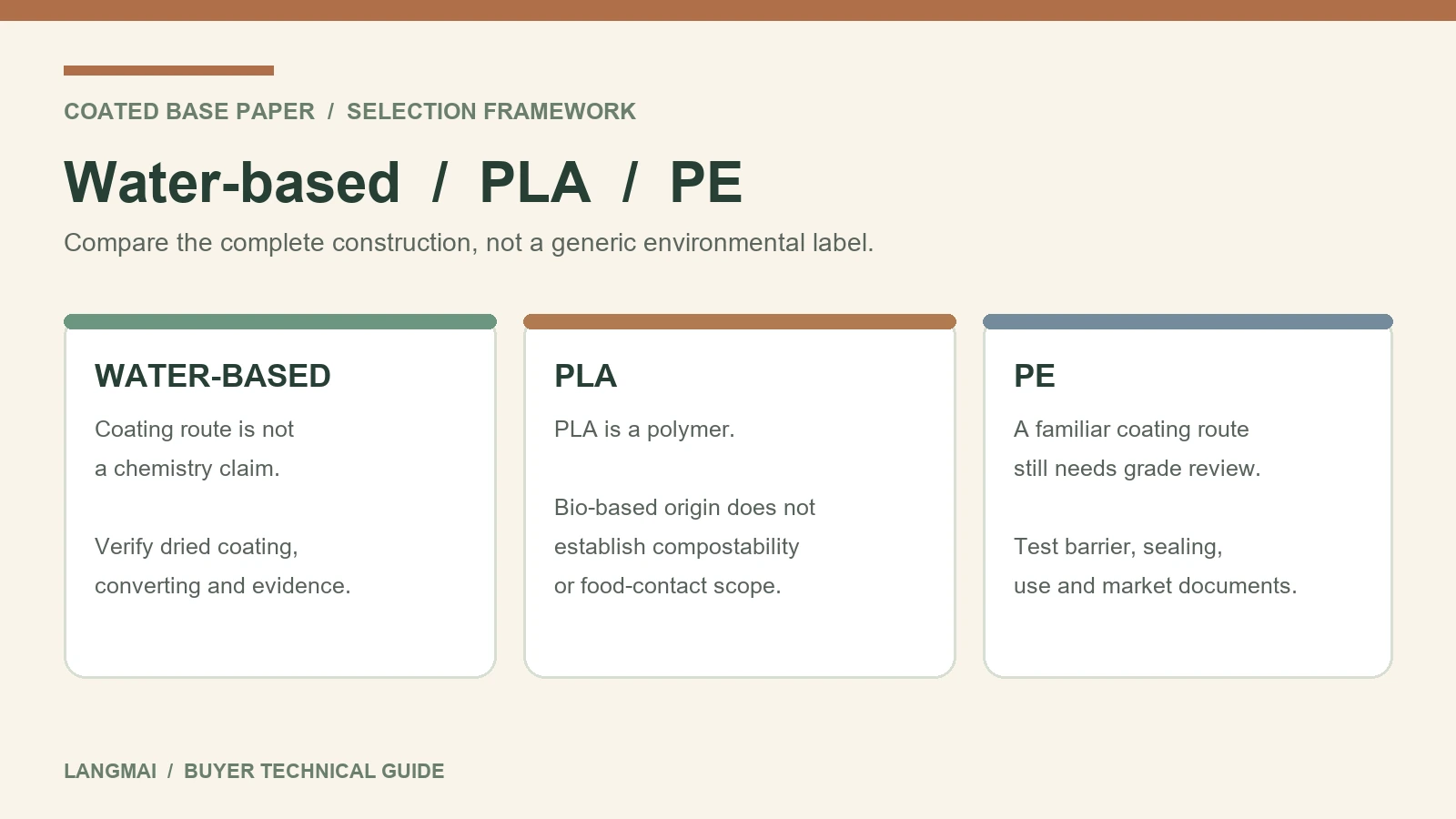
PE coated paper combines a paper substrate with a polyethylene layer. It is a familiar route for many packaging processes, but the exact barrier, sealing window, food-contact suitability and recovery options still depend on the complete construction and local system.
PLA coated paper combines paper with a polylactic acid coating. PLA is a polymer. A bio-based origin, where applicable and documented, does not by itself prove industrial compostability, home compostability, recyclability or food-contact compliance. Those claims require separate evidence for the coated paper or finished item as applicable.
Water-based coated paper describes a coating applied through a water-based process or formulation. “Water-based” does not, on its own, establish that the dried coating is plastic-free, repulpable, recyclable or compostable. Buyers need the coating description and evidence for the exact construction rather than relying on the process label.
| Decision area | PE coated paper | PLA coated paper | Water-based coated paper |
|---|---|---|---|
| What is confirmed first | Paper, PE layer, coating side and dimensions | Paper, PLA layer, coating weight, side and dimensions | Paper, coating system, dry coating, side and dimensions |
| Converting review | Established process fit must still be tested by grade | Sealing, forming, heat and adhesion require a defined trial | Sealing or bonding route must be confirmed for the actual formulation and equipment |
| Environmental wording | Do not infer recovery or impact from a generic material name | Bio-based and compostable are different claims | Water-based, plastic-free, recyclable and compostable are different claims |
| Evidence to request | Food-contact and destination-market documents for the complete item | Food-contact evidence plus any claimed compostability scope | Food-contact evidence plus support for each repulpability, recycling, PFAS or compostability statement |
2. Select Around Food Use and Contact Conditions
Begin with the contents, not the coating. Define whether the package will hold a dry, aqueous, acidic, fatty or oily food; whether contact is direct; the expected temperature; filling and service time; and any freezing, reheating or extended storage step. The same base paper can behave differently after a coating, ink, adhesive or forming process changes.
For cups and bowls, include rim forming, side seams, bottom sealing and liquid hold time in the trial. For containers, define geometry, closure and greasy-food exposure. For paper bags, include the contents, bag-making method, handles or seals and required shelf presentation. The coated-paper converting solution organizes these inputs by application instead of treating all converting jobs as one product.
Do not copy a temperature or barrier value from another supplier's catalogue into an approval specification. Confirm the test method, sample construction and acceptance criterion for the proposed grade. Where the finished package will make a food-contact claim, assess the complete construction and intended use rather than only the base paper.
3. Make Converting Trials the Decision Point
A sample roll should answer production questions that a brochure cannot. Record the machine, settings and observations so the trial can be repeated and compared.
- Incoming specification: base-paper and total grammage, coating side, roll width, roll length, core, moisture condition and dimensional tolerances.
- Printing and slitting: ink system, print adhesion, appearance, dust, edge quality and register where relevant.
- Forming: machinability, curling, cracking, stiffness, bonding and dimensional stability.
- Sealing: method, temperature or process window, dwell, pressure and seam acceptance criteria appropriate to the equipment.
- Finished-item checks: leakage or barrier performance under the intended food and time conditions, appearance and any required food-contact verification.
Keep one approved reference sample and a written construction record. Changes to base paper, coating formulation, coating weight, ink, adhesive or dimensions can change both converting behavior and evidence scope. For buyer teams, the paper-converter path connects this qualification work with repeat-order control.
4. Separate Four Different Evidence Questions
A useful document review keeps four questions apart:
- Food-contact suitability: does the evidence cover the complete construction and intended food-contact conditions in the destination market?
- Compostability: does a current certificate or test programme cover the relevant coated paper or finished item, including its composition, thickness or grammage, printing and other components?
- Recyclability or repulpability: which test method, facility scenario and acceptance scope support the claim, and is that route actually available where the package is sold?
- PFAS or other chemistry statements: does the declaration or test address the exact coating, paper, ink and finished construction rather than a generic raw material?
For North American compostability review, ASTM D6868 specifically addresses end items incorporating plastics or polymers as coatings or additives with paper and other substrates in municipal or industrial aerobic composting. ASTM D6400 has a broader plastics-and-products scope. The applicable route and certification decision belong with the certification body; a food-contact report is not a compostability certificate.
The available LANGMAI coated-paper reference reports support only their tested samples and listed items. The water-based paper evidence section identifies a 246 gsm double-side reference sample, while the PLA-coated paper evidence section identifies a 330 gsm single-side reference sample. Those examples must not be generalized to every grammage or finished package.
5. Compare End-of-Life Claims Without a Blanket Winner
An industrial-compostability certificate does not establish home compostability, recyclability or acceptance by every local composter. Likewise, a repulpability result does not establish compostability or prove that local collection systems accept the item. TÜV AUSTRIA distinguishes OK compost INDUSTRIAL from OK compost HOME, and the US FTC Green Guides call for appropriate substantiation and qualification of compostable claims, including facility-availability limits.
The practical buying question is therefore: which claim matters for this customer, and can the product, evidence and local recovery route all support it? If the destination lacks the relevant collection or treatment route, a material attribute should not be presented as a guaranteed environmental outcome. Avoid broad “eco-friendly,” “plastic-free,” “100% degradable” or unconditional recycling language unless its precise meaning and scope can be substantiated.
6. A Quote-Ready RFQ and Sample Checklist
Send the following information before asking for a price comparison:
- Finished package type and whether the request is for base paper or a finished item.
- Food, direct-contact conditions, fill temperature, service time and any storage or reheating step.
- Base-paper grammage, total grammage target, coating side and preferred coating route.
- Roll width and length or sheet dimensions, core and accepted grammage tolerance.
- Printing, ink, adhesive, forming and sealing process.
- Destination country and the exact documents or claims required.
- Trial quantity, forecast order quantity, packing and delivery requirements.
LANGMAI can provide a 200 m sample length in any requested coated-paper specification after the construction, width and shipping arrangements are confirmed. A sample is for evaluation; it is not automatic approval for mass production or a public claim.
Typical production and order terms
These general planning figures apply to the two coated base-paper grades. They are not unconditional commitments, and they are not conclusions of the test reports. The written specification and quotation state the confirmed figures for each order.
| Item | Typical reference | How it is confirmed |
|---|---|---|
| Grammage tolerance | ±2 g/m² | Accepted tolerance recorded in the approved specification |
| Roll width | Customizable to the converting line | Required width, roll length and core stated in the RFQ |
| MOQ | Generally starts at 5 tonnes | Confirmed against grade, customization, packaging and order structure |
| Lead time | Depends on order quantity | Confirmed in the written quotation, not a fixed number of days |
| Sample length | 200 m in any requested specification | Construction, width and shipment confirmed before dispatch |
The 960 mm and 975 mm widths quoted in the available test reports are the nominal widths of those tested samples. They describe the samples only and do not limit the custom roll width that can be requested. Buyers should state the required width and tolerance in the RFQ rather than deriving them from a report.
FAQ
Is water-based coated paper always plastic-free?
No. “Water-based” describes the coating route, not a complete declaration of the dried coating chemistry. Request an exact construction description and evidence for any plastic-free statement.
Is PLA coated paper automatically compostable?
No. PLA is a polymer, and material origin does not establish compostability. Verify the applicable standard, certification route and product scope for the coated paper or finished item, including thickness, printing and other components.
Which coating is best for heat sealing?
There is no universal answer from the coating name alone. Test the proposed grade on the intended machine and record the sealing method, settings, dwell, pressure and seam acceptance criteria.
Does a food-contact report prove recyclability or compostability?
No. Food-contact testing, compostability and recyclability or repulpability are separate evidence questions. Each claim needs its own applicable method, product scope and destination-market review.
Can we test a custom width and construction?
Yes. Roll width can be customized, and LANGMAI can arrange a 200 m sample length in the requested specification after confirming the construction, width and shipment details. A typical grammage tolerance of ±2 g/m² applies and the accepted value is recorded in the approved specification. Include the application, machine trial requirements, and forecast order quantity in the inquiry: MOQ generally starts at 5 tonnes and lead time depends on the order quantity.
What MOQ and lead time should we plan for?
MOQ generally starts at 5 tonnes for coated base paper and is confirmed against the selected grade, customization, packaging and order structure. Lead time depends on the order quantity and production schedule and is stated in the written quotation rather than published as a fixed number of days.
Conclusion
The best coated-paper route is the one that passes the actual application, converting and evidence review—not the one with the broadest environmental slogan. Compare PE, PLA and water-based options through the same trial sheet, keep each claim tied to its own evidence, and approve the complete construction before ordering. Start with the coated-paper converting review or send a specification for a custom 200 m sample.
CTA
Send your package type, food-contact conditions, grammage, coating side, width, converting process, destination market and required documents. LANGMAI will help structure a coated-paper sample and quotation review without treating reference reports as universal certification.
Request a Coated-Paper Sample Review
Sources
- ASTM International, ASTM D6868-21: end items incorporating plastics and polymers as coatings or additives with paper and other substrates
- ASTM International, ASTM D6400: plastics designed to be aerobically composted in municipal or industrial facilities
- TÜV AUSTRIA, OK compost INDUSTRIAL certification scheme and EN 13432 test areas
- Biodegradable Products Institute, BPI certification and product verification
- US Federal Trade Commission, Environmental Claims: Summary of the Green Guides