Introduction
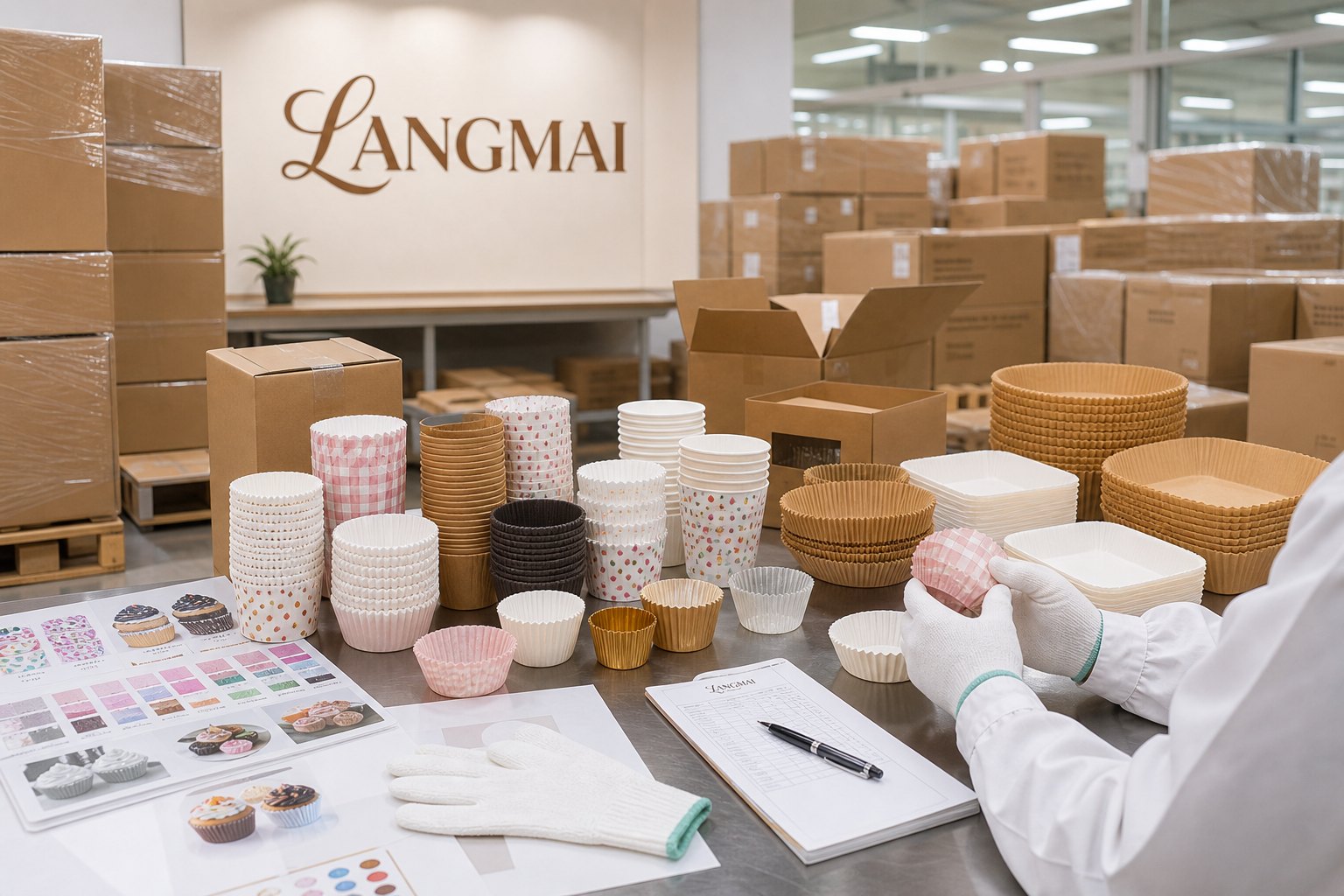
Wholesale buyers should compare parchment and wax paper by intended use, finished construction and evidence, not by product name alone. The RFQ should define food type, temperature, contact duration, release or barrier need, format, packaging and destination market. Buyers comparing these specifications can review our pre-cut parchment paper sheets and rounds programme, where coating weight, base grammage and release values are documented per construction.
Direct answer: Parchment paper is commonly selected for documented baking and release applications, while wax paper is commonly selected for wrapping or interleaving at ambient or cold conditions. Neither name guarantees a coating, temperature limit or legal status. Approve the exact finished SKU against its intended food, time and temperature, and do not place wax paper in an oven unless the supplier's product-specific evidence and buyer testing support that use. Buyers verifying these specifications can review the certificate library alongside supplier documentation requests.
1.0 Material and Construction Fundamentals
Evaluating baking paper vs wax paper begins with a thorough understanding of how the base materials are manufactured and treated. Because there are no universal formulas for either product, wholesale buyers must evaluate the specific construction of each SKU based on the manufacturer’s technical data. For production volumes, the same construction logic applies to our custom printed baking parchment paper line, quoted per roll, sheet or die-cut format.
Parchment Paper Construction
Parchment paper begins as a specialized base paper. Historically, this involved treating wood pulp with sulfuric acid to gelatinize the cellulose, creating a dense, grease-resistant sheet. Today, modern manufacturing often utilizes highly refined, highly beaten pulp to achieve similar physical density and grease resistance without acid treatment. The factory and certificate library lists the third-party audits and test reports behind these claims.
Parchment products may use a release treatment or coating, but construction varies. Ask the supplier to identify the exact base paper and treatment, then validate release, strength and supported use conditions on the finished SKU.
Wax Paper Construction
Wax paper uses a wax-treated paper construction. Wax chemistry, coating weight and base paper vary, so buyers should request the actual material identity and product-specific food-contact basis.
The wax coating process can be categorized into "dry waxing" (where the wax is driven into the paper fibers, leaving a less slick surface) and "wet waxing" (where a distinct, glossy layer of wax remains on the surface). This coating is highly hydrophobic, making it exceptional at repelling moisture and preventing the transfer of moisture between a food item and the ambient environment. However, because waxes are thermoplastic materials, their physical state changes dynamically with temperature, transitioning from solid to liquid under heat.
2.0 Key Application Comparisons
When analyzing parchment and wax paper wholesale options, buyers must map the material properties to the specific processing, packaging, or culinary tasks in their facilities or their customers' facilities.
Baking and High-Heat Pan Lining
For baking, evaluate a parchment SKU whose documented conditions cover the food, temperature and duration. Confirm release and integrity in the actual oven and pan.
Do not assume wax paper is oven-suitable. Heat can change the coating and product behavior, so use only within documented and tested conditions. For baking-paper evaluation, see the silicone-coated baking paper buyer guide.
Confectionery and Interleaving
In the production of sticky confections (caramels, taffy, nougat), both papers have specific roles. Parchment paper provides superior release for hot sugars cooling on a slab. However, for individually wrapping cooled candies, twist-grade wax paper is often preferred because it holds a "dead fold"—meaning it stays twisted without unwinding.
For interleaving—placing a barrier sheet between sliced cheeses, deli meats, or frozen hamburger patties—wax paper is highly effective. Its moisture resistance prevents condensation and meat juices from soaking through, allowing frozen items to separate easily without tearing.
Food Wrapping and Cold/Ambient Use
For ambient or cold wrapping, compare moisture retention, grease holdout, fold behavior and release using the actual food and storage period. Neither paper type is automatically superior for every wrapped product. See the food-grade wax paper wholesale buyer guide for an application-led specification process.
Summary Comparison Table
| Decision factor | Parchment paper | Wax paper | |
|---|---|---|---|
| Typical purchasing purpose | Release and grease resistance for a documented baking use | Moisture resistance, wrapping or interleaving for a documented ambient or cold use | |
| Heat exposure | Use only within the finished product's supported conditions | Do not assume oven suitability | |
| Release behavior | Evaluate with the actual baked product | Evaluate with the actual wrapped or separated food | |
| Common formats | Sheets, rolls and die-cut shapes | Sheets, rolls and interleaving formats | |
| Approval basis | Finished-SKU documents plus application test | Finished-SKU documents plus application test | Delicatessen sheets, twist wrap, cutter-box rolls |
Contact LANGMAI to request a sample pack of our commercial paper products.
3.0 Wholesale Procurement and RFQ Specifications
Engaging a bakery paper supplier requires a detailed and precise Request for Quotation (RFQ). Relying on colloquial terms like "baking paper" can lead to procuring a product that fails under industrial conditions.
Defining Your Requirements
A successful procurement cycle begins with defining the exact physical parameters of the paper required. Buyers must specify the basis weight (GSM), which dictates the thickness and durability of the paper. Basis weight influences handling and strength, but it does not establish release, heat suitability or moisture barrier by itself. Approve it together with the construction and application result.
Format is equally critical. For high-volume bakeries, precut parchment paper sheets streamline operations by eliminating the labor of cutting rolls to pan sizes. For retail distribution, define the consumer format and packaging. Put buyer-agreed dimensions and tolerances on the drawing where equipment or pan fit is critical.
Specification and RFQ Checklist Table
When drafting your RFQ for a bakery paper supplier, ensure the following parameters are explicitly stated to avoid ambiguity:
| RFQ field | Buyer information |
|---|---|
| Intended use | Food type, contact condition, temperature and duration |
| Construction | Requested base paper, treatment or coating, subject to supplier confirmation |
| Physical format | Dimensions, roll core or die-cut drawing, and buyer-agreed tolerances |
| Performance | Release, grease or moisture criteria and test method |
| Packaging | Unit count, inner pack, carton, pallet and label requirements |
| Compliance | Destination market and documents required for the exact finished SKU |
4.0 Sample Testing and Validation
Do not rely on product names or marketing descriptions as proof of construction, safety, or compliance. Once samples are received, buyers must conduct rigorous validation testing tailored to their exact end-use.
Heat Exposure and Release Testing
For parchment paper intended for high-heat environments, run the samples through your specific oven profiles using the exact food product (e.g., high-sugar marinades or sticky batters). Evaluate the release quality post-baking: does the product lift off without leaving residue? Check the paper's integrity after the cycle to ensure it has not become excessively brittle or carbonized.
Moisture and Grease Resistance
When testing wax paper for wrapping or interleaving, simulate the intended storage environment. Wrap the target food product and place it in commercial refrigeration or freezing for the typical shelf-life duration. Inspect the paper upon removal: has the wax flaked off? Has moisture penetrated the barrier? Has the paper retained its fold or twist? If a named laboratory method is used, record the method and result, then compare it with application trials because laboratory conditions may not reproduce the buyer's food and process.
5.0 Regulatory Compliance and Document Review
Safety in food contact materials is governed by strict, market-specific legislative frameworks. A reputable bakery paper supplier must provide verifiable documentation matching the specific SKU to the destination market's laws.
FDA and EU Frameworks
In the United States, the Food and Drug Administration (FDA) regulates paper and paperboard under 21 CFR parts 176.170 (components of paper and paperboard in contact with aqueous and fatty foods) and 176.180 (components of paper and paperboard in contact with dry food).
In the European Union, the overarching regulation is EU 1935/2004, which mandates that materials do not transfer constituents to food in quantities that endanger human health. This is supported by EU 2023/2006 on Good Manufacturing Practice (GMP). Furthermore, for paper specifically, the German BfR Recommendation XXXVI/2 provides specific guidelines for paper and board for baking purposes, which is widely recognized as a benchmark for compliance across Europe.
Verifying Compliance Documentation
Request the compliance statement and supporting evidence required for the destination market. Confirm product identity, legal basis, test conditions, issue date and intended use. Evidence for a cold-use product cannot support an untested thermal application.
6.0 Packaging, Private Label, and Inspection
For wholesale distributors, importers, and retail brands, how the paper is packaged is just as critical as the paper itself.
Private Label Customization
Specify private-label packaging from the channel: roll or sheet count, cutter or dispensing design if needed, inner protection, carton strength, labels and barcode. Approve the packed sample and transport configuration rather than relying on a standard pack.
Quality Inspection
Prior to shipment, implement a structured inspection protocol. Since a fixed AQL (Acceptable Quality Limit) varies based on buyer stringency, negotiate the specific inspection criteria beforehand. Key inspection points include verifying the GSM consistency across the web, ensuring precise dimensional cutting (no skewed edges on sheets), checking for proper coating application (no uncoated spots or heavy streaks), and validating the print quality and barcode readability on retail packaging.
7.0 Evaluating a Bakery Paper Supplier
Selecting a manufacturer goes beyond simply comparing a parchment and wax paper wholesale price list. The supplier’s infrastructure, supply chain stability, and quality assurance programs dictate long-term success.
Manufacturer Capabilities
Map which supplier performs coating, slitting, die-cutting, printing and packing. Then challenge traceability from a selected finished lot to relevant material lots and shipment records.
Supplier Evaluation Criteria Table
| Supplier check | Evidence to review |
|---|---|
| Production boundary | Site and subcontractor map for each process |
| Material identity | Specification and lot records for base paper and treatment |
| Testing | Methods, reports and retained samples for the quoted SKU |
| Traceability | Demonstrated links from materials to finished lot and shipment |
| Change control | Notification and reapproval procedure |
FAQ
Can wax paper be used as a direct substitute for parchment paper in industrial baking?
No. Wax paper relies on a wax coating (paraffin or soy) that melts at elevated temperatures. Using it in an industrial oven will cause the wax to melt into the food, ruining the product and creating significant smoke and fire risks. Always use silicone-coated parchment for baking.
How does the cost of parchment and wax paper wholesale compare?
Price depends on construction, format, volume, packaging and market conditions. Compare total cost in the intended process, including yield, labor, product damage and disposal.
Do product names guarantee heat resistance?
Absolutely not. Terms like "baking paper," "bakery paper," or "greaseproof paper" are often used loosely in international trade. Do not treat product names as proof of construction or compliance. You must request technical data sheets confirming the coating type (e.g., silicone) and conduct physical trials to validate heat resistance under your specific parameters.
What documentation proves food-contact safety?
Depending on your region, you should demand a Declaration of Compliance (DoC) referencing specific regulations, backed by recent third-party laboratory extraction test reports. For the US, tests should reference FDA 21 CFR 176.170/176.180. For Europe, references to EU 1935/2004, 2023/2006, and BfR XXXVI/2 are required. Crucially, the test conditions (time/temperature and simulants used) must match your intended application.
How should we store wholesale inventory of these papers?
Both parchment and wax paper should be stored in clean, dry environments away from direct sunlight and extreme temperatures. High humidity can cause the base paper to absorb moisture, leading to curling or feeding issues in automated machinery. Keep products in their original moisture-barrier shrink wrap or polybags until immediately prior to use.
Can we print our logo directly on these papers?
Printing may be possible on selected constructions. Approve the print side, ink system, set-off controls, physical sample and finished-product regulatory evidence before ordering.
Why might wax paper transfer odor to food?
Odor can arise from materials, storage, printing or contamination. Compare conditioned samples with an approved control and investigate any difference rather than inferring the cause from the paper name.
How do we transition from one bakery paper supplier to another?
Transitioning requires parallel testing. Procure samples from the new supplier and run them alongside your current paper under identical operational conditions. Evaluate release performance, moisture barrier efficacy, and structural integrity. Concurrently, conduct a thorough document review of the new supplier's compliance and facility certifications before committing to bulk commercial volumes.
Conclusion
Successfully navigating a parchment paper vs wax paper procurement strategy hinges on a precise understanding of material science, application constraints, and regulatory requirements. Wholesale buyers must disregard marketing terminology in favor of technical data, utilizing silicone-coated parchment for thermal stability and release, while leveraging wax paper for superior moisture barriers in ambient or cold environments. Our silicone-coated parchment sheets and rolls programme publishes the test data behind each grade so specifications can be verified before ordering.
As a global manufacturer of cupcake liners, paper baking cups, greaseproof food paper, air fryer liners, and custom food-paper packaging, LANGMAI is uniquely positioned to supply technically precise, fully documented paper products. By clearly defining your specifications, executing rigorous sample validation, and auditing supplier credentials, you can secure reliable, safe, and efficient materials for your food processing or retail operations.
Send Your Application Requirements
Sources
- FDA 21 CFR 176.170: https://www.ecfr.gov/current/title-21/part-176/section-176.170
- FDA 21 CFR 176.180: https://www.ecfr.gov/current/title-21/part-176/section-176.180
- EU Food Contact Materials Legislation: https://food.ec.europa.eu/food-safety/chemical-safety/food-contact-materials/legislation_en
- BfR Recommendations on Food Contact Materials: https://www.bfr.bund.de/en/service/databases/bfr-recommendations-on-food-contact-materials/