
Introduction
For parchment paper rounds wholesale, buyers should match the approved die-cut diameter to the measured base of the actual pan, then validate release, grease resistance and edge quality with the intended recipe and baking cycle. The purchase specification should also identify the finished product's construction, destination-market document set, pack count, labeling and buyer-agreed inspection criteria. A nominal pan size alone is not enough because pan geometry can vary by brand and model. Buyers comparing these specifications can review our wholesale parchment paper rolls and sheets programme, where coating weight, base grammage and release values are documented per construction.
1. The Core Utility of Precut Baking Paper Rounds
For commercial baking operations and consumers alike, precut baking paper rounds—often referred to as cake pan parchment circles—serve one primary purpose: eliminating the labor-intensive process of tracing and cutting parchment from rolls or sheets to fit round pans. For production volumes, the same construction logic applies to our baking parchment paper manufacturing programme line, quoted per roll, sheet or die-cut format.
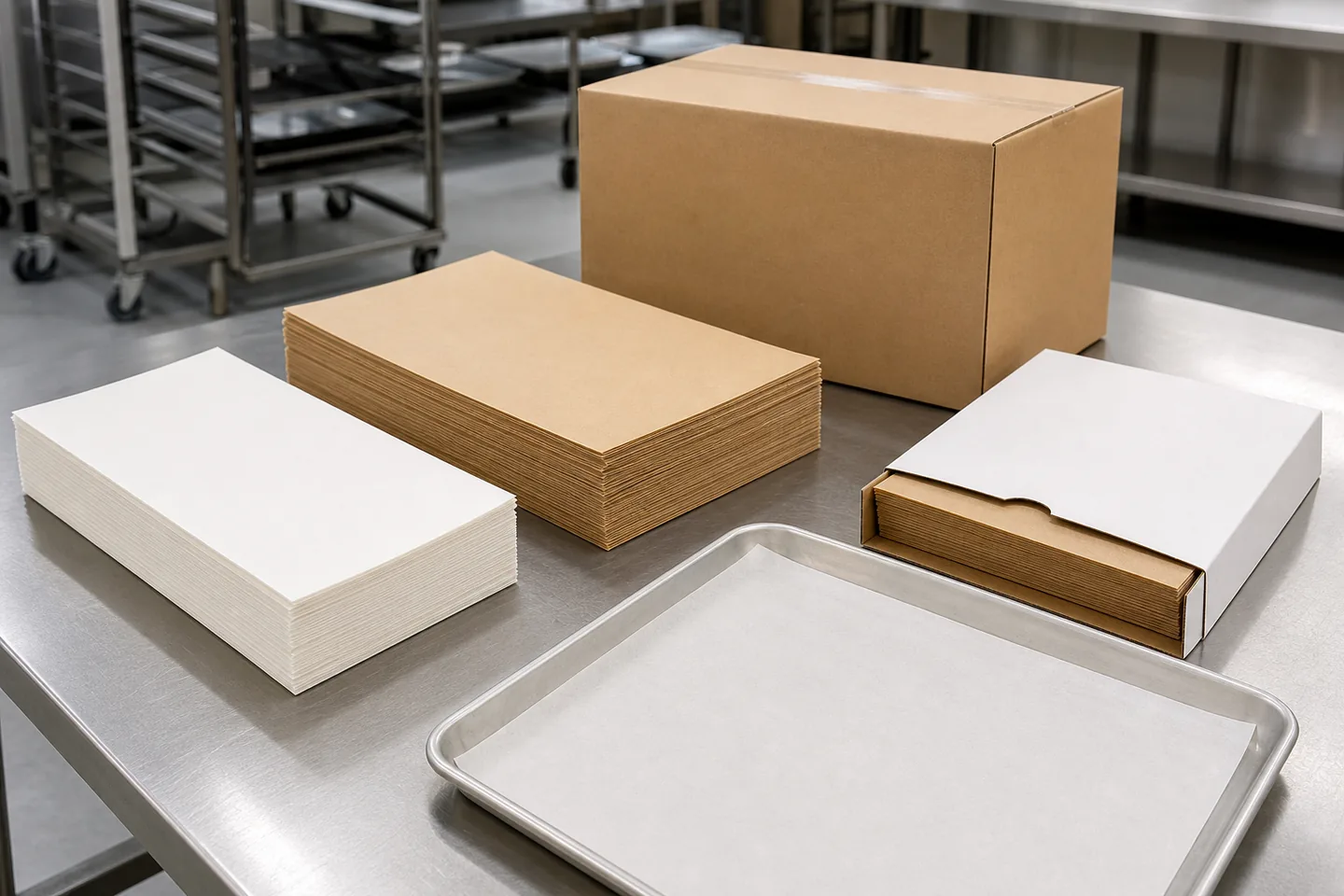
Precut rounds can reduce in-house cutting and give operators a repeatable pan-lining format. Precut parchment paper sheets wholesale serve rectangular pans; rounds require a separate drawing and fit check. Performance still depends on the finished paper, food, pan and baking conditions. The factory and certificate library lists the third-party audits and test reports behind these claims.
2. Sizing, Dimensions, and Tolerance Matching
The most common point of failure when procuring cake pan parchment circles is a mismatch between the paper diameter and the internal base diameter of the pan. Cake pans from different manufacturers vary slightly; an "8-inch pan" may have an internal base diameter of exactly 8.00 inches, or it might taper to 7.85 inches.
If the parchment round is too large, the edges will climb the walls of the pan, creating ridges and deformities in the baked good's edge. If the round is too small, batter will seep into the gap, causing sticking and potential tearing during depanning.
Die-Cutting and Dimensional Tolerances
When negotiating with a round parchment paper supplier, buyers must specify the exact diameter required in millimeters or inches, alongside an acceptable dimensional tolerance. There is no useful universal tolerance for every pan or packing line. State the target diameter and a buyer-approved tolerance in one unit system, then verify fit with representative production samples.
Table 1: Common Pan Sizes and Target Parchment Round Dimensions
| Buyer input | What to record | Why it matters |
|---|---|---|
| Pan identity | Manufacturer, model and nominal size | Nominal sizes can differ between pan designs |
| Measured base | Internal base diameter from representative pans | Establishes the usable flat area |
| Target round | Contract diameter in one unit system | Prevents conversion and fit errors |
| Tolerance | Buyer-approved plus/minus limit | Keeps the round flat without excessive gaps |
| Validation | Fit result in the actual pan | Confirms the drawing works in practice |
*Note: The buyer must verify the internal base diameters of the specific pans their target audience utilizes before finalizing wholesale dimensions.*
3. Material Specifications and Release Constructions
The performance of parchment paper rounds wholesale relies entirely on the base paper quality and the release coating applied during manufacturing.
Base Paper Grammage (GSM)
Grammage, measured in grams per square meter (GSM), dictates the thickness, durability, and cost of the parchment round. Do not select a round from grammage alone. Ask the supplier to state the basis weight and construction of the offered SKU, then compare handling, wet strength, release and tear behavior in the real application. The approved value and tolerance belong in the specification.
Release Coatings
The release coating prevents the baked good from adhering to the paper. The coating chemistry must match the food type and the processing temperatures.
- Release system: Ask the supplier to identify the treatment or coating used on the finished SKU and provide supporting food-contact documentation for the intended conditions. Compare release with the actual recipe; do not infer performance from a coating name alone.
Bleached vs. Unbleached
Buyers can source both bleached (white) and unbleached (brown/natural) parchment rounds. Unbleached rounds offer a rustic, eco-friendly aesthetic popular in artisanal bakeries, while bleached rounds provide a clean, sterile appearance. Color is a purchasing attribute, not proof of environmental or food-contact performance. Any bleaching or sustainability claim should be supported by product-specific supplier evidence.
4. Food Contact Documentation and Regulatory Review
Because parchment paper rounds come into direct contact with food under elevated temperatures, rigorous regulatory compliance is non-negotiable. Importers and brands must demand and review up-to-date documentation from their supplier that matches the specific finished SKU and the intended destination market.
United States FDA Compliance
For products entering the US market, the paper components must comply with specific Food and Drug Administration (FDA) regulations:
- 21 CFR 176.170: This regulation covers the components of paper and paperboard in contact with aqueous and fatty foods, subject to the conditions of use outlined within the standard.
- 21 CFR 176.180: This regulation addresses the components of paper and paperboard safely used in contact with dry food.
European Union Compliance
For the European market, food contact materials are strictly governed by overarching and specific regulations:
- Regulation (EC) No 1935/2004: The general framework regulation requiring that food contact materials do not transfer constituents to food in quantities that could endanger human health, bring about an unacceptable change in the composition of the food, or cause a deterioration in its organoleptic characteristics.
- Regulation (EC) No 2023/2006: Covers Good Manufacturing Practice (GMP) for materials and articles intended to come into contact with food.
- BfR Recommendation XXXVI/2: Issued by the German Federal Institute for Risk Assessment (BfR), this specific recommendation concerns paper and paperboard for baking purposes, detailing safe limits for specific substances when relevant to the intended use.
Verifying Supplier Documentation
Do not accept a generic compliance statement. Review evidence for the exact base paper, treatment and finished SKU, including the legal basis, test conditions, issue date and supplier identity. The documented food type, temperature and contact duration should cover the proposed use.
If you are expanding your catalog beyond rounds, ensure these same stringent document checks are applied when sourcing baking parchment paper rolls wholesale.
Are you ready to evaluate production-grade baking circles for your bakery or retail brand?
Request Parchment Round Samples
5. Sample and Application Testing Checklist
Before finalizing a volume order for private label parchment rounds, buyers must execute a comprehensive testing protocol. Because there is no universal temperature claim that applies to all food types, batter moistures, and oven environments, temperature resistance and release performance must be verified against the buyer's exact operational conditions.
Pre-Bake Inspection
- Dimensional accuracy: Measure samples from different packs and compare them with the drawing and buyer-agreed tolerance.
- Die-Cut Quality: Inspect the edges of the rounds. They should be cleanly cut without hanging fibers, excessive paper dust, or fused edges that make it difficult to separate individual sheets.
- Pan Fitment: Place the round inside the target cake pan. It should lay perfectly flat on the bottom without wrinkling, riding up the sides, or leaving excessive gaps at the perimeter.
Application and Baking Test
- Batter/Food Type Validation: Test the paper using the exact recipes it is intended for (e.g., a high-sugar brownie batter, an egg-heavy sponge cake, or a high-fat cheesecake).
- Time and Temperature Parameters: Bake the products at the maximum intended operational temperature for the maximum intended duration. Monitor the paper for excessive smoking, severe discoloration (some browning is normal), or embrittlement.
- Moisture and Fat Holdout: Observe how the paper handles the moisture and fat of the batter during the bake. The paper should maintain its structural integrity and not disintegrate into the food.
Post-Bake Analysis
- Release Force: Once cooled (or hot, depending on the depot process), remove the baked good from the pan and peel off the parchment round. Assess the release force required. The paper should peel away cleanly without tearing the crumb structure of the cake.
- Residue Check: Verify that no paper fibers or coating residues are left behind on the bottom of the baked good.
6. Private Label Packaging and Case Configurations
Packaging strategies for precut baking paper rounds differ vastly depending on whether the end-user is a commercial bakery, a restaurant, or a home consumer. Protecting the paper from moisture, humidity, and physical edge-damage during international shipping is critical.
Secondary Packaging for Sea Freight
Specify inner protection, master-carton construction, pallet pattern and moisture controls from the actual route and handling risks. Confirm the pack with a transport trial where damage risk is material.
Table 2: Common Packaging Formats by Buyer Segment
| Buyer segment | Packaging decision | Verification point |
|---|---|---|
| Commercial bakery | Bulk packs sized to daily use | Count, separation and moisture protection |
| Foodservice distributor | Inner packs and master cartons | Case labels, handling strength and traceability |
| Retail private label | Printed pouch or carton | Artwork, barcode, language and count accuracy |
| E-commerce | Flat protective pack | Edge protection and parcel-drop testing |
7. Quality Control and Factory Inspection
Consistent quality is paramount when sourcing bulk packaging supplies. Buyers should establish a clear Quality Control (QC) and inspection framework with their supplier prior to production.
Define defect classes, sampling and acceptance rules before production. These are buyer decisions based on application risk, not a fixed AQL that applies to every order.
Key QC Inspection Points for Parchment Rounds
- Material Verification: Confirming the GSM and coating type match the approved golden sample.
- Dimensional Checks: Ensuring the diameter and circularity remain consistent throughout the production run. A die that becomes dull can cause ovality or frayed edges.
- Count Accuracy: Utilizing weight-based counting scales to ensure each bulk pack or retail polybag contains the exact contracted number of sheets.
- Foreign Matter: Ensuring the production environment is free from dust, pests, and contaminants, adhering strictly to GMP standards.
- Packaging Integrity: Verifying that master cartons are adequately sealed, correctly labeled with barcodes, and strong enough to withstand pallet stacking.
For a comprehensive breakdown of implementing QC protocols, refer to our guide on baking paper products quality control and inspection.
8. Supplier Evaluation for Parchment Rounds
Not all paper suppliers possess the specific machinery required to efficiently produce precise die-cut circles at scale. When evaluating a round parchment paper supplier, look for the following core competencies:
- Converting control: Verify how the supplier controls die condition, circularity, count and paper dust.
- Material control: Match incoming roll identities and finished lot codes to the approved specification.
- Change control: Require notice and reapproval when paper, treatment, converting location or packaging changes.
- Capacity evidence: Review equipment and production records relevant to the quoted dimensions and volume.
FAQ
What is the standard minimum order quantity (MOQ) for wholesale parchment rounds?
MOQ depends on tooling, diameter, paper construction, pack format and production planning. Ask the supplier to quote standard and custom options separately, including trial quantity and tooling ownership.
Can parchment rounds be custom printed with our brand logo?
Printing may be possible for some constructions. Approve the print side, ink system, set-off controls and finished-product evidence before ordering; a logo proof is not a food-contact approval.
How does the supplier ensure the rounds do not stick together in the packaging?
Properly manufactured and coated parchment paper should not fuse together. Suppliers control this by ensuring the silicone coating is fully cured during the base paper manufacturing process, maintaining sharp die-cutting blades to prevent edge-welding, and controlling ambient humidity during packing.
Are parchment paper rounds reusable in commercial settings?
Do not assume reuse. Approve any repeated-use claim only for the exact SKU and tested process; many bakery programs specify single use for process control.
Do I need to grease the pan when using parchment rounds?
No, the primary operational benefit of using silicone-coated parchment rounds is the elimination of pan greasing. However, some bakeries use a tiny drop of oil or water solely to adhere the paper flat to the bottom of the pan to prevent it from shifting when heavy batter is poured in.
What causes a parchment round to turn dark brown or brittle in the oven?
Browning and embrittlement occur when the paper is exposed to temperatures exceeding its specific thermal limits, or when exposed to high heat for prolonged periods without the moisture of the food to absorb the heat. Buyers must test the paper under their specific time/temperature conditions, as there is no universal temperature claim applicable to every baking scenario.
What is the difference between parchment rounds and wax paper rounds?
Parchment paper is treated with high-temperature-resistant coatings (like silicone) and is specifically designed for oven use. Wax paper is coated with paraffin or soybean wax, which will melt and smoke at baking temperatures. Wax paper rounds should only be used for cold applications, such as separating frozen burger patties or layering cold desserts.
Conclusion
Sourcing parchment paper rounds wholesale is a critical procurement task that directly impacts a bakery's operational efficiency, product quality, and food safety compliance. By rigorously defining your required dimensions and tolerances, matching the base paper grammage and release coating to your specific batters, and conducting thorough application testing, you can eliminate production bottlenecks and product waste. Our private-label parchment paper supplier programme publishes the test data behind each grade so specifications can be verified before ordering.
Equally important is partnering with a transparent round parchment paper supplier capable of providing verifiable FDA, EU, and BfR food-contact documentation that specifically matches your finished SKU. Ensure your quality control expectations and packaging configurations are clearly communicated and agreed upon prior to mass production to guarantee a seamless supply chain.
For wholesale pricing, custom die-cut tooling inquiries, and regulatory documentation for your target market, contact our team to discuss your project.
Send Your Parchment Round Requirements
Sources
- U.S. Food and Drug Administration. "21 CFR 176.170 - Components of paper and paperboard in contact with aqueous and fatty foods." Code of Federal Regulations. https://www.ecfr.gov/current/title-21/part-176/section-176.170
- U.S. Food and Drug Administration. "21 CFR 176.180 - Components of paper and paperboard in contact with dry food." Code of Federal Regulations. https://www.ecfr.gov/current/title-21/part-176/section-176.180
- European Commission. "Food Contact Materials - Legislation." Food Safety. https://food.ec.europa.eu/food-safety/chemical-safety/food-contact-materials/legislation_en
- German Federal Institute for Risk Assessment (BfR). "BfR Recommendations on Food Contact Materials." https://www.bfr.bund.de/en/service/databases/bfr-recommendations-on-food-contact-materials/