
Introduction
Sourcing greaseproof paper bags wholesale requires a careful balance between culinary performance, regulatory compliance, and structural integrity. For commercial bakeries, quick-service restaurants, and industrial foodservice operators, selecting the right packaging prevents oil stains, preserves food texture, and safeguards brand reputation. However, paper marketed generically as greaseproof is not automatically suitable for every hot, wet, fatty, or direct-food-contact application. Buyers comparing these specifications can review our baking parchment paper manufacturing programme programme, where coating weight, base grammage and release values are documented per construction.
This comprehensive guide walks procurement professionals through bag formats, functional specifications, rigorous laboratory and line-testing protocols, compliance documentation review, and supplier evaluation frameworks. By establishing precise parameters early in the sourcing process, businesses can minimize defect rates, control costs, and secure reliable supply chains for their operations while tailoring every parameter to their specific product profile and regulatory framework. Buyers verifying these specifications can review the certificate library alongside supplier documentation requests.
Understanding Bag Formats and Closure Choices
Commercial food packaging relies on distinct bag styles engineered to match specific preparation and dispensing workflows. Rather than assuming universal terminology, buyers must define structural configurations based on physical construction and sealing mechanics. For production volumes, the same construction logic applies to our private-label parchment paper supplier line, quoted per roll, sheet or die-cut format.
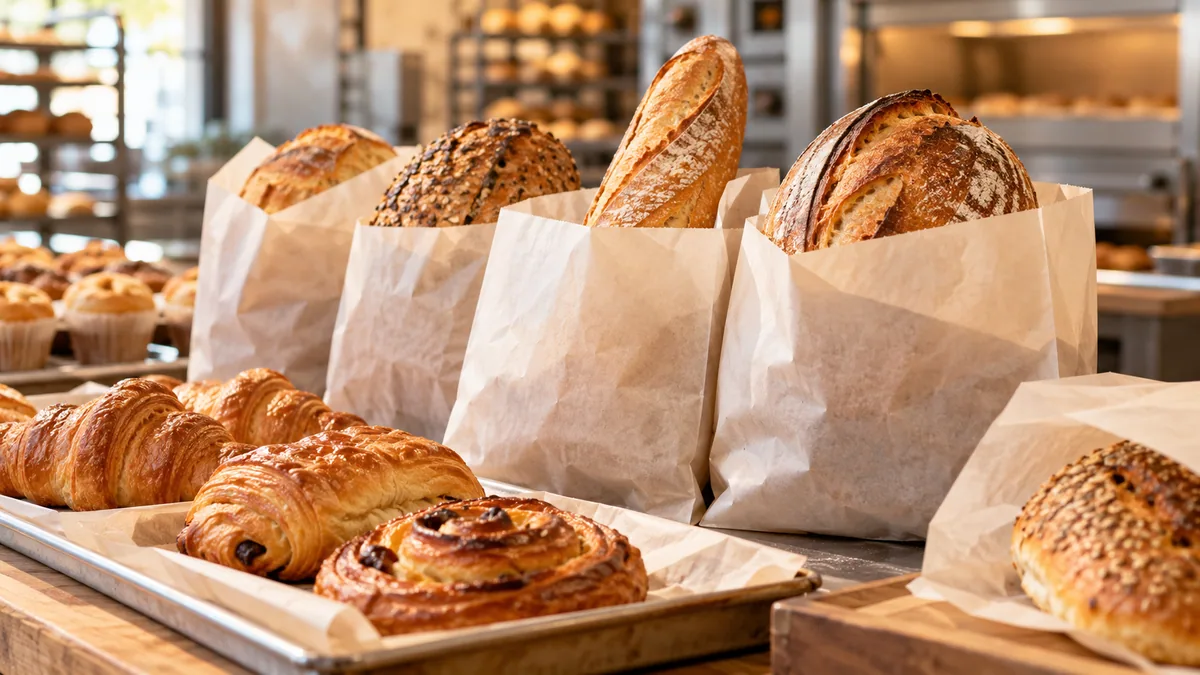
- Pinch-Bottom and Satchel Bags: Featuring a folded, glued rectangular base, these bags open up to stand upright on counters or packing stations. They are widely utilized in bakeries for pastries, artisan breads, and dry confectionery items.
- Flat Bags: Constructed with two side seals or a center seam and an open top without a gusset, flat bags offer a slim profile ideal for individual cookies, flatbreads, or sandwich containment where vertical expansion is minimal.
- Side-Gusseted Bags: Equipped with expandable side pleats, these bags accommodate bulky or high-profile items such as loaves of bread, pastries with toppings, or multiple food portions while maintaining a compact footprint prior to filling.
Closure mechanisms dictate how securely food is contained during transit and whether the packaging can be reclosed by the end consumer. Common options include open-top configurations for rapid manual packing, fold-over top extensions, integrated tin-ties for resealability, and heat-sealable lips designed for automated or high-speed commercial sealing lines. The factory and certificate library lists the third-party audits and test reports behind these claims.
When evaluating these choices, consider how the bag interacts with complementary packaging formats. For instance, businesses utilizing flat sheets for wrapping may integrate bags for final counter delivery, matching the performance benchmarks established in resources like the greaseproof paper sheets wholesale buyer guide. Similarly, operations transitioning from wraps to specialized pouches should review criteria detailed in the burger wrapping paper wholesale greaseproof guide to ensure uniform grease resistance across product lines.
Application Matrix Across Foodservice Sectors
Different culinary applications impose unique physical and thermal stresses on paper packaging. The following matrix outlines typical foodservice sectors, primary bag applications, and critical performance requirements.
| Application | Typical operating stress | Specification focus | Approval test |
|---|---|---|---|
| Croissants, doughnuts and pastries | Butter or frying oil, fragile surfaces, short counter handling | Grease strike-through, opening ease, product fit and presentation | Pack the warm and cooled product, then inspect the bag through the intended display period |
| Sandwiches and panini | Condiments, steam, folded edges and hand pressure | Wet strength, seam integrity, grease barrier and comfortable handling | Use the complete sandwich and normal wrapping or closure sequence |
| Cookies and dry bakery items | Abrasion, crumbs and retail display | Clean interior, print quality, closure and pack count | Run the retail pack-out and shelf-handling simulation |
| Fried takeaway food | Hot oil, steam, irregular edges and delivery movement | Grease and moisture performance, puncture resistance and venting strategy | Test the actual serving portion through holding and delivery conditions |
| Multi-item foodservice packs | Repeated opening, variable loads and fast counter service | Bag opening consistency, loading speed, capacity and carton presentation | Conduct a timed operator trial without changing normal work methods |
These are application prompts rather than universal performance grades. The buyer should define the actual food, portion, packing temperature, expected holding period and secondary packaging. A grease barrier that works for a cooled pastry may fail with a freshly fried item, while a highly closed structure may retain more moisture than a bakery wants for a crisp crust.
Defining Specifications from Actual Product Dimensions
Specifying incorrect dimensions is a primary cause of packaging waste and operational bottlenecks. Buyers should never rely on nominal category names like "medium bakery bag." Instead, specifications must be derived from actual product geometry, accounting for the three-dimensional volume of the food item and buyer-validated fit criteria.
- Measure Maximum Product Width (W): Lay the food item flat and measure its widest point across the horizontal plane.
- Measure Maximum Product Thickness (T): Determine the height or thickness of the item when fully assembled or baked.
- Calculate Flat Width (FW): For gusseted bags, the flat width equals the product width plus the total gusset depth (G) multiplied by two, plus manufacturing clearance tolerances established and validated through your operational trials.
- Determine Open Length (L): Measure the vertical height of the food item, add the gusset depth if applicable, and include a top fold or closure margin determined by your specific packing machinery or manual folding method.
Establishing precise dimensional tolerances prevents items from binding during filling or leaving excessive headspace that compromises package aesthetics. For branded packaging lines, coordinate these structural dimensions with design layouts as outlined in the custom printed greaseproof paper wholesale guide.
Quality Inspection and Testing Protocols
To verify that wholesale shipments meet operational standards, quality control teams should execute a series of systematic evaluations before approving full production runs.
- Grease Resistance Test: Apply heated oil or appropriate test liquids to the internal food-contact surface under conditions matching your operating environment. Monitor the exterior surface over a set duration to detect strike-through or staining.
- Moisture and Wet Strength Test: Expose sample bags to high humidity or steam environments matching your operational reality to verify that the paper maintains structural cohesion without tearing or delaminating.
- Seam Integrity Test: Apply controlled mechanical tension along glued or heat-sealed side and bottom seams to ensure adhesive coverage is uniform and free of weak points.
- Load and Puncture Test: Insert simulated heavy or irregular items to evaluate resistance against sharp corners and bottom blowouts based on your actual product weight and shape.
- Odor and Taint Test: Conduct sensory evaluations on blank and printed stock under temperature conditions relevant to your end use to confirm the absence of residual chemical odors or paper pulp taints that could transfer to food.
- Print Rub and Offset Test: Execute an agreed print-rub and offset protocol appropriate to the specific ink and substrate combination utilized in your program, verifying that graphics do not smear or transfer under normal handling conditions.
- Filling-Line and Pack-Out Tests: Trial sample lots on actual manual or automated packing lines to measure opening speed, product insertion clearance, and sealing efficiency under real-world operating conditions.
Record each test with the sample code, paper construction, bag drawing, food condition, contact duration, number of samples and photographs of the inside and outside surfaces. Define acceptable staining, seam opening, tearing, odour, print transfer and operator handling before comparing samples. Testing without written criteria often produces a subjective decision that cannot be repeated on the first production shipment.
Request Application-Matched Bag Samples
Sample Approval and Factory Audit Frameworks
Moving from initial quotation to bulk manufacturing requires a disciplined sample approval workflow. Buyers should request physical pre-production samples (PPS) representing the exact paper basis weight, coating formulation, dimensions, and printing specifications intended for bulk delivery. Do not authorize mass production based solely on digital mockups or generic stock samples.
Approve the physical bag and its packaging as one reference set. Mark the retained sample with the supplier, item code, drawing and artwork revision, approval date and tested application. If the approval is limited to a cooled cookie or a dry pastry, say so; do not let it become an implied approval for hot sandwiches or fried food. Retain test notes and photographs so receiving inspectors have a meaningful comparison when production arrives.
Concurrently, evaluating manufacturing facilities requires structured auditing. Procurement teams should review operational controls using standardized assessment tools like the food paper packaging supplier audit checklist to examine hygiene practices, cross-contamination prevention, raw material storage, and in-line quality monitoring.
Packaging, Palletization, and Storage Specifications
Protecting paper packaging during transit prevents transit-induced defects such as moisture warping, edge crushing, and contamination.
- Retail and Foodservice Packing Counts: Agree inner counts and bundle orientation around counter replenishment, dispenser capacity, retail labelling and stock rotation. Verify counts during the packed-sample approval.
- Carton Specifications: Specify a master carton and loading pattern suitable for gross weight, stacking, route and warehouse handling. Check whether carton pressure distorts gussets, closures or open edges.
- Pallet Protection: Select a pallet and load-protection method that meets destination, carrier and facility requirements. Review stability, moisture exposure and compression risks for the actual route.
- Storage Environment: Advise warehouse staff to store greaseproof paper stock off the floor in dry, temperature-controlled environments matching the storage parameters defined for your specific paper and coating construction to prevent curling, blocking, or premature degradation.
Incoming Inspection, Traceability, and Documentation
Upon receiving wholesale shipments at your distribution center or central kitchen, incoming quality control (IQC) teams must execute systematic receiving checks. Verify that delivered quantities match shipping manifests, inspect master cartons for transit damage, and confirm that batch numbers match accompanying documentation.
- Batch Traceability: Define the lot identifier and where it appears on cartons and inner packs. The supplier should be able to connect the shipped lot to relevant material, converting and inspection records at the depth required by the buyer. GS1's traceability standard can inform a broader event-and-data model, but it does not prescribe one label for every bag order.
- Change Notification Protocols: Establish binding contractual clauses requiring suppliers to provide advance written notice prior to modifying raw material pulp sources, sizing chemicals, coating formulas, or manufacturing plant locations, structured according to your quality agreement terms.
- Regulatory Documentation Review: Review evidence for the actual paper, barrier, adhesive and print construction under the intended food and contact conditions. In the United States, the status of each component and intended use determines which FDA provisions apply; relevant paper provisions can include 21 CFR 176.170 or 176.180 when within scope. In the EU, Regulation (EC) No 1935/2004 provides the general framework and Regulation (EC) No 2023/2006 addresses GMP. The required declaration or test package depends on the legal scope and buyer program.
Create a receiving checklist before the goods ship. At minimum, compare item and artwork revisions, carton condition, count, dimensions, bag opening, gusset and seam construction, surface cleanliness, odour, print registration and lot marking. Repeat a short version of the approved food or barrier test when the risk justifies it. Use an agreed sampling plan and defect classification; do not import a fixed acceptance level from a different product merely because it is familiar.
Supplier Evaluation and RFQ Requirements
When issuing a Request for Quotation (RFQ) for greaseproof paper bags wholesale, procurement teams should ask for a complete, comparable response. A vague price without a defined construction leaves both performance and compliance assumptions unresolved.
- Core RFQ Data Points: Ask suppliers to quote the proposed paper construction, barrier or treatment, bag dimensions and tolerances, seam and closure, printing, packing counts, commercial minimum, tooling, lead time and shipment unit for each option.
- Direct Supplier Inquiries: Ask which evidence applies to the exact construction, how approved samples are controlled, which changes trigger notification, how lots are identified, what in-process checks are recorded and what root-cause and corrective-action evidence is available when a shipment fails agreed criteria.
FAQ
Are all greaseproof paper bags suitable for microwave heating?
Not automatically. While some greaseproof paper constructions withstand standard microwave reheating cycles, others may contain functional coatings, metallic inks, or structural laminates that can delaminate, scorch, or release odors under microwave radiation. Buyers must verify microwave suitability through specific manufacturer test data before approving bags for hot-holding or consumer reheating.
What is the difference between greaseproof paper and glassine?
Greaseproof paper can obtain oil resistance from a dense fibre structure, a functional treatment or another defined construction. Glassine is a dense, smooth, supercalendered paper, but neither name establishes performance for a particular food. Buyers should compare the offered specification and application-test result rather than treating the terms as grades.
Can greaseproof paper bags be recycled in standard paper streams?
Recyclability depends entirely on the specific barrier treatment, adhesive type, and manufacturing composition. While certain uncoated mechanical greaseproof papers may be repulpable in specific paper streams, bags featuring specialized barrier coatings, wax treatments, or laminated layers may require dedicated recycling pathways or end-of-life testing to confirm compatibility with local recovery infrastructure.
How do I determine the correct paper GSM for heavy or oily foods?
Paper weight, measured in grams per square meter (GSM), should be selected based on empirical testing with your specific food item, considering weight, temperature, oil content, and moisture levels. Rather than relying on generic rules of thumb, trial different basis weights under actual operating conditions to find the optimal balance between structural strength and material efficiency.
What documentation should accompany food-contact paper shipments?
The required documentation depends entirely on destination market regulations, the exact material construction, intended food contact conditions, and your organization's internal quality assurance program. Depending on these factors, shipments may require Declarations of Compliance, migration test summaries, or specific lot traceability records as dictated by your legal and contractual requirements.
Conclusion
Sourcing greaseproof paper bags wholesale is a strategic procurement undertaking that directly impacts product presentation, food safety compliance, and operational efficiency. By carefully evaluating bag formats, specifying exact product dimensions, enforcing rigorous laboratory and line-testing protocols, and demanding complete regulatory documentation, commercial buyers can mitigate supply chain risks. Establishing clear supplier partnerships grounded in transparent specifications ensures consistent quality and long-term brand protection across all foodservice and bakery operations. Our pre-cut parchment paper sheets and rounds programme publishes the test data behind each grade so specifications can be verified before ordering.
If you are ready to evaluate material samples, review technical data sheets, or discuss custom specifications for your operations, our team is available to assist with your wholesale requirements.
CTA
Request Wholesale Samples and Specification Sheets
Sources
- U.S. eCFR, 21 CFR Part 176: Indirect Food Additives, Paper and Paperboard Components
- U.S. FDA, Determining the Regulatory Status of Components of a Food Contact Material
- EUR-Lex, Regulation (EC) No 1935/2004 on food-contact materials and articles
- EUR-Lex, Regulation (EC) No 2023/2006 on good manufacturing practice
- GS1, Global Traceability Standard