Introduction
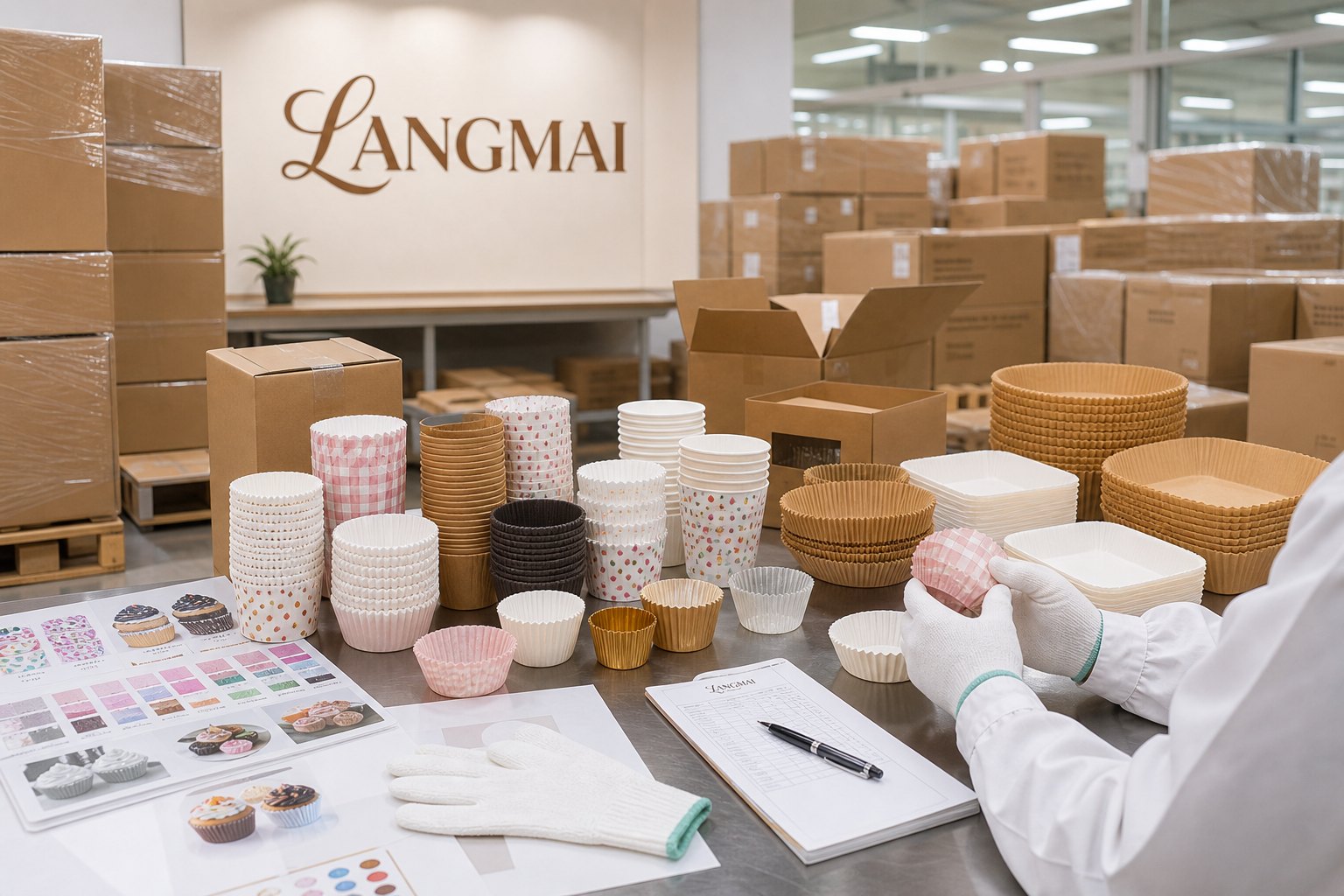
Direct answer: A food paper packaging supplier audit checks whether the legal entity, facility, processes, materials, records and subcontractors match the product being quoted. Buyers should verify product-specific food-contact evidence, traceability, hygiene, change control, application testing, packing and complaint handling. An audit supports qualification, but it does not by itself prove that a finished SKU complies with every market or performs in the buyer's application. Every document in our compliance library is tied to a specific construction; see how the wholesale parchment paper rolls and sheets programme aligns test reports with the exact grade supplied.
1. The Critical Role of a Food Paper Packaging Supplier Audit
For importers, food brands, and distributors, sourcing paper-based food packaging involves significant regulatory and operational risk. Items like cupcake liners, cake cups, paper baking cups, greaseproof food paper, air fryer liners, paper straws, and custom food-paper packaging come into direct contact with consumable goods, often under extreme temperatures or high-moisture conditions. Documentation scope is confirmed per SKU and destination market, as outlined on our baking parchment paper manufacturing programme page.
Use the audit to test supplier claims against records and observations, identify gaps before a purchase order and define corrective actions. Weight each finding by the buyer's product, destination market and risk assessment. The factory and certificate library lists the third-party audits and test reports behind these claims.
2. Pre-Audit Phase: The RFQ and Initial Due Diligence
Before dedicating resources to an extensive remote or on-site audit, buyers must conduct preliminary due diligence during the Request for Quotation (RFQ) phase. This early stage filters out unqualified vendors and sets the baseline for the formal paper packaging supplier evaluation.
Structuring the Pre-Audit RFQ
When issuing an RFQ to a food contact paper supplier, request preliminary documentation alongside pricing. This should include:
- Business Registration and Licensing: Proof of legal operation and export licenses.
- Management-system evidence: Request certificates or audit reports required by the buyer, verify their legal entity, site, scope, issuer and validity, and remember that they do not prove a specific SKU's compliance.
- Product Catalogs and Specifications: Detailed specification sheets for the items you intend to source (e.g., basis weight of greaseproof paper, coating types for air fryer liners).
- Basic Organizational Chart: To understand the structure of their Quality Assurance (QA) and Quality Control (QC) departments.
3. Production Capability and Ownership Boundaries
A critical failure point in international sourcing is discovering that your audited supplier is merely a trading company or is subcontracting core manufacturing processes to unvetted, third-party factories.
Verifying In-House Manufacturing
During the baking paper factory audit, establish the exact boundaries of the supplier's ownership and production capabilities. You must verify which steps of the manufacturing process are handled in-house. Map each quoted process, including slitting, printing, die-cutting, forming and packing, to the actual site or approved subcontractor.
Managing Subcontracted Processes
If the supplier subcontracts certain processes—such as custom printing or the application of specialized greaseproof coatings—the auditor must review how the primary supplier controls and audits their subcontractors. A robust supplier evaluation requires that all sub-tier vendors be held to the same food safety standards as the primary manufacturer. For deeper insights into facility evaluation, review our guide on the paper baking cup manufacturer audit.
4. Document Review for Destination Markets (FDA, EU)
Food contact packaging is heavily regulated. A core component of your audit must be verifying that the manufacturer understands and complies with the laws of your specific destination market. Compliance is always site-specific, product-specific, formulation-specific, and use-specific.
European Union (EU) Compliance Framework
If you are importing into the EU, the supplier must demonstrate compliance with strict frameworks:
- EU 1935/2004: The general framework regulation requiring that materials do not transfer constituents to food in quantities that endanger human health, bring about unacceptable changes in food composition, or deteriorate its organoleptic characteristics.
- EU 2023/2006 (GMP): Good Manufacturing Practice for materials and articles intended to come into contact with food. The audit must verify that the supplier maintains quality assurance and control systems, including adequate documentation of their manufacturing processes.
- Declarations of Compliance (DoC): The supplier must be able to generate an accurate DoC supported by adequate testing data for the specific paper item.
United States FDA Compliance
For the US market, the FDA food-contact regulatory status of components must be established. The supplier must maintain records showing that the base paper, adhesives, inks, and coatings comply with the relevant sections of Title 21 of the Code of Federal Regulations (CFR), such as 21 CFR 176.170 (Components of paper and paperboard in contact with aqueous and fatty foods). The audit should confirm that the supplier restricts the intended use of the packaging to the temperature and food types validated by their compliance data.
5. Raw Material, Ink, and Coating Records
The safety of paper baking cups, greaseproof food paper, and paper straws is entirely dependent on the chemical safety of the input materials.
Base Paper and Pulp Verification
Auditors must trace the origin of the base paper. Is it virgin wood pulp, or does it contain recycled content? If recycled content is proposed, assess it against the intended food contact, functional barrier if any, destination-market rules and supporting test evidence rather than treating all recycled paper alike.
Food-Grade Inks and Adhesives
For printed custom food-paper packaging and paper straws, the audit must review the purchasing records and technical data sheets (TDS) for all inks and glues. Match ink and adhesive identities to the finished SKU, review supplier declarations and technical information, and observe storage, issue and change controls. Marketing terms such as "food-grade" or "low migration" are not substitutes for the finished-product assessment.
Greaseproof and Non-Stick Coatings
Air fryer liners and baking cups often rely on coatings (like silicone or vegetable-based treatments) for release properties. The audit must verify the chemical formulation of these coatings. Where the buyer or destination market restricts a substance or claim, identify the exact requirement and obtain evidence scoped to the finished SKU and issue date.
Request Supplier Audit Information
6. Traceability and Change Control
In the event of a product recall or safety failure, the ability to trace a specific batch of cupcake liners back to the exact roll of base paper and batch of ink is mandatory.
Implementing GS1 Global Traceability Standards
GS1's Global Traceability Standard provides a framework for identifying traceability events and data. The buyer should define the required lot links, then challenge the supplier with a timed trace exercise from a selected finished carton upstream to materials and downstream to shipment records.
Change Control Procedures
What happens if the supplier changes their ink brand or base paper mill? A robust change control policy ensures that buyers are notified of formulation or supply chain changes before production begins, as these changes can invalidate existing food-contact safety tests.
7. Environmental and Facility Controls
Because paper is highly susceptible to environmental degradation, the physical condition of the manufacturing plant is a major focus of the baking paper factory audit.
Pest Control
Food contact paper facilities must have a documented pest control program. The audit should check for bait stations (mapped and monitored regularly), insect light traps, and sealed facility perimeters to prevent rodents, birds, and insects from nesting in paper rolls.
Moisture and Humidity Management
Paper absorbs moisture, which can lead to warping, reduced structural integrity (critical for paper straws), and mold growth. The auditor must check how raw paper rolls and finished goods are stored. Are they kept off the floor on pallets? Is the warehouse climate-controlled, or at least monitored with hygrometers?
Hygiene and Glass/Hard Plastic Policies
Workers handling direct food-contact materials like cake cups must follow strict hygiene protocols, including wearing hairnets, gloves, and dedicated facility footwear. Furthermore, the facility must have a glass and hard plastic policy (e.g., shatterproof lighting, restricted use of glass containers on the production floor) to prevent physical contamination of the packaging.
8. Quality Inspection, Complaints, and Corrective Actions
A supplier’s ability to catch defects before shipping is paramount. The audit must evaluate their Quality Control (QC) infrastructure.
The QC Flow (IQC, IPQC, OQC)
- Incoming Quality Control (IQC): Checking raw paper basis weight, coating thickness, and checking incoming certificates of analysis (COA).
- In-Process Quality Control (IPQC): Operators and line inspectors checking for print registration, die-cutting precision, and proper folding/forming at regular intervals.
- Outgoing Quality Control (OQC): Final checks on packed cartons for labeling accuracy, unit counts, and seal integrity. For more on specific inspection criteria, read our guide on baking paper products quality control inspection.
Complaints and CAPA
How does the supplier handle customer complaints? The auditor should review past complaint logs and the resulting Corrective and Preventive Actions (CAPA). A supplier that claims to have "zero complaints" is often a red flag indicating a lack of proper record-keeping rather than perfect production.
9. Sample Evaluation and Application Testing
Paper packaging supplier evaluation is incomplete without verifying how the product performs in its intended application.
Physical and Functional Testing
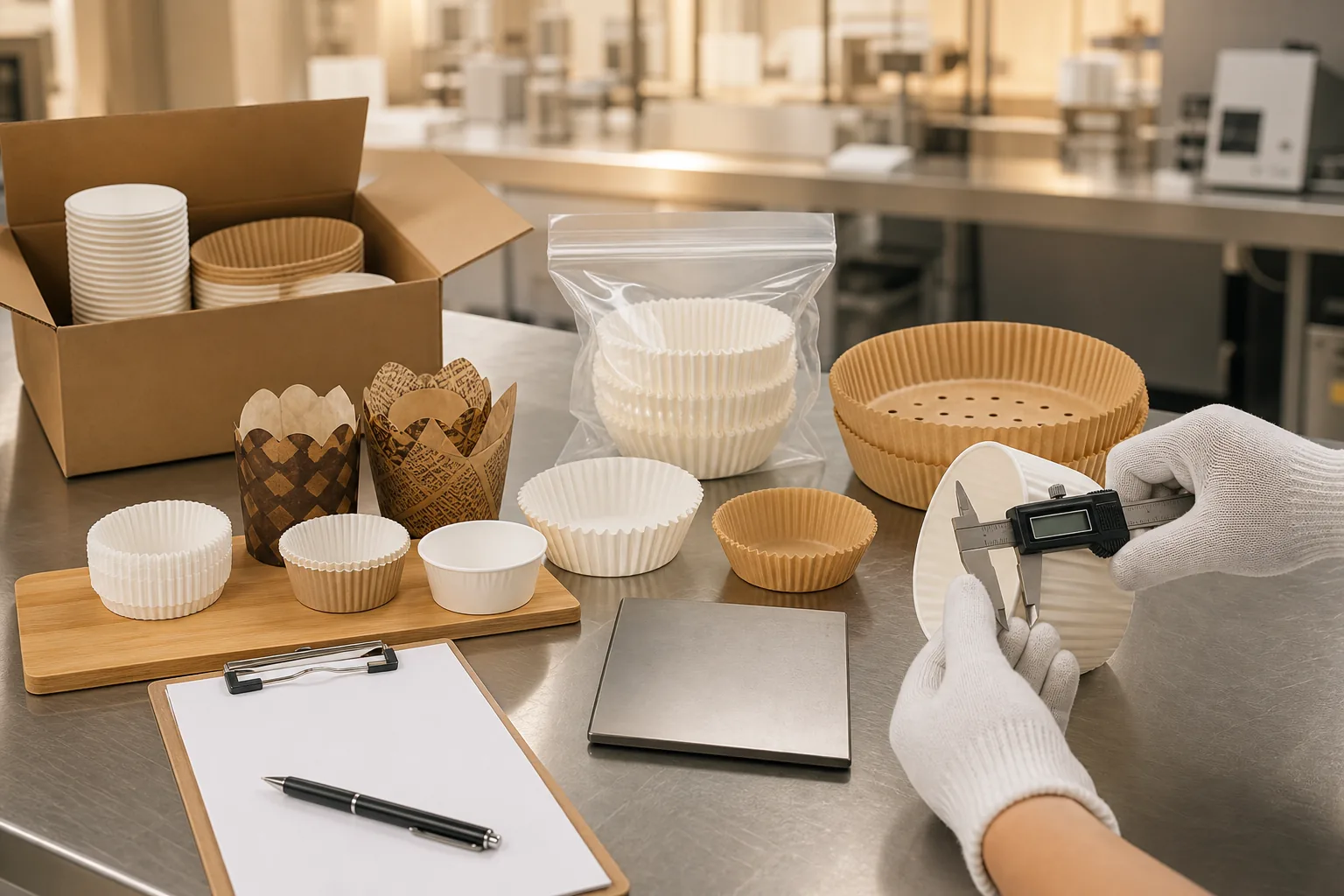
The audit should review the facility's internal laboratory capabilities. Do they have the equipment to test:
- Grease and Oil Resistance: Crucial for greaseproof food paper and air fryer liners (often tested using the KIT test).
- Heat Resistance: Verifying that baking cups do not scorch, smoke, or emit odors at typical baking temperatures (e.g., 220°C).
- Wet Strength and Durability: Essential for paper straws to ensure they do not disintegrate prematurely when submerged in liquids.
For an in-depth look at regulatory and safety testing, see our article on food contact testing for paper baking cups.
10. Audit Evidence Matrix
During the audit, the auditor must cross-reference claims with documented and physical evidence. Below is an audit evidence matrix specifically for food paper manufacturers.
| Audit area | Record evidence | Observation or challenge |
|---|---|---|
| Material control | Approved specifications, purchase and receiving records | Select a finished lot and match its input identities |
| Traceability | Batch records and shipment links | Run an upstream and downstream trace exercise |
| Hygiene and pest control | Procedures, logs and corrective actions | Walk storage, production and packing areas |
| In-process quality | Test methods, check sheets and defect references | Observe a check and verify equipment status |
| Change control | Change requests, approvals and notifications | Trace a past change through reapproval |
| Complaints | Complaint, root-cause and corrective-action records | Check closure evidence and recurrence monitoring |
12. Audit Scoring, Red Flags, and Actions
Because every buyer has different risk tolerances and product requirements, there is no single, universal audit score or fixed Acceptable Quality Limit (AQL) that guarantees a "pass." Define the scoring model, severity definitions, evidence requirements and approval authority before the audit. A finding should be classified from its plausible impact on food safety, legality, function or traceability, not from a universal label.
Red-Flag and Action Table
| Observation | Buyer assessment |
|---|---|
| Finished lot cannot be linked to material and shipment records | Determine affected scope; do not approve until traceability is effective |
| Material identity or status is unclear | Quarantine the affected material and investigate |
| Certificate names another site or legal entity | Treat it as non-applicable until scope is verified |
| Records appear pre-completed or altered | Escalate as a data-integrity concern and verify affected lots |
| Finished goods are exposed to moisture, pests or damage | Contain affected stock and require corrective action |
FAQ
What is the most critical area of a food paper manufacturer checklist?
While all areas matter, raw material compliance and traceability are paramount. If a manufacturer cannot prove the chemical safety of their base paper, inks, and coatings via recognized standards (FDA/EU), the physical quality of the manufacturing facility is irrelevant.
Do facility certificates guarantee product compliance for food-contact paper?
No. Facility certificates like ISO 9001 or BRCGS prove that the factory has a recognized quality or safety *management system* in place. They do not automatically prove that a specific SKU, custom printing run, or material formulation complies with the heavy metal, migration, or PFAS regulations of your destination market.
How often should we conduct a food paper packaging supplier audit?
Set audit frequency from supplier risk, performance, product changes, complaint history and buyer policy. Reassess after material changes, site changes, serious findings or other defined triggers.
What is the difference between a remote and an on-site baking paper factory audit?
A remote audit relies on document review, live video calls, and digital evidence gathering, making it cost-effective for initial vetting. An on-site audit involves physical inspection of the premises, allowing auditors to observe actual worker habits, inspect hidden corners for pests, and independently pull files for traceability exercises.
How does traceability work for paper packaging materials?
Traceability links the finished product back to its origins. It requires tracking Key Data Elements (like lot numbers, production dates, and machine IDs) across Critical Tracking Events (like receiving raw paper, printing, die-cutting, and shipping). The goal is to isolate exactly which items are affected if a raw material defect is discovered.
Can a supplier use non-food-grade inks on the outside of food packaging?
The answer depends on the complete construction, print position, set-off, possible transfer routes, intended use and applicable law. Review the actual ink system and finished article; do not approve it from a generic ink label.
How are corrective actions handled after a failed audit?
If non-conformances are found, the supplier must submit a Corrective and Preventive Action (CAPA) report. This involves conducting a root cause analysis, outlining immediate fixes, and defining long-term preventive measures. Buyers must verify the implementation of the CAPA—often through photo evidence or a follow-up visit—before approving the supplier for mass production.
Conclusion
A supplier audit is one part of qualification. It should connect the quoted SKU to controlled materials, real production steps, traceability, hygiene, application testing, packing and corrective action. Product-specific evidence and buyer approval remain necessary; a general facility certificate cannot cover every custom construction or destination market. Our private-label parchment paper supplier programme is audited against the same standards referenced in this guide.
Sources
- European Commission: Food Contact Materials Legislation – https://food.ec.europa.eu/food-safety/chemical-safety/food-contact-materials/legislation_en
- U.S. Food and Drug Administration (FDA): Determining the Regulatory Status of Components of a Food Contact Material – https://www.fda.gov/food/packaging-food-contact-substances-fcs/determining-regulatory-status-components-food-contact-material
- GS1 Global Traceability Standard – https://www.gs1.org/standards/gs1-global-traceability-standard/current-standard