
Introduction
Wall design is one of the most consequential decisions in a cake cup specification, yet it is often treated as an aesthetic afterthought. Whether a cup is fluted (pleated or corrugated at the sidewall) or smooth walled changes how it is formed, how it denests, how it handles batter and grease, how it presents on the shelf, and what it costs per unit at wholesale volumes. Cup programmes usually ship alongside pan lining; our wholesale parchment paper rolls and sheets specs cover the sheets and rolls that pair with them.
Buyers who specify wall construction without understanding the production trade-offs discover problems downstream: fluted cups that jam in a denesting magazine, smooth cups that oil-stain on the shelf, or a distinctive fluted product that costs 15 percent more with no commercial benefit for the application. Buyers verifying these specifications can review the certificate library alongside supplier documentation requests.
This guide compares fluted and smooth wall paper cake cups across forming methods, structural and barrier behaviour, filling-line compatibility, presentation and cost, with a decision framework and specification language for RFQs.
1. How the Two Constructions Are Made
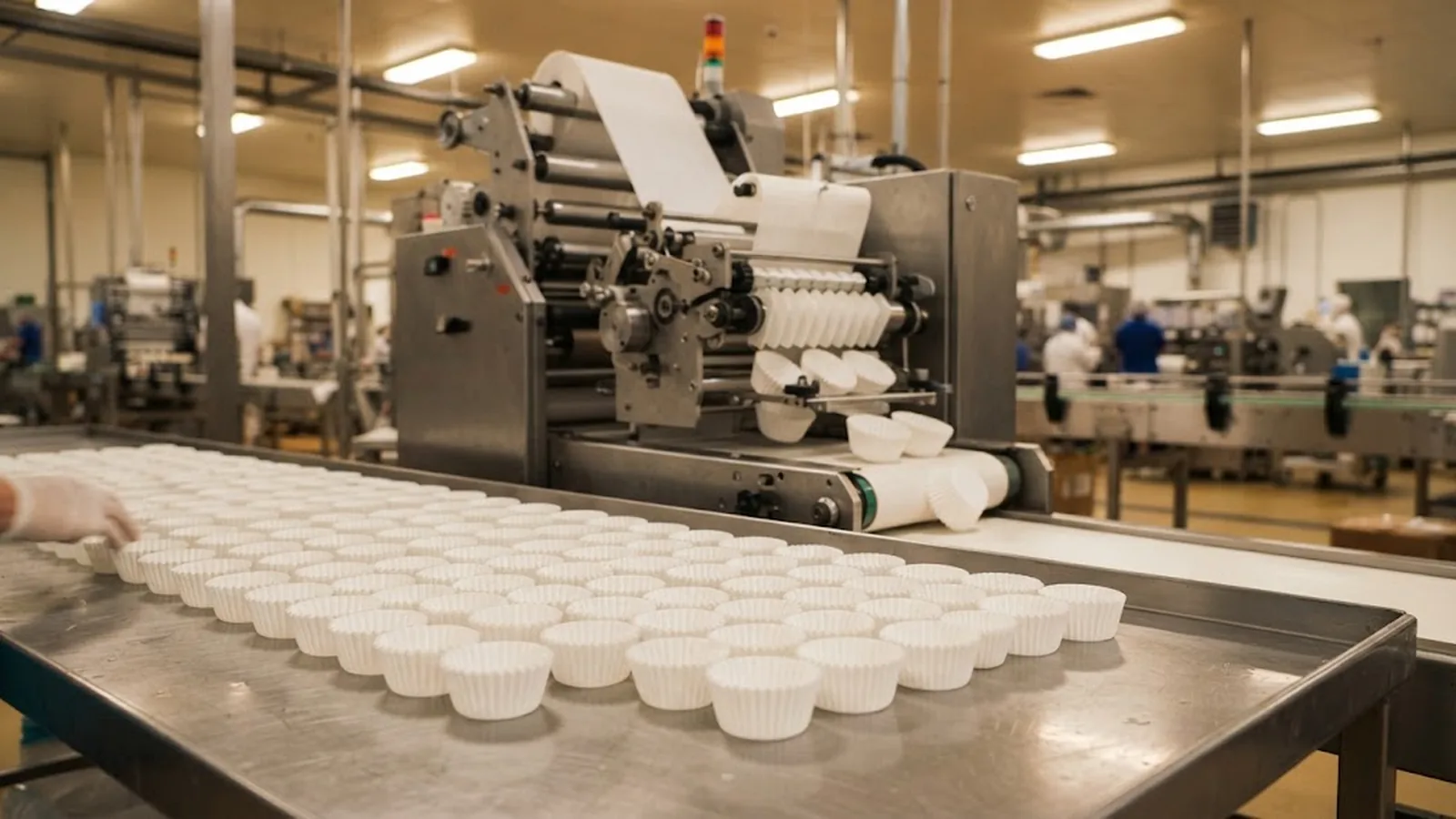
The production difference is fundamental, and it explains nearly every downstream behaviour. Where a bakery lines trays and moulds product in the same run, our baking parchment paper manufacturing programme are quoted with the cup programme for a single documentation package.
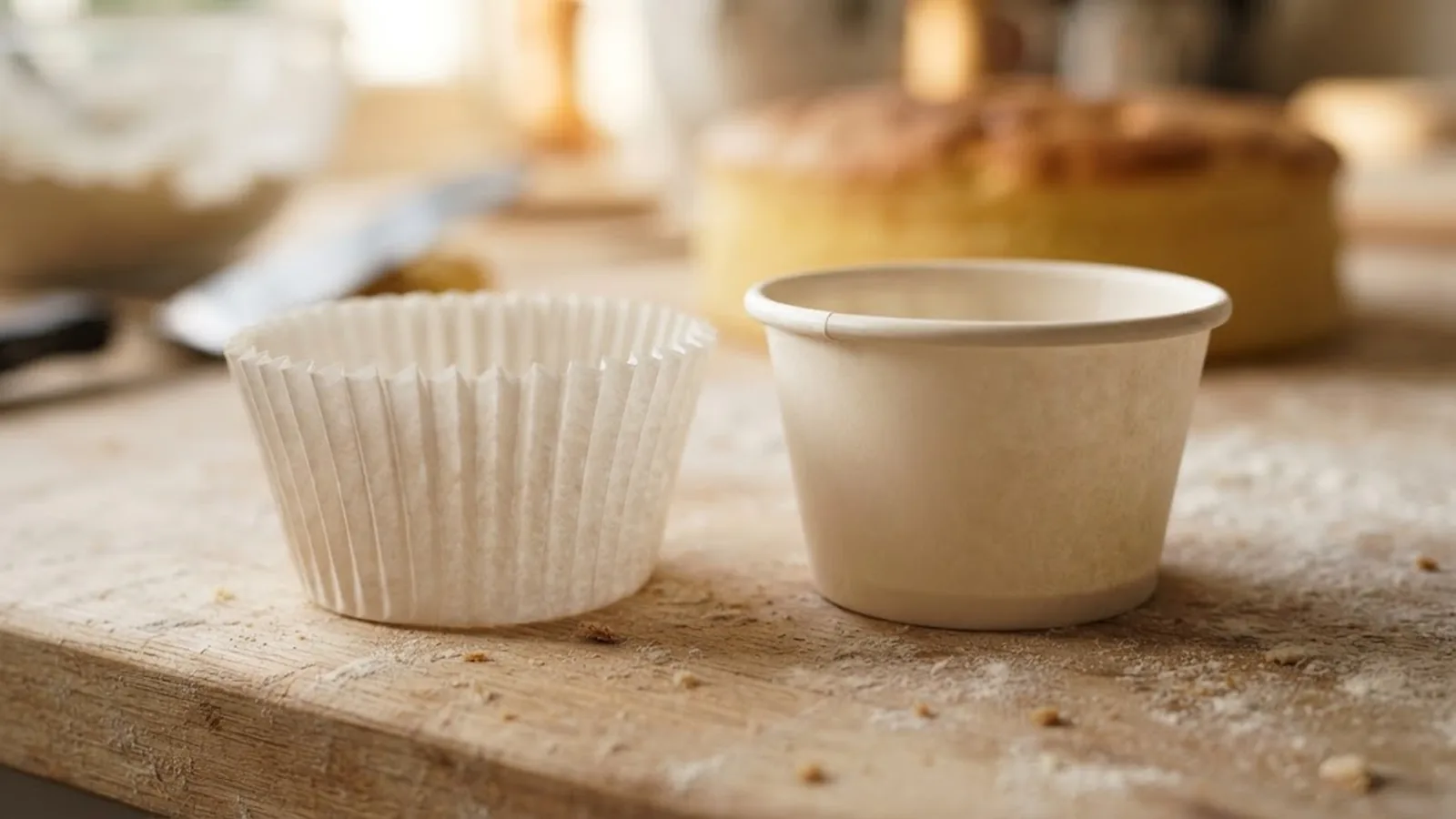
Smooth wall cups are die-cut from a web and formed on a rotary or single-point cupping machine. The sidewall is a simple truncated cone or cylinder with a rolled or curled rim for stiffness. Forming is fast, tooling is straightforward, and the construction suits food-grade barrier papers including greaseproof and coated stocks. The factory and certificate library lists the third-party audits and test reports behind these claims.
Fluted cups pass the paper through a pleating or corrugating section before or during forming. Fluting depth and pitch are fixed by tooling, forming speed is typically lower, and the paper must crease cleanly without cracking the coating or splitting the fibre.
For buyers, the practical consequence is that fluted cups have a narrower range of compatible paper grades and higher sensitivity to stiffness and moisture; a paper that runs well on a smooth-wall line can crack at the flutes unless validated for fluting.
2. Structure, Release and Barrier Behaviour
The flute does more than decorate. It changes the mechanics of the cup in use.
- Sidewall stiffness: fluting raises the moment of inertia of the wall, so a fluted cup in a lighter grammage can feel as firm as a heavier smooth cup. Buyers can sometimes step down one grammage class by going fluted, partially offsetting the higher forming cost.
- Release: flutes create air channels between paper and crumb, and the pleated wall flexes during unmoulding. Fluted cups often release delicate sponges more cleanly than smooth cups of the same coating system, particularly for butter-rich or sticky formulas.
- Grease presentation: a smooth wall shows a grease shadow as a clean, growing stain; a fluted wall distributes staining along the crests. This can mask light transudation visually but does not stop it — grease resistance still comes from the paper grade and any coating.
- Moisture behaviour: in chilled or humid display, condensate collects differently on a fluted wall. For frozen or high-moisture desserts, smooth walls with an adequate barrier coating are the safer default; fluting hides a developing barrier problem until it is severe.
3. Filling Lines, Denesting and Automation
Line compatibility is where wall design bites hardest, and where the mismatch between bakery and packaging supplier most often surfaces.
Smooth wall cups nest tightly and predictably. On high-speed denesting equipment — vacuum pick-up, rotary magazines, chain-fed cups — smooth walls generally run at the rated speed with minimal setting work. That predictability is a real cost: a line that runs 120 cups per minute without stops versus one that needs operator attention every 20 minutes is a large annual difference.
Fluted cups nest less compactly, and their behaviour in magazines depends on flute pitch, rim design and cup stiffness. Many modern denesters handle fluted cups well, but the specific cup must be validated on the specific machine. Before committing to a fluted SKU at volume, run a line trial with production-speed deposits and record jam rates, misfeeds and changeover time. Confirm that lids, trays or secondary packaging designed around a smooth-wall SKU still fit, because fluted cups often need a slightly larger outer diameter for the same fill volume.
4. Presentation, Branding and Retail Considerations
Where presentation matters, the two constructions serve different strategies.
Fluted cups read as premium and artisanal. The dimensional shadow of the flutes photographs well for social-media-driven dessert brands, and the silhouette distinguishes a product on a crowded bakery shelf. Print behaviour differs too: artwork on a fluted wall is distorted by the pleats, so continuous graphics and small text do not survive; buyers planning custom printing on fluted cups should design for the flute pattern and require a printed proof before approval.
Smooth wall cups offer a continuous printable surface, cleaner geometry for stacked or sleeved retail packs and a neutral look that suits private-label ranges where category consistency matters more than shelf theatre.
5. Cost, Case Pack and Container Economics
At wholesale volumes, fluted cups typically carry a modest premium over equivalent smooth wall cups, driven by slower forming speeds, more complex tooling and a narrower choice of substrate. At large order quantities the premium can shrink enough to be commercially irrelevant when the fluted look earns its keep on the shelf.
Buyers should compare the two on total applied cost, not unit price alone:
- Grammage offset: if fluting lets you drop a grammage class for the same felt stiffness, part of the premium is recovered.
- Line efficiency: a smoother-running denesting line favours smooth wall; quantify stoppages from the trial before deciding.
- Case pack density: fluted cups nest less tightly, so more cases are needed for the same unit count — a real freight cost for importers buying FCL. Ask both suppliers to quote cases per 20-foot and 40-foot container so the difference lands in the comparison.
- Minimum order quantities: fluted tooling is more product-specific. Custom fluted cups frequently carry a higher MOQ and longer lead time, which matters for seasonal or promotional programmes.
6. A Decision Framework for Buyers
A workable rule set, tested against common programmes:
- High-speed industrial muffin and cupcake lines: smooth wall is the default. Predictable denesting and the widest paper choice outweigh presentation gains.
- Premium artisanal products sold on appearance: fluted wall, validated on the actual line, with print designed for the flutes.
- Frozen or high-moisture desserts: smooth wall with a specified barrier system; reserve fluted versions for dry, fat-forward products where its release behaviour shines.
- Private-label grocery ranges: smooth wall for category consistency and lower MOQ per SKU; consider one fluted hero product for range differentiation.
- Cost-critical foodservice volume: smooth wall, standard sizes, stock tooling.
Whichever direction you choose, put the decision in the specification explicitly: wall construction, flute pitch where applicable, grammage, rim treatment, grease resistance requirement and denesting performance target. A specification that names "fluted, 5 mm pitch, 160–170 GSM, kit level per test method X" prevents the quiet substitution of a lookalike cup that behaves differently on your line.
FAQ
Does fluting improve grease resistance?
No. Grease resistance comes from the paper grade — dense greaseproof refining or a barrier coating — not from the wall shape. Fluting changes how a grease stain appears and can visually mask light transudation, but the barrier requirement is identical. Specify grease resistance by test method and pass criteria for both constructions.
Can I switch from smooth to fluted cups without line changes?
Not safely. Nesting behaviour, outer diameter and magazine feed all differ. Run a denesting and filling trial at production speed, and check downstream handling — lids, trays, case counts — before switching any volume SKU.
Why do fluted cups usually cost more?
Fluted forming is slower and tooling is more complex, and fewer paper grades are validated to crease without cracking. The premium is typically modest at volume and can be partly offset by stepping down grammage, since fluting adds stiffness.
Which wall type is better for custom printed cups?
Smooth walls accept continuous artwork and small text cleanly. Fluted walls distort printed graphics along the pleats, so designs must be adapted to the flute pattern. Request a printed proof from production tooling, not a flat mock-up, before approving artwork on either construction.
Conclusion
Fluted versus smooth wall is not a style question dressed up as an engineering one — it is an engineering decision with style consequences. Fluting buys stiffness, release behaviour and shelf presence; smooth walls buy line speed, packing density, printing flexibility and lower MOQ. The right answer depends on your product's fat and moisture profile, your filling line, your freight lane and your shelf strategy. Buyers standardising on one paper supplier can review our private-label parchment paper supplier next to their cup specifications.
Buyers who treat wall construction as a specified parameter — validated on the real line, priced on total applied cost including freight, and locked into the specification document — get the benefits of their chosen construction without the surprises. Buyers who treat it as a catalogue checkbox discover the trade-offs one production day at a time.
If you are evaluating fluted or smooth wall cake cups for a wholesale programme, LANGMAI supplies both constructions in food-grade greaseproof and coated papers, with line-trial samples, custom printing support and documentation for your compliance file. Contact us with your cup dimensions, fill weight and line details for a recommendation matched to your application and cost target.