Introduction
When sourcing paper food-contact items at scale, procurement professionals frequently encounter overlapping terminology across global markets. Specifically, deciding between cupcake liners vs baking cups requires a detailed technical evaluation of paper basis weight, wet strength, release properties, and automated machinery compatibility. In commercial baking and large-scale food distribution, terminology varies significantly by supplier, region, and customer specification; there is no universal naming rule or fixed definition. Generally, items designated as cupcake liners are frequently lightweight paper cases engineered primarily for presentation and holding finished items inside rigid trays, whereas baking cups often refer to heavier structural paper containers designed to withstand high-volume batter deposition and baking under specific thermal conditions. For global business buyers, selecting the correct specification dictates production line efficiency, structural integrity, and final product presentation. This guide examines the mechanical differences, material parameters, structured sample design, controlled trials, and incoming quality inspection procedures necessary to make informed wholesale procurement decisions. Cup programmes usually ship alongside pan lining; our private-label parchment paper supplier specs cover the sheets and rolls that pair with them.
Terminology Variations and Market Definitions
Across international supply chains, industrial buyers must look past colloquial product names and analyze physical specifications. Because vocabulary differs by manufacturer, distributor, and geographic region, procurement teams should establish clear technical definitions based on end-use application rather than relying solely on catalog titles. Where a bakery lines trays and moulds product in the same run, our pre-cut parchment paper sheets and rounds are quoted with the cup programme for a single documentation package.
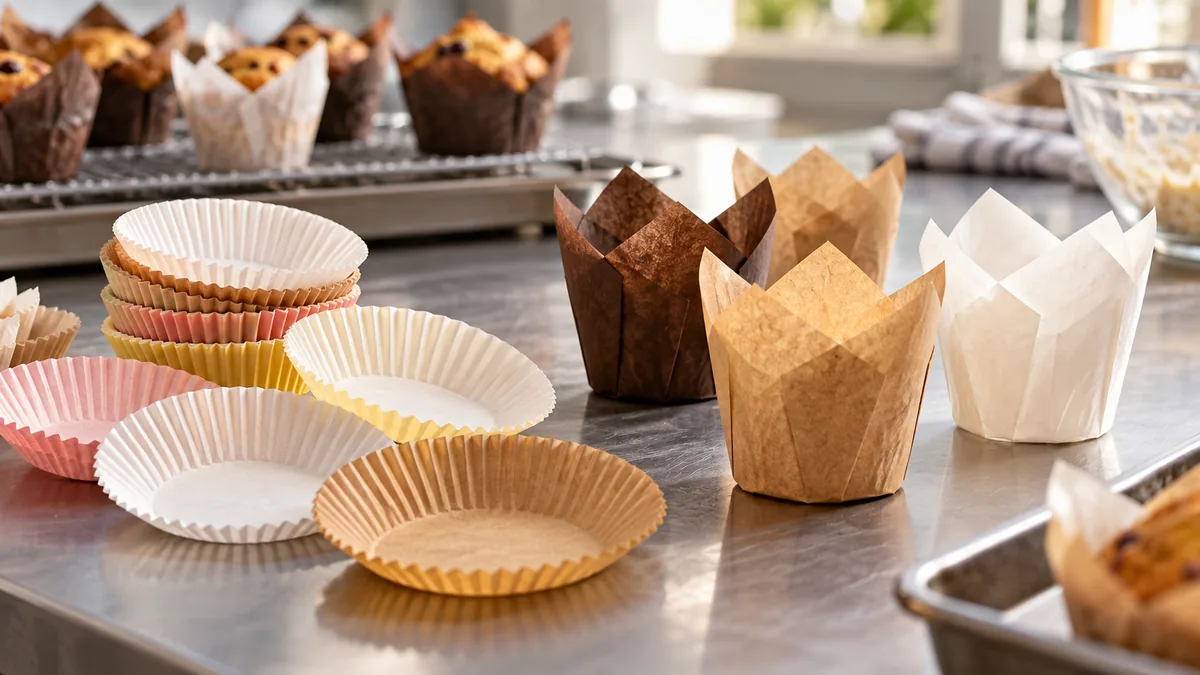
- Cupcake Liners: Often described as fluted or pleated paper cases produced from specialized greaseproof or glassine base papers. They are typically nested for manual or mechanical depanning and are usually inserted into rigid metal, silicone, or paperboard pans to provide structural support during baking.
- Baking Cups: A broader category that can encompass heavy-duty, self-supporting containers, tulip-style wraps, and rectangular or round specialty shapes. These products frequently utilize specific paper stocks, barrier treatments, and folded or crimped side walls capable of maintaining structural rigidity under specific oven parameters.
Understanding these distinctions prevents costly misalignment between factory output and bakery line requirements. Buyers operating commercial bakeries or retail packaging divisions must evaluate whether their operation requires collapsible fluted liners for pan-supported baking or rigid baking cups engineered for specific freestanding or tray-supported baking environments. The factory and certificate library lists the third-party audits and test reports behind these claims.
Material Composition and Technical Performance Parameters
The structural performance of paper food-contact packaging relies heavily on the selection of base paper, chemical treatments, and physical dimensions. Procurement specifications must account for how these parameters behave under thermal stress, moisture exposure, and fat migration.
Paper Grammage and Basis Weight
Base paper weight directly affects mechanical strength and release efficiency. Commercial paper cases vary widely in basis weight depending on the functional requirements of the recipe and equipment. When reviewing technical data sheets, buyers should cross-reference grammage with caliper (thickness) and density to ensure consistent feeding through automatic denesters without causing jams or double-feeding errors.
Greaseproofing and Release Properties
Bakery items contain varying percentages of fats, oils, and sugars that can weaken untreated paper. Depending on the construction, a converter may use a dense paper structure or a defined release or barrier treatment. Its regulatory status and suitability still need review for the actual recipe, temperature, contact time and destination market. Evaluating non-stick performance is critical because poor release can cause crumb adhesion, tearing during peeling and presentation defects. Buyers with difficult recipes can use the non-stick cupcake liners wholesale guide to build a product-specific test.
Comparative Matrix: Cupcake Liners vs Baking Cups
To assist commercial buyers in evaluating product tiers for procurement bids, the following matrix outlines key technical differences, typical applications, and operational behaviors.
| Decision factor | Pan-supported liner format | Structural or specialty baking-cup format | Buyer verification |
|---|---|---|---|
| Support during baking | Usually relies on a correctly fitted pan or tray | May be self-supporting, semi-rigid or designed for a specific tray | Bake a filled sample in the intended equipment; do not judge an empty cup |
| Shape and presentation | Fluted profile, often selected for familiar cupcake presentation | Can include tulip, roll-mouth, straight-wall or other formed styles | Approve dimensions, forming details and finished-product appearance |
| Denesting and placement | May suit manual placement or a dedicated denester | Placement method depends on stiffness, shape and nesting design | Run the actual stack through the line at representative conditions |
| Release and grease performance | Depends on paper, treatment, recipe and cooling | Also depends on the complete construction and process | Compare controlled bake results against an approved reference sample |
| Packing efficiency | Nested stacks can be compact but vulnerable to compression | Rigid formats may require more protective space | Approve inner count, carton loading and pallet pattern with transit risk in mind |
| Best purchasing description | Drawing plus pan fit, recipe and release criteria | Drawing plus support method, baking limits and packing method | Put the measurable description in the RFQ and purchase order |
The table is a starting point, not a product standard. A supplier may call a pan-supported item a baking cup and a structural item a cupcake cup. The drawing, material specification and approved application result should control the order when the commercial name is ambiguous.
Production-Line Handling and Machine Compatibility
Integrating paper packaging into automated baking lines introduces mechanical variables that procurement teams must verify prior to issuing large purchase orders. Mismatched dimensions can lead to costly line stoppages, jammed denesters, and deformed products.
- Bottom Diameter and Wall Angle: The base diameter of the liner must match the pocket dimensions of the baking tray or conveyor mold precisely. Variations in wall angle or pleat depth can cause the paper to tilt, resulting in lopsided baked goods.
- Nest Height and Separation: Liners are supplied in tightly nested stacks. If the paper lacks adequate stiffness or if nesting is overly compressed, mechanical denesters may pull multiple cups simultaneously or fail to release, halting production.
- Moisture and Thermal Stability: During high-temperature baking, moisture within the batter turns to steam. The paper must permit controlled moisture vapor transmission while maintaining wet strength to prevent bottom blowouts or sidewall collapse. For operations analyzing specific structural formats, reviewing detailed insights in the muffin baking cups commercial bakery guide provides further context on industrial manufacturing tolerances.
Sample Design and Controlled Trials
Before committing to bulk volume, structured sample design and controlled trials are essential to validate product performance under real-world operating conditions.
- Sample Design Phase: Specify exact dimensions, flute counts, print layouts, and base paper specifications in technical drawing submissions. Ensure prototype samples match the exact mechanical parameters of intended production runs.
- Controlled Batter Trials: Execute benchtop baking trials using representative batter formulations (e.g., high-fat, high-sugar, or high-protein mixes). Monitor how the paper interacts with moisture and fat over the full baking cycle.
- Line Trials: Run sample lots through automated denesting, filling, and baking equipment to evaluate feed consistency, mechanical reliability, and structural retention under speed. For procedural alignment, consult the paper baking cup samples approval checklist for structured testing guidelines.
Use enough samples to expose normal variation across stacks rather than selecting only the best-looking pieces. Record the sample code, carton or inner-pack location, pan reference, recipe, fill amount, oven program, cooling point and operator observations. Photograph cups before filling, after baking, after cooling and after peeling. Where the finished product enters retail distribution, repeat the inspection after the normal display, chilling, freezing or transport simulation that applies to the SKU.
The approval record should distinguish a cosmetic concern from a functional failure. A slightly different flute appearance may be acceptable when it does not affect line handling or presentation, while double-feeding, base leakage, sidewall opening, objectionable odour or excessive crumb adhesion may require rejection or redesign. Buyers should define these categories before the trial so the result is not decided retrospectively.
Request Technical Samples & Specification Sheets
Packaging Configuration, Carton Protection, and Pallet Integrity
Protecting paper goods during transit is critical to preventing deformation, crushing, or moisture contamination before the product reaches the production line.
- Carton Specifications: Define a corrugated-carton strength and loading pattern suitable for the route, stack height, gross weight and warehouse handling risk. Verify the packed carton rather than relying on a material label alone.
- Inner Protective Packaging: Select an inner protection method that meets hygiene, moisture and unpacking requirements without deforming the nested stacks. The appropriate construction depends on the buyer's packaging and sustainability program.
- Palletization and Edge Protection: Agree a pallet pattern, load height and protective method appropriate to the transport route. A trial shipment or packed-pallet review can reveal compression and movement risks that are invisible in a flat specification.
Regulatory Compliance and Documentation Review
Compliance requirements vary depending on the destination market, material composition, and the specific risk profile of the buyer's quality assurance program. When required by regulatory frameworks or customer specifications, buyers should request relevant compliance documentation from suppliers.
- Regulatory Frameworks: In the United States, the regulatory status of each component and the intended conditions of use determine which provisions apply; paper and paperboard provisions can include 21 CFR 176.170 or 21 CFR 176.180 when their scope matches the article. In the European Union, the general framework in Regulation (EC) No 1935/2004 and GMP rules in Regulation (EC) No 2023/2006 are relevant starting points.
- Documentation Evaluation: Request declarations, test reports, specifications or other evidence only where applicable to the destination market, material construction and buyer program. Check that every document identifies the tested construction, method, conditions, date and issuer; a report for a different paper, treatment or print system does not automatically support the offered cup.
Build the RFQ Around the Decision, Not the Product Name
A comparable quotation needs more than size, colour and volume. Tell each supplier whether the cup will be pan-supported, tray-supported or freestanding; identify the product and recipe family; provide the pan or denester reference; and state the packing route. Include the destination market, artwork status, annual forecast and required trial quantity, but allow the supplier to state its feasible production and packing options rather than forcing an unverified assumption.
Ask the supplier to return a completed specification with the offer. It should identify the drawing revision, nominal paper construction, treatment or coating where present, print process, dimensions and tolerances, nesting orientation, pack count, carton plan, lot-code location and proposed change-notification process. Commercial terms such as minimum order, tooling, lead time and shipment unit should be quoted for the exact option, not copied from a generic catalogue SKU.
For a side-by-side decision, score the offers on application fit, sample repeatability, document relevance, packaging protection, inspection readiness and commercial terms. A lower price does not offset a cup that needs manual correction on the line or arrives with compressed walls. Conversely, a structural cup is not automatically the better choice if a simple pan-supported liner meets the recipe, equipment and presentation requirements with less material and easier packing.
Incoming Inspection, Change Control, and Procurement Decision Workflow
Implementing a structured procurement workflow and change control process safeguards manufacturing operations from quality drift and unexpected supply chain disruptions.
Incoming Inspection Protocol
- Dimensional Audit: Measure bottom diameter, sidewall height, and top flare using precision calipers across multiple sample locations within the shipment.
- Print and Surface Evaluation: Inspect custom-printed graphics for accurate color matching, registration, and absence of physical smudging or surface defects. Review applicable specifications and evidence regarding printing inks, ensuring checks cover odor, offset, and potential transfer risks.
- Release and Performance Verification: Perform routine peel tests and grease resistance checks on incoming batches to verify consistency against approved master samples.
Change Control Management
Establish a formal change notification agreement with suppliers. Any modifications to base paper grammage, release coatings, sizing dies, or ink formulations must require prior written notification, sample submission, and re-qualification before commercial implementation.
Procurement Decision Workflow
- Define Application Requirements: Identify whether the operation requires pan-supported liners or structural baking cups.
- Evaluate Technical Specifications: Review supplier technical data sheets, grammage, and dimensional tolerances.
- Perform Sample Testing: Conduct structured sample design reviews, controlled batter trials, and full-line machinery tests.
- Review Documentation: Request and verify compliance documentation and test reports when mandated by market regulations or buyer programs.
- Authorize Batch Production: Approve initial production runs subject to strict incoming quality control and ongoing change control protocols.
FAQ
What is the primary difference between cupcake liners and baking cups?
Cupcake liners are frequently lightweight paper cases designed to be supported by rigid baking pans during the baking process. Baking cups generally feature heavier structural paper construction, allowing them to serve as self-supporting or tray-supported containers in commercial ovens depending on the specific design.
How do I determine the correct size for commercial automated machinery?
Accurate measurement requires evaluating the bottom base diameter, sidewall angle, total height, and fluting depth. Procurement teams should cross-reference these dimensions with equipment manufacturer specifications and perform physical test runs using pre-production samples.
Are all paper baking products greaseproof?
No. Standard paper lacks natural resistance to oils and moisture. Commercial baking cups and liners utilize specialized greaseproof base papers, glassine treatments, or food-grade barrier coatings to prevent fat migration and ensure clean release from baked goods based on specific recipe formulations.
Are Declarations of Compliance universally mandatory for all orders?
No. Declarations of Compliance and migration reports are documents to request when applicable to the destination market, material construction, and buyer program requirements. They should be evaluated based on statutory rules of the importing country and specific customer quality assurance protocols.
How should printed paper components be evaluated for quality?
Inspection should include verifying that printing inks meet applicable specifications and evidence regarding odor, offset, and transfer risks, ensuring graphics remain stable and do not interact with food-contact surfaces.
Conclusion
Choosing between cupcake liners and baking cups involves balancing structural specifications, equipment compatibility, and regulatory compliance. By moving beyond generic terminology and focusing on technical parameters such as grammage, barrier properties, and dimensional tolerances, commercial procurement teams can optimize production efficiency and safeguard product quality. Establishing rigorous sample testing, incoming inspection protocols, and change control procedures ensures a stable, reliable supply chain for high-volume baking operations. Buyers standardising on one paper supplier can review our custom printed baking parchment paper next to their cup specifications.
CTA
Ready to secure commercial-grade paper packaging tailored to your exact manufacturing requirements? Contact LANGMAI today to discuss technical specifications, request sample kits, or initiate custom food-paper packaging inquiries.
Contact LANGMAI Commercial Team
Sources
- U.S. eCFR, 21 CFR 176.170: Components of paper and paperboard in contact with aqueous and fatty foods
- U.S. eCFR, 21 CFR 176.180: Components of paper and paperboard in contact with dry food
- U.S. FDA, Determining the Regulatory Status of Components of a Food Contact Material
- European Commission, Food-contact materials legislation
- EUR-Lex, Regulation (EC) No 2023/2006 on good manufacturing practice