Introduction
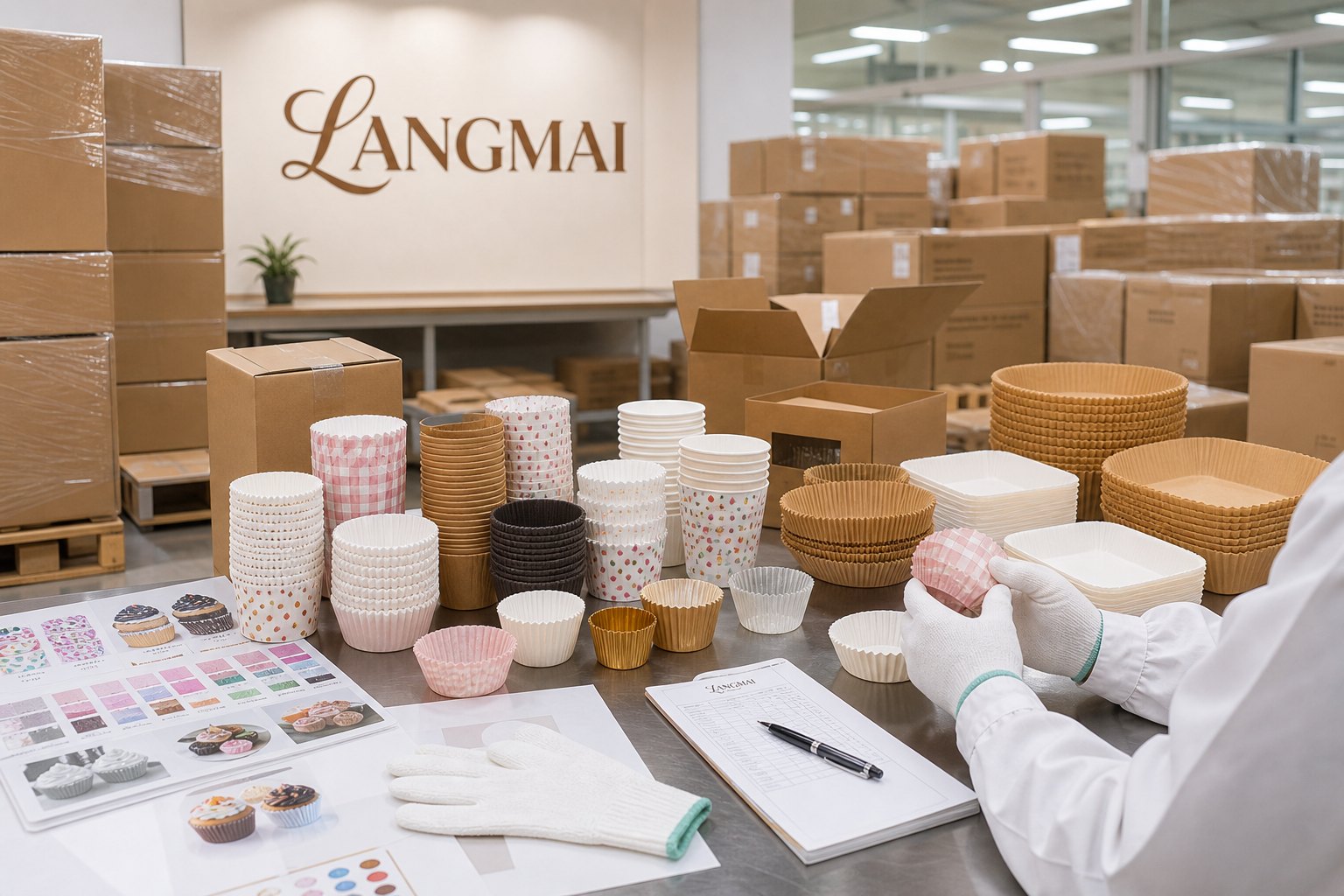
Effective cupcake liner grease resistance testing requires commercial bakeries, importers, and distributors to conduct controlled application trials that replicate exact production environments. To properly evaluate greaseproof cupcake liners, buyers must design a standardized test protocol using their specific commercial batter formulations, baking pans, oven parameters, and cooling procedures. By systematically monitoring grease migration, staining, and visual appearance throughout the baking, cooling, and extended storage phases, procurement teams can accurately assess baking cup oil resistance and structural integrity. Because there is no single universal lab method that accurately predicts how a paper baking cup will perform with every distinct recipe, real-world application testing is the most reliable method for cupcake liner quality inspection and selecting reliable packaging suppliers. Cup programmes usually ship alongside pan lining; our baking parchment paper manufacturing programme specs cover the sheets and rolls that pair with them.
1.0 Distinguishing Key Paper Characteristics in Baking Environments
Before initiating any cupcake liner grease resistance test, procurement teams and quality assurance professionals must clearly define the distinct performance characteristics expected from commercial baking paper. It is common for buyers to conflate grease resistance, release properties, and structural strength, but these are independent variables engineered through different paper manufacturing processes. Where a bakery lines trays and moulds product in the same run, our private-label parchment paper supplier are quoted with the cup programme for a single documentation package.
Grease Resistance
Grease resistance is the ability of the paper matrix to prevent fats, oils, and moisture from migrating completely through the liner to the exterior surface. When grease permeates the paper, it creates unsightly translucent patches, dark spots, and compromises the visual appeal of the final baked good. High baking cup oil resistance is achieved through the dense refining of wood pulp fibers to minimize porosity or through specific barrier treatments that block lipid migration. The factory and certificate library lists the third-party audits and test reports behind these claims.
Release Properties (Non-Stick)
Release refers entirely to how easily the baked crumb separates from the interior surface of the paper upon consumption. A liner can be highly grease-resistant but have poor release, causing the cake to tear when unwrapped. Conversely, a liner might release perfectly but show severe grease staining on the outside. Buyers sourcing for specific un-molding requirements should also review our guide on non-stick cupcake liners wholesale to understand the separation between barrier performance and release treatments.
Structural Strength
Structural strength dictates the liner's ability to maintain its corrugated fluting and overall dimensions under the heavy weight of dense batters and the thermal stress of industrial ovens. A liner lacking structural strength will flare outward, creating a flattened profile rather than a tall, uniform sidewall. While heavy grease saturation can weaken paper fibers and reduce structural integrity, strength itself relies heavily on the paper's basis weight (GSM) and the depth of the initial pleating.
2.0 The Necessity of Application-Based Testing
While laboratory tests exist for evaluating the general barrier properties of paperboards, the dynamic environment of a commercial oven introduces complex variables that static tests cannot simulate.
In a commercial baking scenario, the paper cup is exposed to elevated temperatures, expanding steam, fluctuating pH levels from leavening agents, and varying lipid structures (from butter, margarine, liquid vegetable oils, or emulsifiers). Each of these factors alters how fats interact with paper fibers. Therefore, a comprehensive cupcake liner quality inspection cannot rely on standardized laboratory solvent testing alone to predict final shelf appearance. There is no universal lab method that guarantees how a specific paper will react to your proprietary red velvet or high-ratio carrot cake batter. Real-world application testing is the only definitive method to evaluate true field performance.
3.0 Designing a Buyer-Controlled Sample Protocol
To achieve accurate supplier comparisons, commercial buyers must implement a highly controlled, repeatable testing protocol. The objective is to eliminate external variables so that the only changing factor is the cupcake liner being evaluated.
Establishing the Baseline Batter Formulation
Select a single, highly challenging batter formulation to serve as your universal testing standard. Batters with high percentages of liquid vegetable oil, heavy butter content, or high moisture (such as banana or pumpkin bases) exert the maximum stress on greaseproof cupcake liners. Document the exact recipe, ingredient brands, mixing times, and batter temperature prior to depositing.
Defining Pan Specifications and Depositing Weights
The interaction between the paper liner and the metal baking cavity significantly influences grease migration. The metal pan traps heat and restricts airflow, which can force expanding oils directly into the paper fibers. Ensure that the test liners are seated in the exact commercial pans used in your standard production. Record and control the deposited mass with the same production method used for every candidate so comparisons are repeatable.
Calibrating Oven Time and Temperature
Thermal dynamics are the primary catalyst for oil viscosity changes and paper fiber relaxation. The testing environment must exactly match the production floor. Document the oven type (convection, rack, deck, or tunnel), the target temperature, fan speed settings, and total dwell time in the baking chamber.
Standardizing Cooling and Extended Storage
Grease migration does not stop when the product exits the oven. As cakes cool, steam condenses, and lipid structures stabilize. A thorough grease stain test for baking cups must monitor the product through the complete cooling cycle and into the expected shelf-storage phase. Define the ambient temperature and humidity of the cooling area, as well as the exact duration the product will remain in its clamshell or display packaging before final evaluation.
Table 1: Key Variables in a Buyer-Controlled Baking Trial
| Variable | Record for each trial | Why it matters |
|---|---|---|
| Batter | Formula, fat source, moisture and starting temperature | Changes how oil and moisture interact with paper |
| Pan and deposit | Pan identity, cavity dimensions and deposited mass | Controls fit, heat transfer and contact pressure |
| Bake | Oven type, set point, airflow and dwell time | Defines the actual thermal exposure |
| Cooling and storage | Time, environment and final pack | Reveals delayed staining after baking |
4.0 Executing the Grease Stain Test on Baking Cups
Once the controlled trial is complete, the evaluation phase begins. This phase requires objective visual analysis and meticulous sample retention to compare different suppliers accurately.
Implementing a Visual Rating System
Because visual appeal is the primary concern for retail packaging, quality control teams must establish a standardized visual rating matrix. Examine the liners under bright, consistent lighting conditions. Look for dark bands around the base, translucent spotting on the sidewalls, and oil pooling in the bottom folds. Choose evaluation points that represent release from the pan, completion of cooling, packing and the buyer's intended shelf or service life. Use the same timing for every candidate.
Table 2: Visual Evaluation Matrix for Grease Migration
| Buyer rating | Observable condition | Decision |
|---|---|---|
| No visible migration | Exterior remains consistent with the unbaked control | Compare against the approved target |
| Localized spotting | Limited translucent areas at folds or base | Accept or reject using the buyer's visual standard |
| Broad staining | Darkening extends across the base or sidewall | Investigate paper, batter and process interaction |
| Saturation or loss of strength | Extensive translucency, leakage or weakened paper | Treat as a functional failure for the tested use |
Managing Retained Samples
For ongoing supplier comparison and dispute resolution, always maintain a library of retained samples from the test batch. Keep unbaked liners from the test roll in a sealed, climate-controlled environment to serve as a baseline for color and structural dimensions. Additionally, photograph the baked test products at each time interval from multiple angles (top, side profile, and bottom base) to provide an indisputable record of the cupcake liner grease resistance test results.
If you are a buyer prepared to initiate your own standardized application trials, you can reach out directly to coordinate sample materials.
5.0 Evaluating Packaging, Odor, and Documentation
Beyond actual batter performance, a comprehensive cupcake liner quality inspection must evaluate the physical condition of the liners upon delivery and review all supporting supplier documentation.
Incoming Packaging and Odor Checks
When conducting initial evaluations, thoroughly inspect the raw packaging. Inspect nesting, shape, count, inner protection and carton damage on receipt. Conduct a documented sensory check on unbaked and baked samples; investigate any odor that differs from the approved control.
Distinguishing Application Testing from Regulatory Compliance
It is critical to recognize that a successful visual grease stain test on baking cups evaluates *application performance*, but it does not serve as legal evidence of food safety or regulatory compliance. A liner that perfectly resists grease in your oven must still legally conform to the relevant food contact material frameworks for your target market.
Buyers must independently verify that their suppliers adhere to safety standards applicable to paper used in high-temperature food contact. In the United States, this relates to FDA 21 CFR 176.170 (Components of paper and paperboard in contact with aqueous and fatty foods) and 176.180 (Components of paper and paperboard in contact with dry food). In the European Union, relevant frameworks include Regulation (EC) No 1935/2004 on materials intended to come into contact with food, and (EC) No 2023/2006 on good manufacturing practice, along with specific recommendations like BfR XXXVI/2 for baking papers. For a deeper understanding of navigating these documentation requirements, refer to our comprehensive guide on food contact testing for paper baking cups.
6.0 Implementing Bulk Inspection and Change Control
Scaling up from a small sample trial to continuous volume purchasing requires ongoing vigilance to ensure consistent baking cup oil resistance.
Incoming Lot Inspection protocols
Do not assume that an initial successful test guarantees permanent quality. Implement a rigorous incoming inspection protocol for every commercial delivery. Randomly sample sleeves from different master cartons within the shipment. Check the base dimensions, wall height, fluting count, and paper thickness against your approved specifications. Periodically route these incoming lots through your standard batter test to ensure the paper mill has not introduced variations. Detailed methodologies for routine checks are covered in our resource on baking paper products quality control inspection.
Supplier Change Control Procedures
Paper manufacturing is subject to raw material fluctuations. Buyers must establish strict change control agreements with their suppliers. The supply agreement should define which changes require advance notice and reapproval, such as base paper, barrier system, basis weight, forming location or packaging. Repeat affected document and application checks before accepting changed production.
FAQ
How do we test baking cup oil resistance during product development?
During product development, start by defining the most aggressive batter in your intended product line (highest fat/moisture). Run controlled trials matching exact commercial oven settings and baking pans. Monitor the liners visually over the intended shelf life to document the rate and severity of oil migration.
Why do liners pass lab tests but fail the grease stain test with baking cups?
Lab tests often use standard chemical reagents at room temperature on flat sheets of paper. They cannot account for the stress of folding, the complex chemistry of hot expanding batters, steam generation, and prolonged contact with specific lipid structures under high baking heat.
Can we rely entirely on visual testing for food safety compliance?
No. Visual testing only confirms cosmetic and application performance. Food safety compliance requires independent evaluation against jurisdictional regulations (such as FDA or EU frameworks) regarding the migration of chemical substances from the paper into the food under intended use conditions.
What is the difference between grease resistance and non-stick release properties?
Grease resistance stops oil from penetrating through the paper to the outside, maintaining a clean appearance. Release properties dictate how smoothly the baked cake detaches from the inside of the liner without pulling the crumb apart. They are separate functionalities.
How should we store retained samples for long-term cupcake liner quality inspection?
Store raw, unbaked retained samples in airtight, moisture-proof packaging away from direct UV light and extreme temperature fluctuations. This preserves the original moisture content and prevents degradation, providing an accurate control sample for future lot comparisons.
Does batter temperature before baking affect cupcake liner grease resistance testing?
Yes. The starting temperature of the batter can affect the bake time and the speed at which fats melt and interact with the paper fibers before the batter structure fully sets. Consistency in pre-bake batter temperature is crucial for repeatable test results.
How does cooling time impact the final appearance of greaseproof cupcake liners?
Prolonged cooling in high-humidity environments or rapid packaging before complete cooling traps steam. This trapped moisture can relax the paper fibers and degrade the barrier properties, leading to delayed grease migration that was not visible immediately out of the oven.
What documentation should accompany wholesale non-stick liner orders?
Wholesale orders should be accompanied by clear packing lists, lot traceability codes, and relevant declarations of conformity regarding food contact safety. For a broader overview of wholesale procurement documentation, see our guide on non-stick cupcake liners wholesale.
Conclusion
A useful cupcake liner grease-resistance program separates oil holdout, release and structural strength, then compares suppliers under one controlled batter, pan, bake, cooling and storage protocol. Record observations against the buyer's visual standard, retain controls and repeat checks on production lots. Application testing demonstrates performance; product-specific document review addresses regulatory suitability. Buyers standardising on one paper supplier can review our pre-cut parchment paper sheets and rounds next to their cup specifications.
Ready to evaluate our paper performance with your proprietary batter formulations? Connect with our team to discuss your exact testing parameters.
Send Your Baking Test Requirements
Sources
- U.S. Food and Drug Administration. 21 CFR 176.170 - Components of paper and paperboard in contact with aqueous and fatty foods. https://www.ecfr.gov/current/title-21/part-176/section-176.170
- U.S. Food and Drug Administration. 21 CFR 176.180 - Components of paper and paperboard in contact with dry food. https://www.ecfr.gov/current/title-21/part-176/section-176.180
- European Commission. Food Contact Materials Legislation. https://food.ec.europa.eu/food-safety/chemical-safety/food-contact-materials/legislation_en
- German Federal Institute for Risk Assessment (BfR). BfR Recommendations on Food Contact Materials. https://www.bfr.bund.de/en/service/databases/bfr-recommendations-on-food-contact-materials/