
Introduction

Wholesale cake cup problems rarely start at the oven. They start at the pan: a rim that blocks the neighboring cavity, a base that tips in a shallow well, a wall too short to grip, or a cup that looked right in the sample box but leaves gaps across a full baking tray. Capacity charts tell you how much batter a cup holds, but they do not tell you whether the cup fits your pans, your tray layout and your depositor. That fit is a dimensions question, and dimensions are the one thing a wholesale buyer should always demand in writing before ordering. Cup programmes usually ship alongside pan lining; our silicone-coated parchment sheets and rolls specs cover the sheets and rolls that pair with them.
This guide provides a practical size chart for the main cake cup families, explains how each dimension interacts with standard muffin pans and baking trays, and shows how to run a fit check with suppliers so the first production delivery behaves like the approved sample. Buyers verifying these specifications can review the certificate library alongside supplier documentation requests.
LANGMAI manufactures paper cake cups and baking cups for wholesale and private-label buyers and quotes against declared dimensions and tolerances. The framework below works with any supplier.
Cake Cup Size Chart: The Core Families
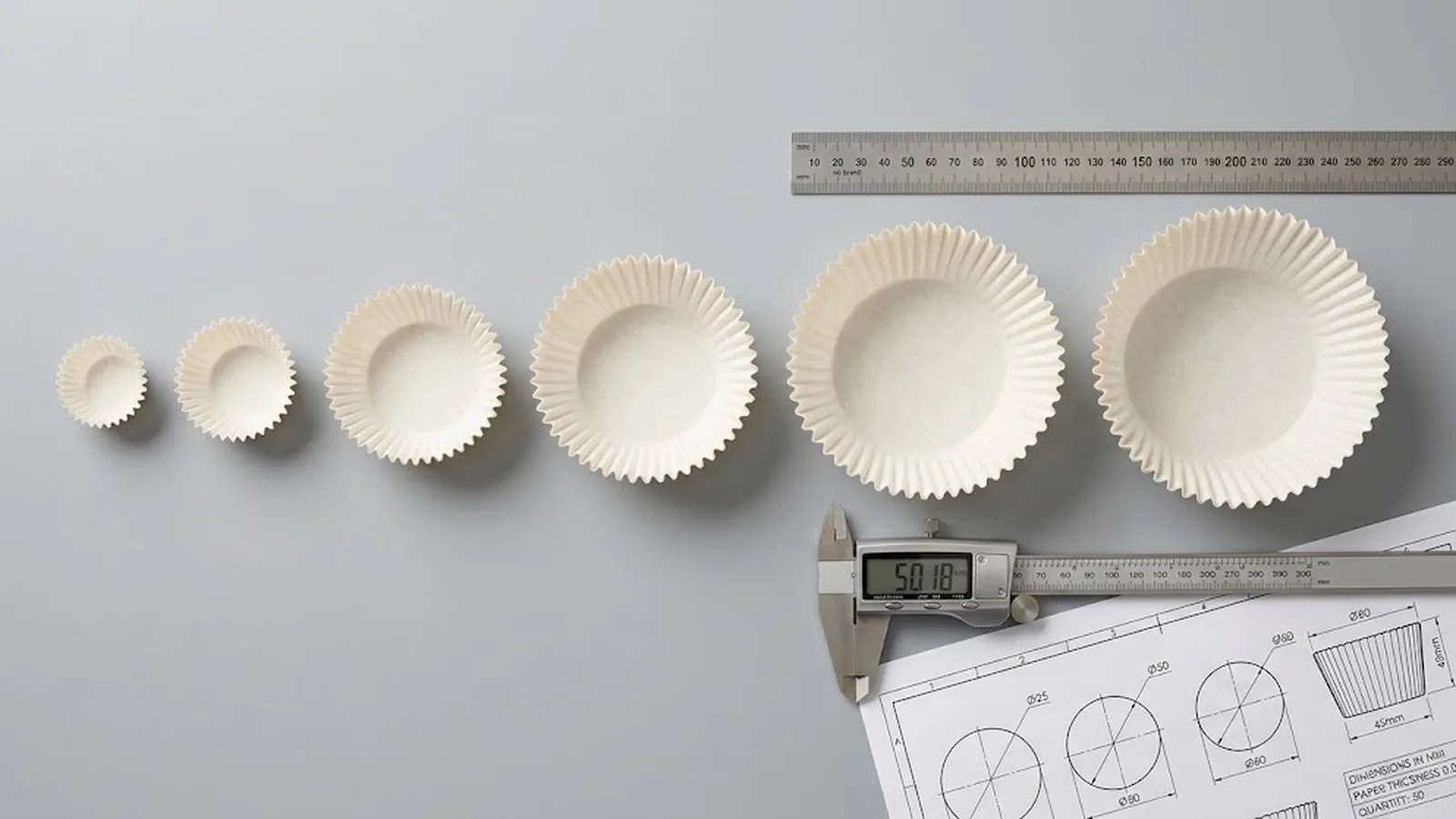
Most commercial cake cups fall into five families. Typical dimensions are ranges, because constructions vary between manufacturers; treat them as orientation, not as a substitute for a supplier specification sheet. Where a bakery lines trays and moulds product in the same run, our food-grade die-cut parchment rounds are quoted with the cup programme for a single documentation package.
| Family | Base diameter | Rim diameter (flared) | Wall height | Typical capacity |
|---|---|---|---|---|
| Mini cup | 25–30 mm | 40–50 mm | 12–18 mm | 15–30 ml |
| Standard cup | 45–50 mm | 65–75 mm | 22–30 mm | 55–70 ml |
| Tall standard | 45–50 mm | 65–75 mm | 32–40 mm | 75–100 ml |
| Jumbo cup | 55–65 mm | 85–100 mm | 35–45 mm | 120–180 ml |
| Tulip / wrap style | 40–50 mm | 80–120 mm | 45–75 mm | 90–150 ml |
Three numbers do most of the work: base diameter decides whether the cup sits flat and centered in the pan cavity; flared rim diameter decides whether the cup rests on the pan surface and holds shape; wall height decides how far the finished product stands above the pan and how easily operators grab it. The factory and certificate library lists the third-party audits and test reports behind these claims.
Pan Compatibility: Making the Cup Fit the Cavity
Matching the rim to the cavity opening
A cup stays in place in a muffin pan when its flared rim is slightly wider than the cavity opening at the top, so the rim rests on the pan surface instead of sliding inside. As a working rule, the flared rim should exceed the cavity top opening by roughly 10 to 25 percent. A rim that barely covers the opening allows the cup to drop or tilt during depositing; a rim far wider than the opening can overlap adjacent cavities and shade the neighboring product from heat.
Matching the base to the cavity bottom
The cup base should meet the pan cavity floor with clearance at the corners. A base close to the cavity bottom diameter spreads batter evenly and prevents tipping; a base much smaller than the floor leaves a pocket where batter escapes and bakes onto the pan, defeating the purpose of the liner.
Wall height above the pan
Wall height controls both presentation and handling. The cup wall should rise clearly above the pan cavity so the finished product can be lifted out without tools, and so the paper, not the pan edge, defines the visible shape of the muffin top. For tall or tulip styles used as standalone presentation cups, confirm that the height clears clamshell lids and flow-wrap film in the retail pack.
From Cup to Tray: Density and Equipment Checks
Pan fit is the unit-level question; tray and line fit are the production-level questions:
- Cavity pitch and tray density. Standard muffin pans use a cavity pitch of roughly 70 to 75 mm center to center for standard cups. If your flared rims approach or exceed the pitch, rims will touch or overlap, reducing heat circulation and producing pale edges. Count usable cavities per tray with the actual cup in place, not on paper.
- Trays per rack and per oven. Multiply verified cavities per tray by trays per rack to get real units per bake. Buyers who size cups on nominal charts often discover that a wider-rim cup costs them a tray row and several percent of oven output per shift.
- Depositor compatibility. Volumetric depositors are set in milliliters or grams. Agree the fill volume, fill ratio (typically 50 to 70 percent of nominal capacity) and any splash-back behavior with the supplier at the same time as the dimensions, so sample approval covers the full filling setup.
- Post-bake change. Paper shrinks slightly after baking. Verify that the cooled, baked cup still presents correctly in the retail pack and releases from trays without deforming.
Tolerances: The Field Buyers Forget to Ask For
A dimension without a tolerance is a dispute waiting to happen. On the specification sheet, require tolerances for base diameter, rim diameter, wall height and capacity, plus lot-to-lot consistency commitments on paper grammage and coating weight. As a reference, established manufacturers commonly hold dimensional tolerances within a few percent; a supplier who cannot state a tolerance at all is signaling weak process control, and that risk eventually reaches your tray.
Running the Fit Check with Your Supplier
Structure the supplier conversation around the numbers:
- Request the full dimension set in writing: base diameter, flared and unflared rim diameter, wall height, nominal capacity and capacity tolerance.
- Ask which standard pan cavity sizes the cup is designed for, and request dimensional drawings, not only product photos.
- Bake a fit check with your recipe and depositor setting: verify rim seating, cavity coverage, tray density and post-bake release.
- Pack baked units into the retail format and confirm height clearance and presentation.
- Record the approved dimension set on the specification sheet that both sides sign, so future lots are compared against the sample, not against memory.
LANGMAI supports wholesale buyers with dimensional drawings, declared tolerances and sample programs matched to the buyer's pans and filling equipment, and can quote against the approved specification for repeat production.
FAQ
What size cake cup fits a standard muffin pan?
A standard pan cavity of roughly 70 mm top opening works with a cup whose base is near 45 to 50 mm and whose flared rim exceeds the cavity opening by about 10 to 25 percent, which places most standard cups in the 65 to 75 mm rim range. Always verify with the actual pan, because cavity dimensions vary between pan manufacturers.
Can I use jumbo cups in a standard muffin pan?
Usually not without cost. A jumbo cup's wide rim often overlaps adjacent cavities, blocking heat and reducing usable cavities per tray. If the recipe needs jumbo volume, a pan with jumbo cavity spacing is normally the better investment.
Why do my cupcake liners slide into the pan cavity?
The rim is too close to the cavity opening size. A rim barely wider than the opening has nothing to rest on and drops in during depositing. Choose a cup with a clearly larger flared rim, or switch to self-supporting construction where pans are not part of the process.
Does LANGMAI provide cake cup dimension charts and tolerance sheets?
Yes. LANGMAI supplies dimensional data and declared tolerances with quotations, supports sample baking for pan and depositor fit checks, and manufactures to buyer specification for wholesale and private-label programs. Contact Sales with your pan cavity dimensions and fill volumes for matched samples.
Conclusion
A cake cup is a dimensional product, and the decisive dimensions are the ones that touch your equipment: base against the cavity floor, rim against the cavity opening, wall against the pan edge and the retail pack. Use the size chart to shortlist families, then convert interest into a signed specification with tolerances and a baked fit check. That discipline costs one sample round and prevents the expensive kind of discovery, which happens after a container arrives. Buyers standardising on one paper supplier can review our custom silicone-coated baking parchment paper next to their cup specifications.
CTA
Contact Sales for LANGMAI cake cup samples, dimensional drawings and wholesale quotations matched to your pans, trays and depositor settings, including private-label sizing for retail programs.