
Introduction
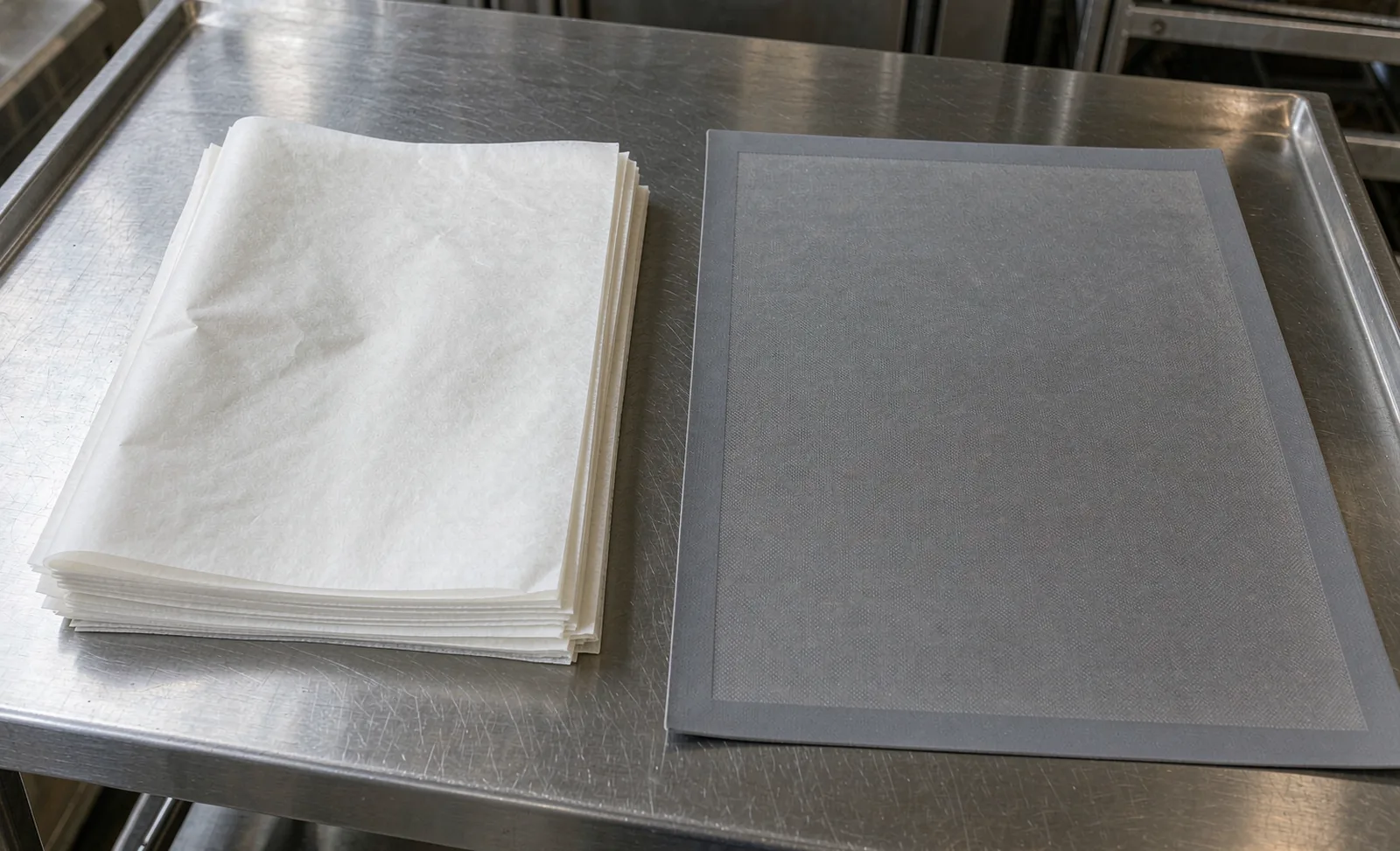
Choosing between baking parchment paper and silicone baking mats is one of the most common sourcing decisions a bakery brand, foodservice group, or private-label distributor has to make. Both products stop dough and batter from sticking to trays, but they behave very differently in cost structure, release performance, food-contact compliance, and the logistics burden they place on your supply chain. Buyers comparing these specifications can review our food-grade die-cut parchment rounds programme, where coating weight, base grammage and release values are documented per construction.
This guide compares the two from a wholesale buyer's perspective. If you are purchasing by the container load, specifying liners for a commissary kitchen network, or building a private-label range, the differences that matter are cost per bake, consistency across production runs, regulatory documentation, and what happens when a specification drifts. Neither product is universally better; the right answer depends on your production style, labor model, and customer expectations. Buyers verifying these specifications can review the certificate library alongside supplier documentation requests.
Cost Structure: Recurring vs Amortized
Parchment paper has a low unit cost and a fully recurring cost. Every bake cycle consumes sheets, so annual spend tracks directly with production volume — predictable and easy to model, but sensitive to pulp price cycles when locking in annual contracts. For production volumes, the same construction logic applies to our custom silicone-coated baking parchment paper line, quoted per roll, sheet or die-cut format.
Silicone mats invert the model. A mat costs far more per unit, but if it survives several hundred baking cycles, its cost per bake can fall below paper. The catch is that cycle life is often shorter in commercial kitchens than in marketing claims: mats cut with knives, cleaned with abrasives, folded in storage, or baked above their rated temperature degrade quickly. Ask suppliers for cycle-life data gathered under commercial conditions, and treat any per-bake saving calculation as provisional until validated on your own line. The factory and certificate library lists the third-party audits and test reports behind these claims.
A practical middle ground many commercial bakeries land on: silicone mats for high-turnover standard tray work, parchment for delicate or sticky products, high-heat applications, and anything sold on the tray.
Release Performance and Baking Results
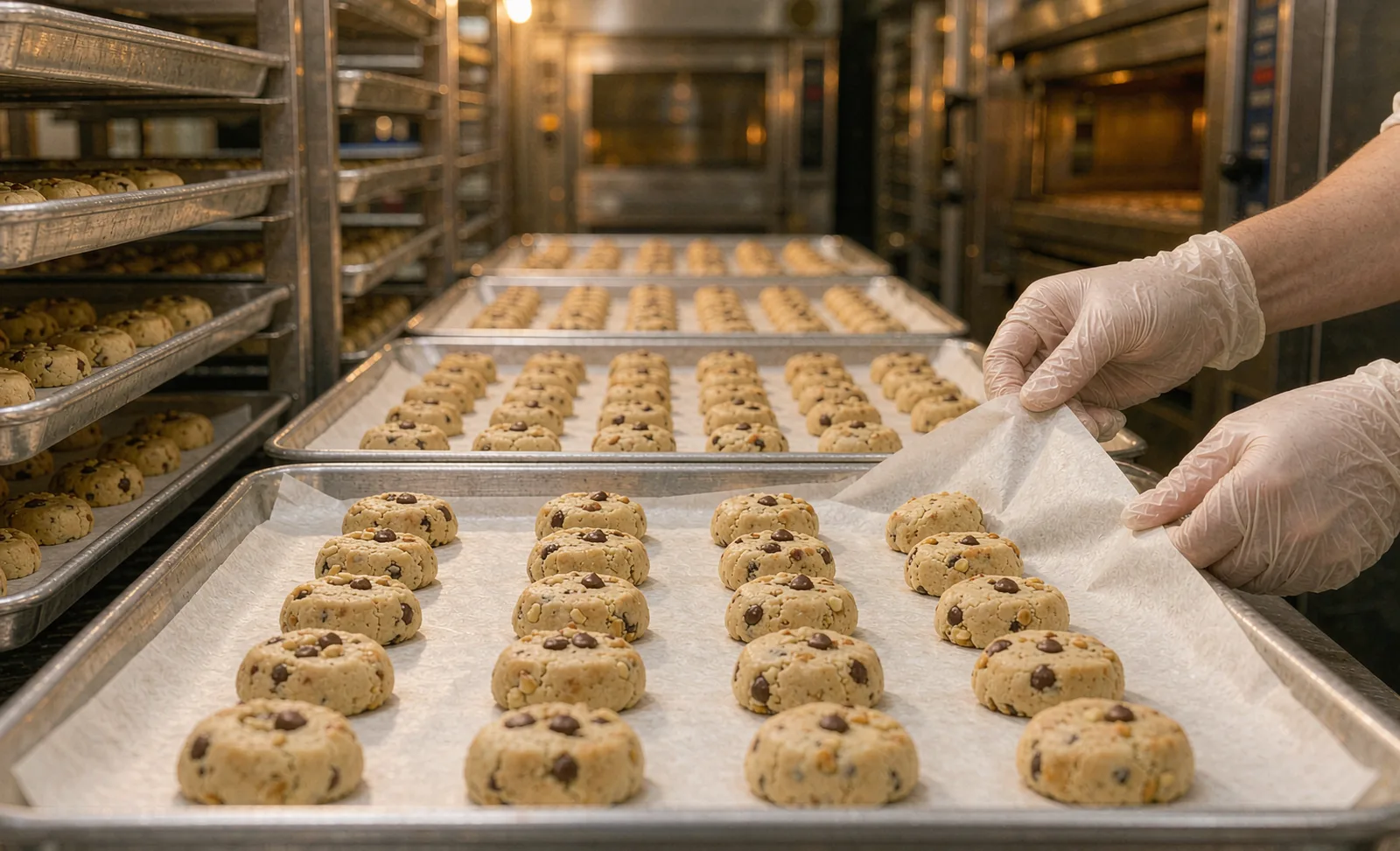
Fresh parchment offers excellent, consistent release across nearly all dough and batter types, including high-fat cookie doughs and meringues. Because every sheet is new, release performance never drifts. Parchment also browns bottoms slightly less aggressively than a bare tray or mat, which matters for delicate pastry.
Silicone mats generally release well too, but performance degrades as the surface wears and residue builds up. Mats also insulate the tray bottom somewhat, slowing browning on the underside of breads and cookies — a real issue where bottom color is a quality attribute. Parchment's disposable nature has another advantage for packaged goods: the product can travel on the same sheet it was baked on. Silicone mats cannot.
Heat Tolerance and Oven Compatibility
Both products handle typical commercial baking temperatures comfortably — quality parchment is generally rated for continuous use around 220–230°C, silicone mats around 230–260°C depending on grade. The important check is the written specification of the exact product, not a category claim; the cheapest product in either category is usually the first to fail at the top of its claimed range.
Parchment wins in two situations. First, convection and deck ovens with hot spots can exceed rated temperature locally: over-heated parchment simply browns, while over-heated silicone can smoke and permanently harden. Second, parchment can be trimmed, pleated, and shaped to fit unusual pans, cake tins, and steam baskets, while silicone mats are rigid rectangles. If your range includes round tins, loaf molds, or irregular trays, pre-cut parchment rounds and custom sheets cover needs mats cannot.
Food Safety, Compliance, and Hygiene
For B2B buyers, documentation is where the two diverge sharply — and where parchment often wins on procurement simplicity.
Baking parchment is a mature, well-understood food-contact paper category. In the United States, buyers look for compliance with FDA food-contact requirements for paper and paperboard under Title 21 of the Code of Federal Regulations; in the European Union, paper and board for food contact are addressed under EU framework regulation and harmonized Council of Europe guidance. Reputable parchment manufacturers supply declarations of compliance and migration test reports as standard wholesale paperwork.
Silicone mats add a second material — cured silicone rubber over a fiberglass mesh — so buyers should request food-contact documentation for the silicone grade itself, plus confirmation that the mesh is fully encapsulated. Worn mats with cut edges or surface cracks expose the mesh, a rejection point in most food safety audits. Reusable products also create hygiene obligations between cycles: documented washing, drying, and storage procedures for BRCGS-style audits. Parchment's single-use nature eliminates that entire workstream.
Logistics, Storage, and Waste Handling
Parchment ships flat and light, stores for years in dry conditions, and creates minimal warehouse burden; its waste-stream cost is modest, and greaseproof grades are increasingly available with responsibly sourced and compostable options. Silicone mats ship bulkier per usable cycle and demand racks, wash stations, and drying space — and in labor-costed markets, the washing and handling step often erodes the material saving. Reuse is a genuine sustainability advantage only if cycle life is actually achieved, so collect real replacement-rate data before claiming waste reduction.
Which Should You Buy?
Choose parchment when you need guaranteed per-bake release, clean compliance paperwork, liners that can be trimmed to unusual pans or shipped with the product, low labor overhead, or private-label products where each customer receives a fresh food-safe surface.
Choose silicone mats when you have a stable, high-volume tray product with consistent pan sizes, in-house wash capacity, trained staff who will not cut or fold mats, and verified cycle-life data showing genuine savings.
Choose both when your range is mixed — the most common outcome for commercial bakeries after a trial period.
FAQ
Are silicone baking mats really cheaper than parchment in commercial use?
Only if cycle life holds up. Commercial kitchens frequently see shorter mat life than advertised due to cutting, folding, abrasion, and over-temperature exposure. Run a monitored trial and count actual cycles before committing volume.
Can parchment and silicone mats be used at the same oven temperature?
Both typically handle continuous use around 220–230°C, with some mats rated higher. Work from the written specification of the exact product, and check locally measured oven temperatures as well as set points.
Is baking parchment compostable or recyclable?
Silicone-coated parchment can often be industrially composted and, where food-soiling rules permit, included in paper recycling. Acceptance varies by municipality and coating type, so confirm with your waste contractor and request documentation from the supplier.
What documents should a wholesale buyer request?
For parchment: food-contact compliance declarations, migration test reports, and grammage/coating specifications. For mats: silicone food-contact compliance, confirmation the fiberglass core is encapsulated, and cycle-life test data. Both should include batch traceability.
Do silicone mats affect how baked goods brown?
Yes, somewhat. Mats insulate the tray bottom and can slow browning underneath cookies and breads. Where bottom color is a quality attribute, most commercial bakers prefer parchment or adjust bake times.
Conclusion
Baking parchment and silicone mats are not direct substitutes; they are different cost models with different operational footprints. Parchment offers per-bake consistency, simple compliance paperwork, shape flexibility, and minimal handling overhead at a cost that recurs with every tray. Silicone mats offer amortized economics and waste reduction at the cost of washing infrastructure, storage discipline, and real-world cycle-life risk. For most wholesale buyers the decision is not exclusive: parchment carries the majority of production and all customer-facing applications, while reusable mats handle steady, uniform tray work. Specify both against written data, trial them on your own line, and let measured cost per bake — not marketing claims — settle the split. Our wholesale parchment paper rolls and sheets programme publishes the test data behind each grade so specifications can be verified before ordering.
Call to Action
LANGMAI supplies silicone-coated baking parchment in rolls and pre-cut sheet formats for wholesale buyers across Europe, North America, and the Middle East, with food-contact documentation, custom sheet sizes, and private-label options. Request samples and a quotation at https://www.lmcakecup.com to run your own cost-per-bake trial.
Sources
- U.S. Food and Drug Administration — Food Contact Substances: https://www.fda.gov/food/food-ingredients-packaging/food-contact-substances
- European Commission — Food Safety, Food Contact Materials: https://food.ec.europa.eu/food-safety/food-contact-materials_en