
Introduction
Par-baked crusts changed the economics of pizza: bake the base once at the plant, freeze or chill it, then finish with toppings and a short final bake at the store. Every stage of that flow — dough pressing, par-bake, blast chill, stacking, frozen distribution, re-bake — puts one consumable in contact with the product: baking paper. Buyers comparing these specifications can review our private-label parchment paper supplier programme, where coating weight, base grammage and release values are documented per construction.
It is a small line item that causes large problems when wrong. Dough sticks to under-specified liners and tears during demolding; cheap sheets curl in blast freezers and jam automated stackers; wrinkled liners print flour-and-oil patterns into the base that customers read as a defect. This guide walks the par-bake flow stage by stage, gives liner specifications for each step, and closes with a cost model and an RFQ checklist. Buyers verifying these specifications can review the certificate library alongside supplier documentation requests.
1. Where Baking Paper Sits in the Par-Bake Flow
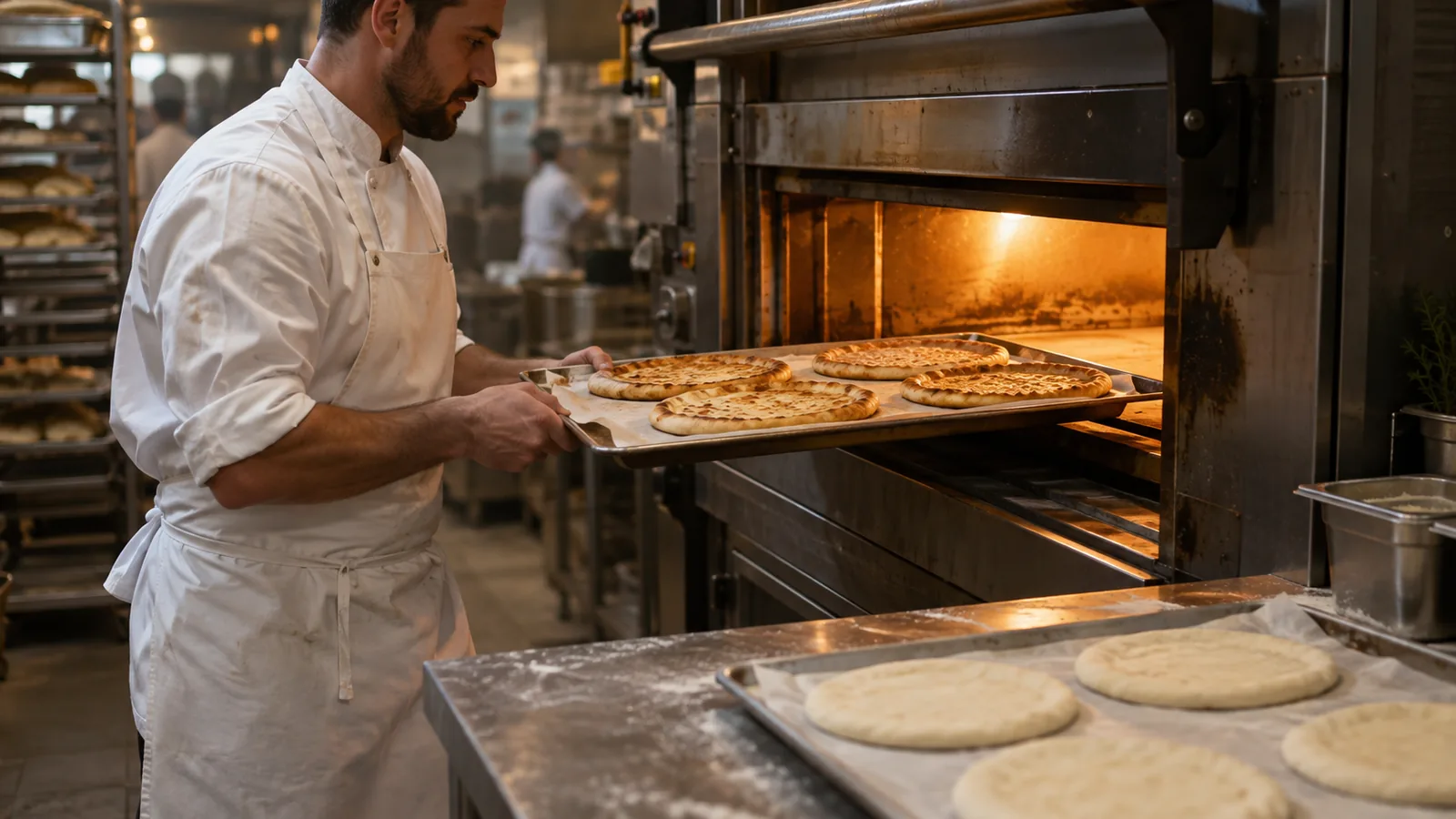
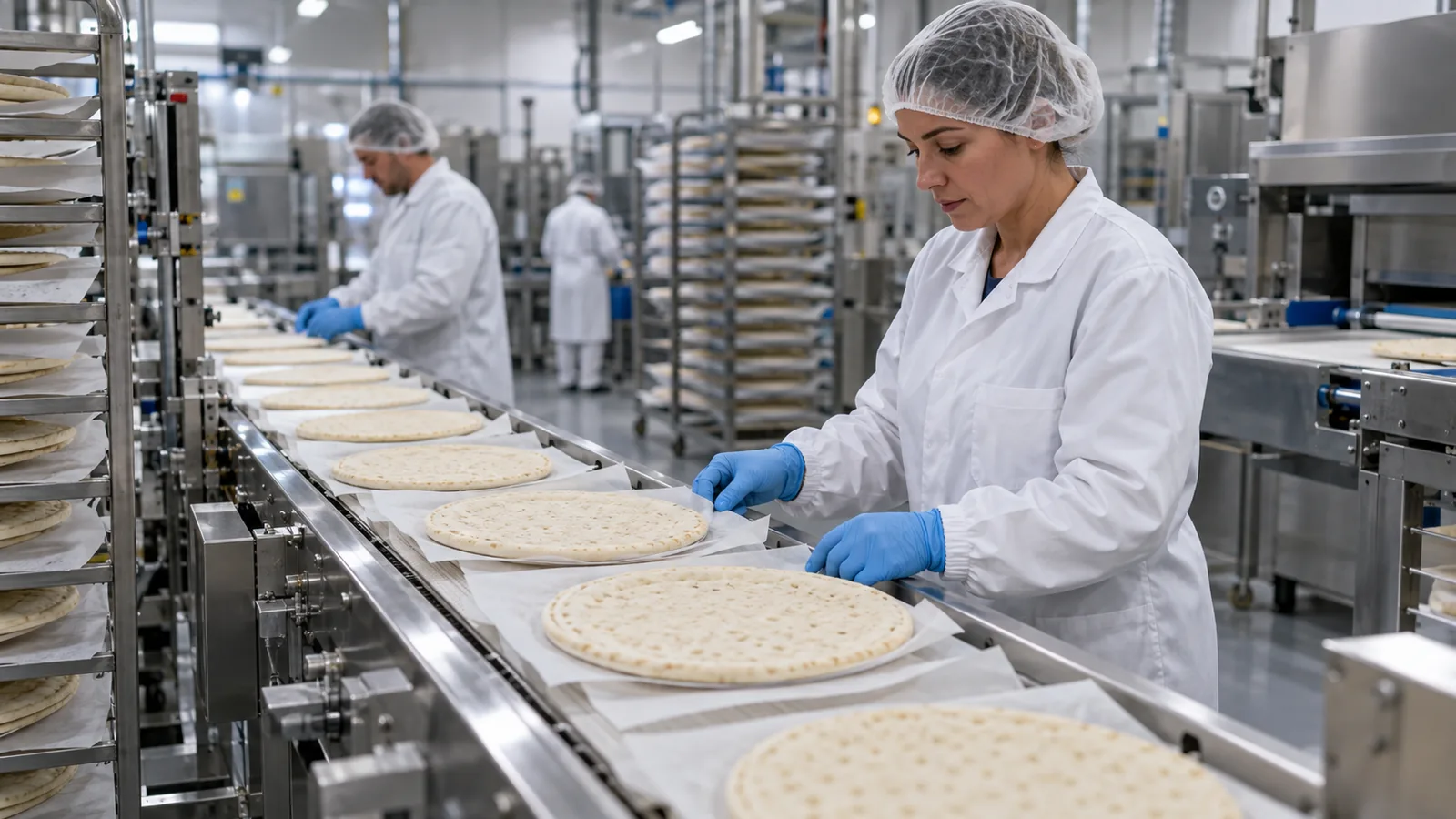
A typical industrial flow looks like this: dough balls are pressed or sheeted, proved, then par-baked — typically 5 to 8 minutes at high temperature — just long enough to set the crumb while keeping the base flexible, then cooled, stacked and frozen or chilled, distributed, and finished with a 2 to 4 minute re-bake with toppings. Baking paper appears at four points: For production volumes, the same construction logic applies to our pre-cut parchment paper sheets and rounds line, quoted per roll, sheet or die-cut format.
- Under the raw dough disc during pressing and proofing, where release and dimensional stability matter most.
- On the par-bake oven conveyor or pan, where heat tolerance and release after bake matter.
- Between stacked crusts during chilling and freezing, preventing crusts from welding into one block.
- On the finishing tray or screen at the store, supporting the frozen crust through the re-bake.
Each stage stresses a different property. Buying one sheet for all four is possible, but only if it is specified against the hardest stage — usually dough release before the bake. The factory and certificate library lists the third-party audits and test reports behind these claims.
2. Dough Release: Why Silicone-Coated Parchment Is the Default
Raw dough is adhesive: hydrated gluten, active surface starch, and often a light oil coating from the press. Uncoated greaseproof will bond to it under pressure and moisture, and demolding tears the disc and leaves residue that contaminates the next disc.
Silicone-coated parchment solves this. The cured silicone layer releases even wet dough, and double-sided coating means the sheet works whichever face meets the dough — a real advantage in interleaving, where orientation on the line is random. Coat weight matters: heavier silicone coatings maintain release over multiple contacts and at high oil levels, which is why plants running oil-brushed discs often step up one coating grade. For plants that press dough directly onto a liner before proofing, specify: double-sided silicone, 40 gsm or heavier base, and a sheet cut to press-tool dimensions with tight tolerance, since oversized sheets fold under the press head and create rejects.
3. Tray and Conveyor Liner Specifications
On the par-bake side, the liner sees peak stress: oven temperatures commonly 200 to 250°C at the deck or tunnel, with contact times of several minutes. Practical specification ranges from plants running this duty:
- Grammage: 40 to 50 gsm for pan liners that must hold flat through bake and survive scraping; 38 gsm is workable for conveyor or screen liners replaced each cycle.
- Construction: silicone-coated both sides on a dense base paper; unbleached grades are common where a rustic crust edge is acceptable.
- Format: die-cut rounds cut 10 to 20 mm smaller than the pan wall so the liner lies flat without riding up, or rolls for conveyor-width lining.
- Heat rating: confirm continuous dry-heat tolerance in writing with your actual dwell time; ratings around 220–230°C are typical, but tunnel ovens with high airflow demand confirmation under those conditions.
A note on re-use: some plants flip or reuse liners for a second cycle. If so, test release after the first cycle — once the silicone surface has loaded with baked starch and oil, release drops and sticking complaints follow.
4. Freezer and Cold-Chain Considerations
After the par-bake, crusts move through a blast chiller or freezer — often -35°C air — before storage at -18°C or below. Paper performance in this window is different from oven performance.
Moisture is the enemy. A warm crust entering the blast freezer releases humidity; if the interleaving sheet absorbs it and freezes against the crust surface, sheets freeze-bond to the product and tear on separation. Dense base papers with low moisture uptake, and silicone surfaces, hold up far better than open, fibrous sheets.
Curl is the second failure mode: sheets fine at ambient can curl after humidity and temperature swings, and curled interleavers feed badly into automatic stackers. Ask for curl specifications after humidity conditioning, not just flatness at delivery.
Finally, the interleaver must not be a migration risk: inks or coatings on a sheet in direct, prolonged frozen contact with an oil-bearing food need food-contact compliance for that condition, including fat migration testing. Printed interleaf sheets are common, but the inks must be tested for that duty.
5. Interleaving and Stacking Specs
Stacked par-baked crusts typically interleave every crust or every second crust, depending on surface oil and stack height. Specification points:
- Sheet size: cut to the crust diameter plus a small overlap, or to the full stack dimension for case liners as well as interleaf.
- Grammage: 35 to 45 gsm balances cost and handling; below 35 gsm, sheets tear on fast stackers and curl more.
- Stiffness: the sheet must feed from a stack or dispenser without doubling — a caliper and moisture-content question. Ask for caliper tolerance, not just gsm.
- Dispensing format: rolls for automated interleaving heads, fan-fold stacks or pre-cut sheets for manual stations.
The same sheet family serves frozen pizza assembly: a liner under the pizza in the box prevents the base freezing to the carton and improves re-heat presentation.
6. Cost per Crust, Not Cost per Sheet
Liner economics only make sense per unit of output. Work a simple model: crusts per shift ÷ sheets per liner use = sheets consumed per shift; multiply by sheet cost, then add the cost of failures — dough torn at the press, rejects from stuck crusts, line stops for stacker jams, and re-bake complaints from stores. Three levers dominate:
- Re-use policy: a liner that cleanly survives a second cycle halves sheet consumption — if release after cycle one is verified.
- Grammage: dropping from 45 to 40 gsm where handling allows typically saves double-digit percentages on sheet cost with no functional loss in interleaving duty.
- Format: die-cut rounds in the right diameter reduce trim waste versus cutting from rolls, and dispenser boxes reduce double-sheet feeding.
Ask suppliers to quote per sheet and per thousand crusts at your sizes, and to state the tolerance on cut dimensions — a ±2 mm tolerance is the difference between liners that sit flat and liners that jam.
7. RFQ Checklist for Pizza and Crust Lines
Send suppliers this list:
- Application map: which sheets serve the press/proof stage, the par-bake, the interleave, and the store re-bake.
- Silicone coating: one or two sides, coat weight, cure confirmation.
- Base paper: grammage, caliper tolerance, unbleached or bleached, wet strength if used under sauced products.
- Format: die-cut diameters with tolerance, roll widths and cores, pack counts and dispenser type.
- Heat rating with dwell time; curl specification after humidity conditioning.
- Food-contact documentation: compliance declarations and fat-migration reports for the contact conditions actually used.
- Trial terms: sample quantities sized for a real line trial, not a bench demo.
Conclusion
Baking paper in pizza and par-baked crust operations is a process component, not a commodity purchase. Specify double-sided silicone-coated parchment for dough release and oven duty, dense low-moisture stock for frozen interleaving, and cut formats that match your pans and stackers — then price it per crust, including the failure costs the cheapest sheet quietly generates. A converter who answers the RFQ checklist with numbers is worth trialing. Our custom printed baking parchment paper programme publishes the test data behind each grade so specifications can be verified before ordering.
What is a par-baked pizza crust?
A crust baked once — typically 5 to 8 minutes — to set the structure, then chilled or frozen and distributed. The store finishes it with toppings and a short re-bake, giving fresh-baked quality without a dough program.
Can greaseproof paper be used under pizza dough?
Not for release duty. Raw dough bonds to uncoated paper under pressure and moisture. Use silicone-coated parchment for anything dough touches before or during baking.
What grammage should pizza pan liners be?
40 to 50 gsm for pan liners that must stay flat and survive scraping; 35 to 40 gsm usually suffices for interleaving between frozen crusts.
Why do my baking paper liners curl in the freezer?
Moisture uptake and humidity cycling. Dense base papers with low moisture uptake, specified with a curl-after-conditioning value, avoid the problem; very light, open sheets curl most.
Can baking paper go from freezer straight into a hot oven?
Yes — silicone-coated parchment tolerates the transition, which is exactly the par-bake-to-re-bake flow, but confirm the heat rating with your dwell time in writing.
CTA
Send LANGMAI your line details — press type, oven profile, freeze conditions, stack format and crust volumes. The team will specify liner grammages, coatings and die-cut formats per stage, supply food-contact documentation and arrange production-trial samples.
Request Liner Specification and Samples