
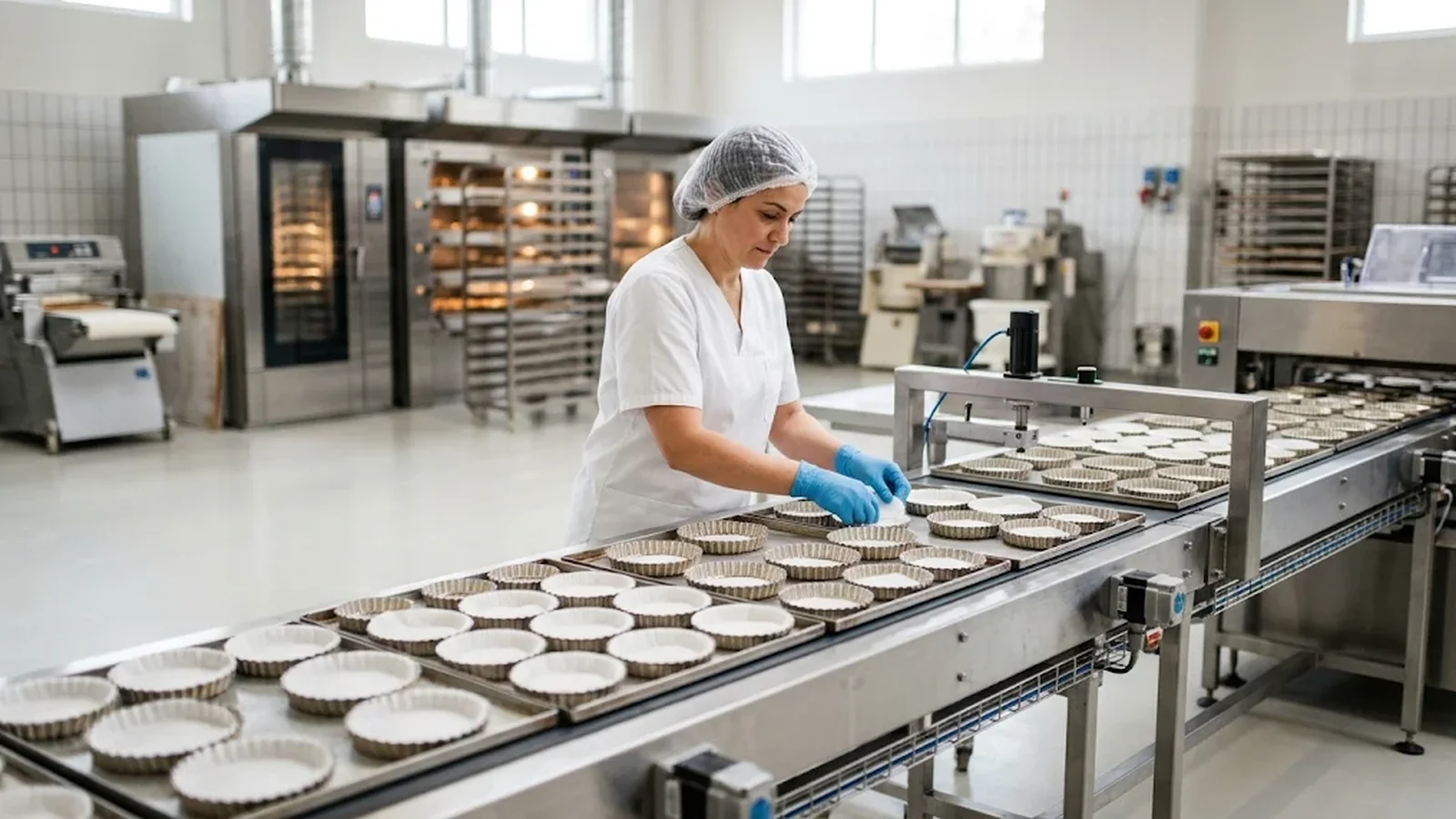
Introduction
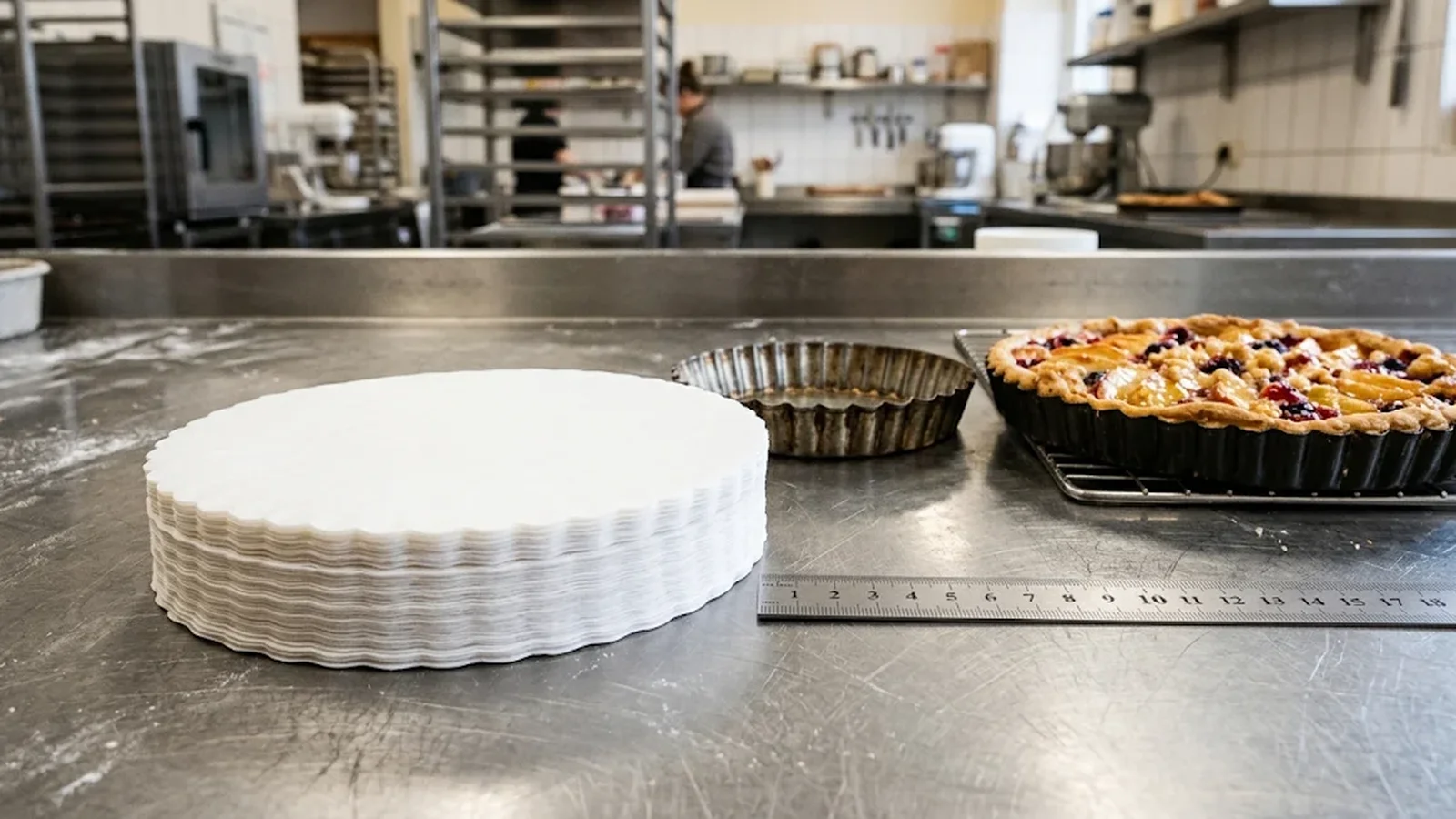
Pies and tarts are among the hardest products to line well. Fillings high in butter and caramelizing sugar bond to under-coated papers, blind-baking with ceramic or metal weights presses weak surfaces into the dough, and the fluted walls of tart tins magnify every coating defect at depanning. Bakeries that buy generic sheets often end up doubling layers to stop tearing, which raises cost per bake and slows line speed without solving transfer at the rim. This guide sets out how procurement teams can specify baking paper for pie and tart production: where the paper is actually stressed, how to choose basis weight, silicone coating and format, what custom die-cut tooling means for MOQ and lead time, how rounds should be packed and palletized, and which bake trials and food-contact documents to request before committing to a volume order.
1. Where Pie and Tart Lines Stress Baking Paper
Release is the headline requirement. Fruit fillings, frangipane and custards give off steam and sugars as they bake through the typical 170–210°C window for pies and tarts, and wherever syrup pools against the paper, a light coating can bond to the tin and tear on removal. Blind-baking is a second stress point: pie weights or dried beans press through the dough into the paper for a long pre-bake, so tensile strength and even coating coverage matter as much as non-stick performance. Fluted tart tins are the third factor. Their sharp ridges concentrate pressure onto narrow contact lines, which is why rounds cut to the correct diameter consistently outperform oversized sheets folded into the tin and creased at the flutes. Commissary and frozen operations add a fourth: trays move through cold stores and condensation before baking, so the paper must hold its release behavior after cold-store handling, not only on the day of the lab test. Naming these stresses in your specification makes supplier quotations comparable. Cost pressure shows up in a different way: when generic sheets are doubled to survive a bake, the real cost per bake doubles too, which is why a heavier single layer with adequate coating is usually the cheaper route at volume.
2. Specifying GSM, Silicone Coating and Format
Start with basis weight. Most pie and tart programs sit between 35 and 45+ gsm: lighter papers run economically through high-speed placing equipment but crease under wet doughs, while heavier grades stay flat under blind-baking weights and survive depanning from deep tins. Silicone coating weight is the variable buyers should state explicitly rather than accept as a generic "non-stick" claim; 0.7–1.5 g/m² is the practical manufacturing range, and caramel- or syrup-driven applications benefit from the upper half of that band. Double-sided coating is the default for rounds that touch dough underneath and filling above; single-sided coating can be acceptable where only one face contacts food. On format, die-cut rounds matched to the tin's inner rim diameter, with roughly 3–5 mm clearance, are the cleanest answer for tart lines; flat sheets suit slab pies and rectangular tins; rolls serve bakeries with mixed or irregular pans. Diameter tolerance on die-cut rounds should be agreed in millimeters in the specification, not assumed. When a program needs its own sizes, food-grade die-cut parchment rounds can be specified by diameter, gsm and coating weight instead of selected from a generic catalogue.
3. MOQ, Die-Cut Tooling and Lead Time
Custom rounds are produced by die-cutting jumbo rolls, which changes the commercial picture compared with stock sheet sizes. A new diameter requires cutting tooling; the tooling cost is usually modest but is quoted separately and amortized across the order. MOQ for a custom diameter typically starts above stock-size levels because the converter must process the full width of the jumbo roll through the die-cutting station, and offcuts on an unusual diameter cannot always be resold. Realistic planning numbers are 1–2 weeks for sample rounds once tooling is agreed, then 2–4 weeks for mass production after sample approval, extending around the Q4 peak when bakery conversions compete for capacity. Buyers should confirm three points in writing before paying for tooling: who owns the die, whether repeat orders skip the tooling charge, and whether the approved sample is retained by both sides as the incoming-inspection reference. Where line trials need several diameters at once, pre-cut parchment paper sheets and rounds can be sampled across a size matrix before any tooling spend is committed.
4. Packaging, Cartons and Pallet Loading
Round formats are unusually sensitive to how they are packed. Flat-stacked rounds ship in a dense cube but can block together in humid climates; loosely shingled rounds feed faster by hand but waste space and arrive with more edge curl. A workable middle ground is a flat stack interleaved or bagged, with an inner poly liner that keeps moisture out and lets rounds separate cleanly on the line. Carton counts should match line-side consumption: a carton holding roughly one shift's usage reduces open-bag time and moisture pickup at the make-up table. On the pallet, round and sheet cartons need edge protection and stretch wrap, and mixed containers that combine parchment with cups or other SKUs should follow a load plan agreed before booking, because die-cut cartons crush more easily than rigid cup packs. For bakeries running rolls at make-up tables and rounds at the ovens, consolidating both formats into one wholesale parchment paper rolls and sheets order simplifies container planning and makes landed cost per thousand rounds easier to track. Storage after arrival matters just as much: cartons kept off the floor and away from oven exhaust stay flatter, and first-in-first-out rotation stops older stock from absorbing ambient moisture before it reaches the line.
5. Bake Trials, Release Testing and Compliance Documents
No data sheet replaces a bake trial on your own filling. Run the approved physical sample through a blind-bake, a caramel-heavy fruit tart and your longest bake at the top of your oven window, then inspect for sugar transfer, tearing and edge lift while the tins are still warm. Grease resistance can be benchmarked with KIT-style ratings, but the pass mark should come from your own product, not a generic number in a catalogue. On compliance, US buyers typically reference the FDA 21 CFR Part 176 framework for paper in food contact, EU programs ask for a Declaration of Compliance supported by migration testing, and many retail customers now add PFAS-free evidence such as total organic fluorine screening or supplier declarations. Request a certificate of analysis per production lot covering basis weight, coating weight and dimensional tolerance, and confirm in writing that the paper is manufactured without fluorochemical grease-proofing treatments. Buyers building these requirements into a pie and tart program can review the PFAS-free baking paper program when fluorochemical-free evidence forms part of the customer specification.
FAQ
What parchment round sizes cover standard pie and tart pans?
Common diameters run from around 3 inches for mini tart shells up to 12–14 inches for deep pie tins, but pan tooling varies between manufacturers. Measure the inner rim diameter of the tin and add 3–5 mm of clearance instead of ordering by nominal pan size. For unusual diameters, also ask whether a supplier holds an existing die close to your size — reusing a near-stock tool can remove tooling cost and weeks from the schedule.
Do pie and tart programs need double-sided silicone coating?
If both faces contact food — for example a round placed under blind-baking weights and then over a filling — double-sided coating avoids mixed release behavior. Single-sided coating remains acceptable for liners where only one face touches the product.
What MOQ should we expect for custom die-cut rounds?
Custom diameters usually carry a higher MOQ than stock sizes because full jumbo-roll widths must be converted and offcuts on unusual diameters are hard to resell. Tooling is normally a one-time quoted cost; confirm tooling ownership and whether repeat orders are tooling-free.
How do we validate release performance before a volume order?
Bake the approved physical sample with your actual fillings across your real temperature window and judge depanning, transfer and tear on the line, not in a catalogue. Retain the approved sample as the incoming-inspection reference for every shipment.
Conclusion
Specifying baking paper for pies and tarts comes down to four decisions: a basis weight and coating weight matched to your fillings, rounds cut to true tin diameter with an agreed tolerance, tooling and MOQ terms settled in writing, and packaging that protects flatness from container to line. Bake trials on real fillings, backed by per-lot COAs and food-contact declarations, turn those decisions into a repeatable purchase rather than a negotiation after every complaint. Buyers verifying these specifications can review the certificate library alongside supplier documentation requests.
CTA
Planning a pie or tart program? Request die-cut parchment rounds matched to your tin diameters, with samples for bake trials before mass production.
Sources
- FDA — Indirect Food Additives: Paper and Paperboard Components (21 CFR Part 176): https://www.ecfr.gov/current/title-21/chapter-I/subchapter-B/part-176
- European Commission — Food Contact Materials: https://food.ec.europa.eu/food-safety/food-contact-materials_en
- TAPPI — Technical Association of the Pulp and Paper Industry: https://www.tappi.org
- American Bakers Association: https://www.americanbakers.org