
Introduction
Format is one of the most underestimated cost drivers in a parchment paper program. Two bakeries buying the same silicone-coated, 40 GSM greaseproof base paper can end up with radically different cost-per-pan simply because one buys 45 cm master rolls while the other buys pop-up interfolded sheets. Roll, pre-cut sheet, and pop-up each shift costs between the paper price, labor, waste, and storage — and the cheapest format on the invoice is not always the cheapest in operation. Buyers comparing these specifications can review our food-grade die-cut parchment rounds programme, where coating weight, base grammage and release values are documented per construction.
This guide breaks down the three main parchment dispensing formats from a wholesale buyer's perspective: how each is converted, where it performs best, what it does to yield and labor, and how to structure an RFQ when you want to compare suppliers on equal terms. Buyers verifying these specifications can review the certificate library alongside supplier documentation requests.
Why Dispensing Format Matters More Than Paper Grade
When buyers evaluate parchment, they usually start with grammage, silicone coating type, and grease resistance (KIT level). Those attributes decide whether the paper performs on the pan. Format decides how efficiently the paper reaches the pan. In high-volume operations, the difference between tearing sheets off a master roll and pulling them from a pop-up dispenser is measured in seconds per sheet. At 2,000 sheets per day, even two seconds saved per sheet equals more than an hour of recovered labor daily. For production volumes, the same construction logic applies to our custom silicone-coated baking parchment paper line, quoted per roll, sheet or die-cut format.
Format also drives waste. Roll-based systems depend on operator skill and cutting equipment: inconsistent pulls, incorrect lengths, and trim scraps can push real consumption 5–10% above theoretical yield. Pre-cut and pop-up formats convert that variability into a fixed, predictable sheet count — which is why many purchasing teams find that the higher unit price of sheets is offset by lower consumption. The factory and certificate library lists the third-party audits and test reports behind these claims.
Format 1: Master Rolls
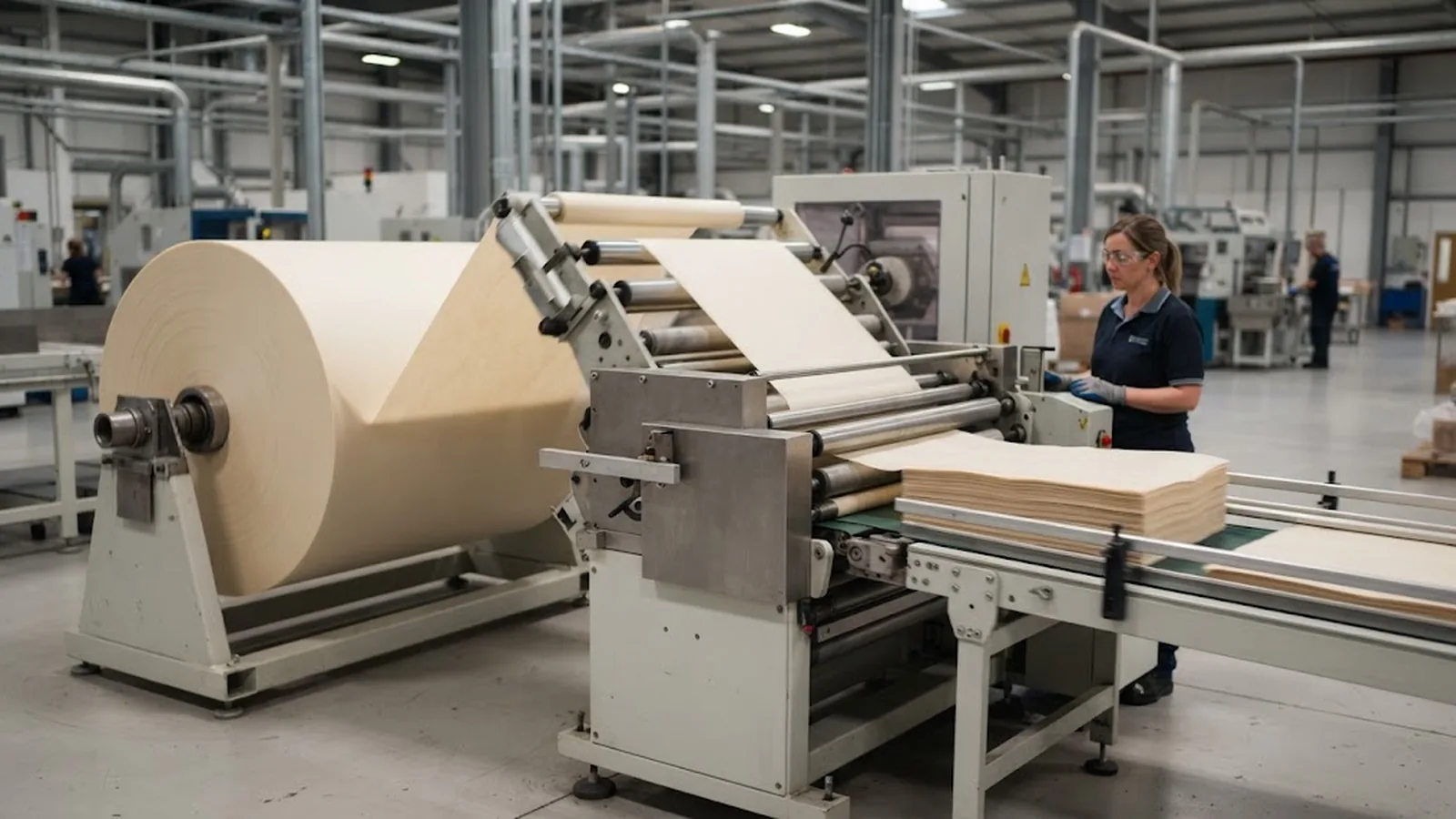
Master rolls are the original format: wide jumbo rolls (typically 40–120 cm wide, wound on cores) that are cut to length by the end user or by an in-house converting station.
Strengths. Rolls offer maximum flexibility. One roll width can serve multiple pan sizes, wrapping tasks, and lining jobs by simply varying the cut length. Rolls carry the lowest cost per square meter because there is no secondary conversion, no interfolding, and minimal packaging. They are also the most space-efficient per usable area, and the format of choice for large industrial bakeries running automatic sheeting or interleaving equipment that takes paper directly from a roll stand.
Weaknesses. Rolls demand a cutter — either a wall-mounted dispenser with a serrated edge, an under-counter unit, or an integrated slitter on the line. Every manual cut introduces variance and time. Roll edges can telescope or crush if stored poorly, and core-to-end yield depends on operators actually using the last meters of the roll. For satellite sites or franchise locations without disciplined training, roll programs often quietly bleed margin.
Format 2: Pre-Cut Sheets
Pre-cut sheets are master rolls converted into fixed-size flat sheets, usually packed in cartons of 500–2,000 sheets depending on size and grammage.
Strengths. Sheets eliminate cutting labor entirely and make portion control exact. A 40 x 60 cm sheet fits a standard full-size sheet pan with predictable overhang; a 30 x 40 cm sheet matches a half pan. Inventory counting is trivial — you count cartons, not meters — which simplifies reordering and cost allocation across production lines or franchise outlets. Sheets are also easier to spec for tenders, because every supplier quote is priced per identical, countable unit.
Weaknesses. Sheets cost more per square meter than the equivalent roll area, typically 10–25% higher after conversion, packaging, and logistics. One sheet size serves one pan size, so multi-format bakeries must hold several SKUs. Sheets are bulkier to ship — flat cartons waste cube in a container compared to tight roll wound coils — which matters for import programs where freight is priced by volume.
Format 3: Pop-Up (Interfolded) Sheets
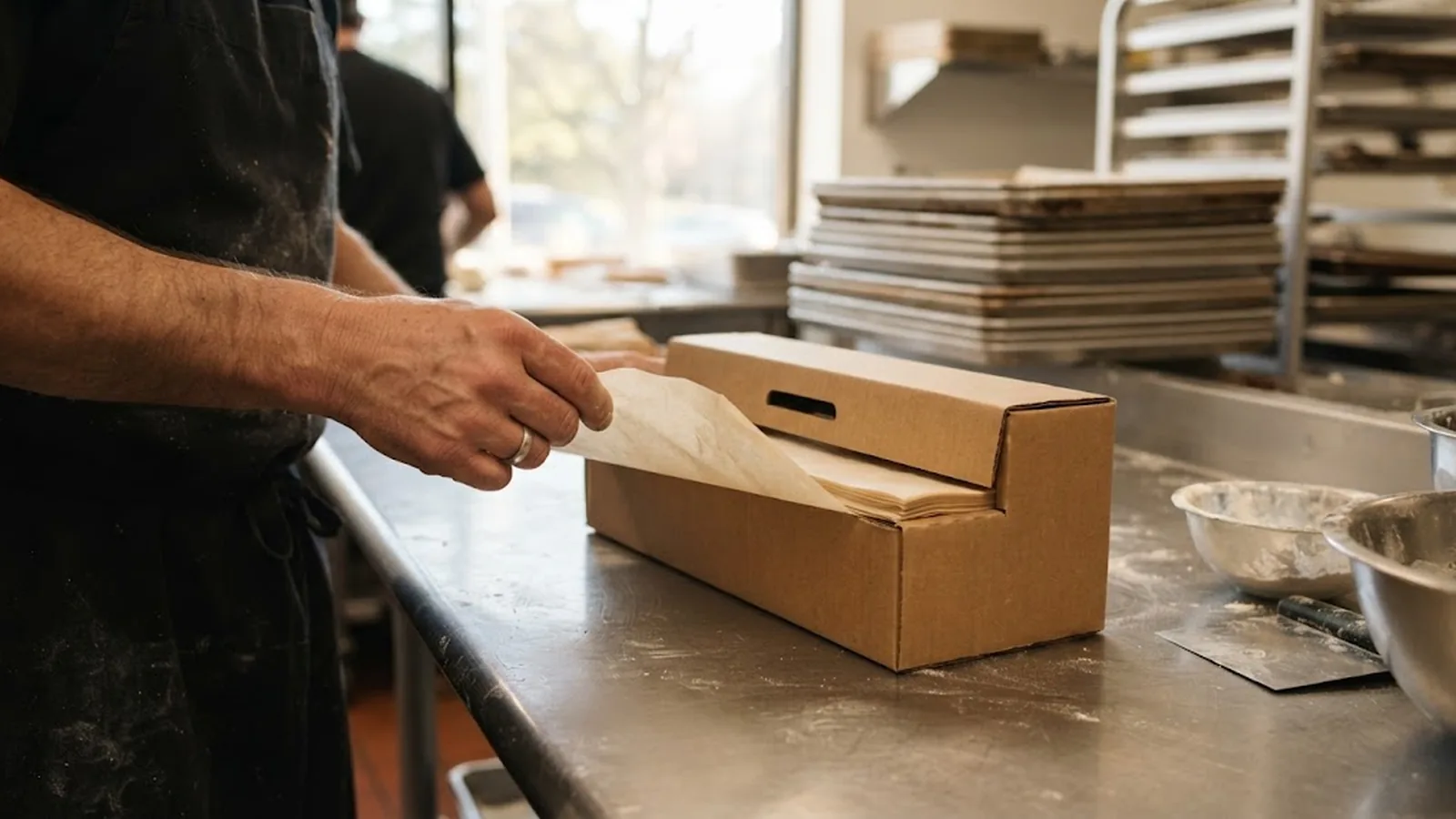
Pop-up sheets are cut and interfolded during conversion so each sheet partially overlaps the next, allowing one-handed dispensing from a compatible box or countertop dispenser — the same interaction model as facial tissue.
Strengths. Pop-up is the fastest format for hand-pulling sheets: the next sheet presents itself automatically. This makes it the default choice for QSR kitchens, hotel banqueting, and fast-casual prep stations where speed and single-sheet dispensing reduce labor and over-pulling. Interfolding also prevents sheets from sticking together in humid kitchens — a real complaint with tightly stacked flat-cut sheets.
Weaknesses. Pop-up carries the highest conversion cost of the three formats: interfold machinery, dispensing boxes or cartons, and higher freight volume per usable sheet. Standard pop-up sizes are also more constrained than flat sheets, though most manufacturers can tool custom dimensions at higher minimum order quantities. Dispenser compatibility should be specified up front — pop-up folded to the wrong fold width will jam in your countertop units.
Cost Model: How to Compare Formats Honestly
Build your comparison on cost-per-pan, not cost-per-kilogram. A simple model:
- Unit price per sheet or per meter from supplier quotes, on equivalent specification (same GSM, silicone system, and KIT level).
- Consumption per pan — measured length of roll used versus actual sheet size, including trim and over-pull. Track this over one production week rather than estimating.
- Labor — seconds per dispensing event multiplied by loaded labor rate and daily volume.
- Waste rate — unusable ends, crushed roll edges, double-pulled sheets.
- Freight and storage — cube per usable square meter, especially if importing.
In most high-volume baking operations, rolls win on raw paper cost while pop-up wins on labor and waste control; pre-cut sheets are usually the balanced middle ground and the easiest to standardize across multiple sites. The right answer depends on whether your bottleneck is paper budget, labor, or consistency.
Specifying Formats in a Wholesale RFQ
Whichever format you choose, lock the specification before requesting prices:
- Rolls: width tolerance (±1–2 mm), core inner diameter, roll length per roll, winding direction, outer wrap for hygiene.
- Sheets: dimensions and tolerance (±2 mm typical), sheet count per carton and tolerance (±2%), squareness, nesting direction.
- Pop-up: fold pattern and folded dimensions, dispenser carton dimensions, pull force consistency, sheet count per box.
- Common to all: base paper grammage, silicone coating type (solvent-based or solventless), KIT grease resistance level, food-contact declarations, and carton labeling requirements.
Ask suppliers to quote all three formats on the same base paper when you are undecided — several manufacturers operate roll, sheeting, and interfold conversion in-house, which keeps quality identical across formats and simplifies your comparison.
FAQ
Are pop-up parchment sheets always more expensive than rolls?
Per usable square meter, yes — typically by 15–30% once conversion and packaging are included. But total program cost can favor pop-up in high-labor environments because dispensing is faster and over-pulling drops sharply. Model cost-per-pan rather than price-per-meter.
Can one roll width serve multiple pan sizes?
Yes. A 60 cm master roll can be cut to full-sheet-pan length, half-sheet width, or smaller liner sizes. That flexibility is the core roll advantage — but it requires reliable cutting equipment and operator discipline at the point of use.
What tolerance should I accept on pre-cut sheet dimensions?
A common wholesale specification is ±2 mm on length and width with a ±2% sheet count tolerance per carton. Tighter tolerances are possible but may raise price; looser tolerances can cause fitting problems on automated pan-line setups.
Do pop-up sheets work in standard dispensers?
Only if the fold width matches your dispenser. Folded dimensions vary between manufacturers, so provide your dispenser model or its internal dimensions to the supplier before ordering samples.
Is paper quality identical across the three formats?
It should be. Reputable converters start from the same jumbo rolls and differ only in downstream conversion. Confirm in your RFQ that all formats are quoted on the same base paper and coating specification — that is the only way to isolate the format variable in your cost model.
Conclusion
Roll, sheet, and pop-up are not competing grades of paper — they are competing operating models. Rolls minimize paper cost for centralized, well-trained production teams. Pre-cut sheets buy predictability and are the easiest format to standardize across sites. Pop-up minimizes labor at the point of use, which is why foodservice operators favor it despite a higher unit price. Run a one-week consumption and labor measurement, build the cost-per-pan model, and let your own operating data decide the format. Our wholesale parchment paper rolls and sheets programme publishes the test data behind each grade so specifications can be verified before ordering.
CTA
LANGMAI supplies silicone-coated baking parchment in master rolls, pre-cut sheets, and pop-up interfolded formats, converted in-house from the same food-contact base paper. Send us your pan sizes, daily sheet volumes, and dispenser requirements, and our team will quote all three formats side by side with samples for trial. Contato LANGMAI for wholesale pricing and format recommendations.
Sources
- U.S. Food and Drug Administration — Food Contato Substances: https://www.fda.gov/food/food-additives-petitions/food-contact-substances
- European Commission — Materials intended to come into contact with food: https://food.ec.europa.eu/food-safety/food-contact-materials_en
- German Federal Institute for Risk Assessment (BfR) — Paper and board recommendations: https://www.bfr.bund.de/en/
- FSC International — Chain of Custody Certification: https://fsc.org/en/chain-of-custody-certification