Introduction
Custom printed baking parchment has moved from a nice-to-have to a commercial weapon for bakery chains, meal-kit brands and foodservice groups. A printed edge, a repeating brand mark between tray lines, or a portion sheet with usage instructions turns a functional liner into packaging that works the entire time it is in use. For procurement teams, however, printed parchment is a different specification exercise from stock liners: the base paper construction, the silicone release system and the printing process all interact, and a mistake at any layer shows up as ink offset on product, blocked release, or compliance documents that do not match the goods. This guide covers what can realistically be printed on baking parchment, how food-contact ink rules apply, how the approval workflow should run, and which cost drivers separate one OEM quote from another. Buyers building a wider liner programme around a printed sheet can review our private-label parchment paper supplier specifications before shortlisting factories.
What Can Be Printed on Baking Parchment — and Where OEM Makes Sense
Buyers should first confirm that "printed parchment" covers several distinct product architectures, not one SKU. Single-side silicone-coated parchment carries the print on the uncoated or lightly sized reverse, which protects the image and keeps the food-contact face untouched; this is the standard architecture for tray liners and wrap sheets. Double-sided silicone parchment is print-restricted, because both faces carry release coating and ink adhesion is unreliable — for this construction, most factories limit printing to edge marking or move the brand message to a band or a die-cut shape. Fully unbleached kraft parchment prints well with darker palettes, while bright brand colors on kraft need a white under-print pass that adds cost.
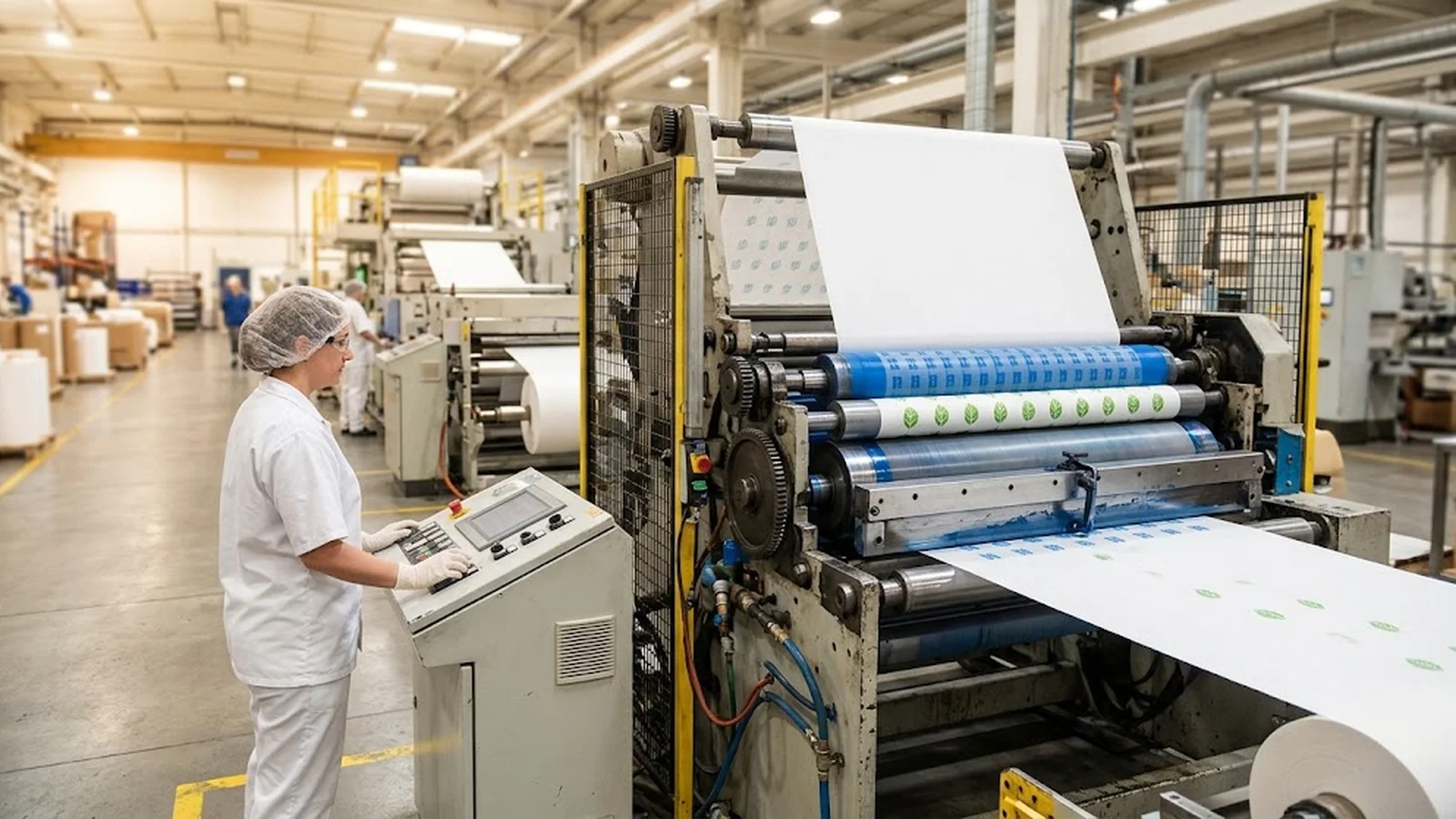
Format drives what is achievable. Flat sheets and die-cut rounds are the easiest to print because they run as pre-cut blanks; roll stock can be flexo-printed in-line with slitting, which suits bakeries that auto-dispense liner from a roll. Buyer programmes that combine printed sheets with plain stock usually consolidate both under one construction so the release performance matches across formats — our wholesale parchment paper rolls and sheets line is quoted per format for exactly that reason.
OEM makes the most sense when the print is structural to the brand experience: printed portion-control sheets for franchise kits, branded liners for dessert delivery boxes, or color-coded sheets that segregate allergen-handling zones in commissary kitchens. Where the requirement is only a small logo on an internal-use liner, a private-label program with standard formats will beat a fully custom OEM route on cost.
Food-Contato Ink Systems and Migration Compliance
Printed parchment is a food-contact material in most markets, which means the ink system is part of the compliance package, not an afterthought. In the United States, printed parchment is specified under FDA 21 CFR 176, and buyers should expect the supplier's declaration of compliance to name the base paper, the silicone system and the ink components together. In the European Union, Framework Regulation (EC) No 1935/2004 applies the same logic: the printed surface must not transfer constituents to food in quantities that endanger health or change composition. Practically, that pushes OEM programs toward water-based flexo inks formulated for food packaging, with low-migration pigment sets and documented declarations from the ink supplier.
Three checks protect buyers here. First, request the migration test report for the actual printed construction — base grammage, coating side, ink colors and coverage area — not a generic unprinted parchment report. Second, confirm how the declaration handles set-off: printed sheets stacked or rewound in the roll can transfer unreacted ink constituents onto the food-contact face, so the supplier should describe drying and curing controls, not just ink chemistry. Third, verify that re-order documentation ties each purchase order to the approved construction, because a silent ink substitution between production runs is the most common failure mode in repeat OEM business. The factory and certificate library lists the third-party audits and test reports behind these claims.
Artwork, Proofing and the Approval Workflow That Prevents Rework
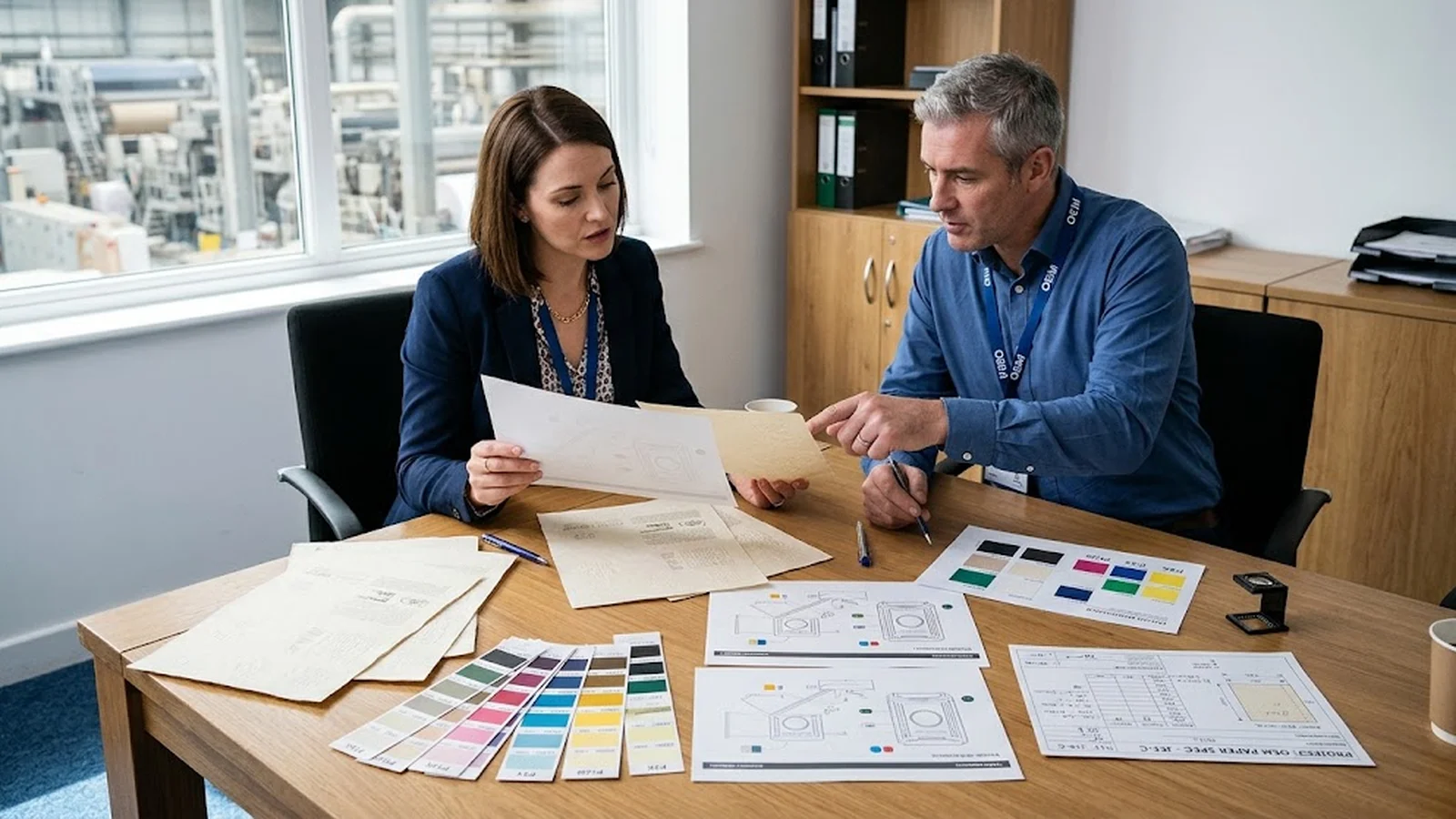
Strong OEM buyers treat artwork as a specification document. Files should arrive as vector art with named spot colors or a locked CMYK profile, minimum line weights and registration tolerances agreed in writing, and the print position defined relative to the sheet edge or the die-cut contour. Flexo printing on parchment tolerates artwork differently than offset carton board, so buyers who copy artwork rules from their carton supplier into the parchment RFQ are the ones who discover registration drift on the production floor.
The proofing sequence that works in practice has three gates. A digital proof confirms layout and copy. A printed draw-down or hand-proof confirms ink color on the actual base paper, which matters because unbleached kraft shifts every color compared with white stock. A pre-production press proof on the final machine, at final web speed, confirms adhesion, set-off behavior and the silicone-ink interaction. Only after that gate should mass production start — approving a printed parchment order from a PDF alone is the most expensive shortcut in OEM buying. Buyers standardizing print across multiple formats should also lock a reference sample set: our silicone-coated parchment sheets and rolls programme documents the retained samples behind each approved grade so repeat orders have an arbitration baseline.
Cost Drivers and How to Compare OEM Printed Parchment Quotes
Printed parchment quotes separate into base paper cost, coating cost and conversion cost, and the conversion layer is where OEM prices diverge most. Number of print colors drives press passes; print coverage area drives ink consumption and drying load; repeat length and artwork position determine whether sheets can be printed in an efficient multi-up layout or waste stock at the margins. MOQ is set by minimum ink and plate quantities more than by paper volume — a one-color edge mark may be viable at a modest order size, while a four-color print on a short run usually forces the unit price up or the MOQ out.
When comparing quotes, force every supplier onto the same statement of work: identical base construction, identical ink declaration, identical proofing gates and identical tolerance table. A quote that omits the migration test scope or bundles "food-safe ink" without naming the system is not cheaper — it is undocumented. Lead time follows the same logic: plate-making and ink sourcing sit in front of production, so OEM lead times include an artwork and proofing phase that plain liners never need.
FAQ
What MOQ should I expect for custom printed baking parchment?
It depends on color count and format. Single-color edge printing on standard sheet sizes can be economical at modest order volumes, while multi-color process printing carries plate, ink and setup minimums that raise MOQ and unit price. Ask each factory to quote MOQ per construction rather than quoting one number for "printed parchment".
Can you print on silicone-coated parchment without losing release?
Printing is normally placed on the non-food-contact, less heavily coated side, and a pre-production press proof confirms the ink does not interfere with release or cause set-off onto the food face. Double-sided silicone constructions are the wrong substrate for heavy printing; buyers move the brand message to a band or to the die-cut shape.
Which ink compliance documents should an OEM supplier provide?
At minimum: a declaration of compliance naming the ink system, migration test reports for the printed construction as actually produced, and FDA 21 CFR 176 or EU 1935/2004 references appropriate to the destination market. Reports should identify the exact grammage, coating side and print coverage they cover.
How long does the artwork-to-production cycle take?
Plan for proofing gates before production: digital proof, color draw-down on the real base paper, and a press proof at final running conditions. Plate-making and ink sourcing run in front of standard production time, so OEM lead times are longer than plain liner orders and should be confirmed in writing per format.
Conclusion
Custom printed baking parchment rewards buyers who separate the three layers of the product — base paper, silicone release system and ink system — and hold each one to a documented specification. The factories worth shortlisting are the ones that volunteer the construction details before you ask: which side carries the print, what the ink formulation declaration covers, which migration reports match the actual goods, and what the retained reference samples look like. Run the three-gate proofing workflow, lock the tolerance table into the purchase order, and the print becomes an asset instead of a defect source. Treat the printed liner like any food-contact packaging investment, and OEM parchment will carry your brand through every bake without adding risk to the line.
CTA
Planning a custom printed baking parchment program for a bakery chain, meal-kit brand or foodservice group? Send LANGMAI your artwork, target construction and destination market. Our engineering team will return a specification proposal, free test samples and the matching compliance document set so you can approve printed quality before committing to volume.
Sources
- US FDA, Title 21 CFR Part 176 — Indirect Food Additives: Paper and Paperboard Components: https://www.ecfr.gov/current/title-21/chapter-II/subchapter-B/part-176
- EU Framework Regulation (EC) No 1935/2004 on materials and articles intended to come into contact with food: https://eur-lex.europa.eu/legal-content/EN/TXT/?uri=CELEX%3A32004R1935
- EuPIA — European Printing Ink Association, food packaging ink compliance guidance: https://www.eupia.org/
- Swiss Ordinance SR 817.023.21 on Articles and Materials Intended to Come into Contato with Foodstuffs: https://www.fedlex.admin.ch/eli/cc/2016/154/en