Introduction
A baking paper product lives or dies on the shelf by decisions that have nothing to do with silicone coating weights. Retail buyers evaluating a private-label parchment programme judge the SKU as a complete unit: the carton the consumer picks up, how sheets dispense, the claims on the face panel, and how the package photographs against competitors. Packaging design is not a decorative afterthought — it is a structural choice that drives tooling costs, minimum order quantities, compliance labelling and launch dates. This guide walks through the formats, print and materials, sustainability positioning and artwork workflow that turn a bulk parchment construction into a retail-ready SKU. Buyers building a range can review our private-label parchment paper supplier programme, where retail formats are quoted alongside the underlying paper specification.
Why Packaging Design Decides the Retail Fate of a Baking Paper SKU
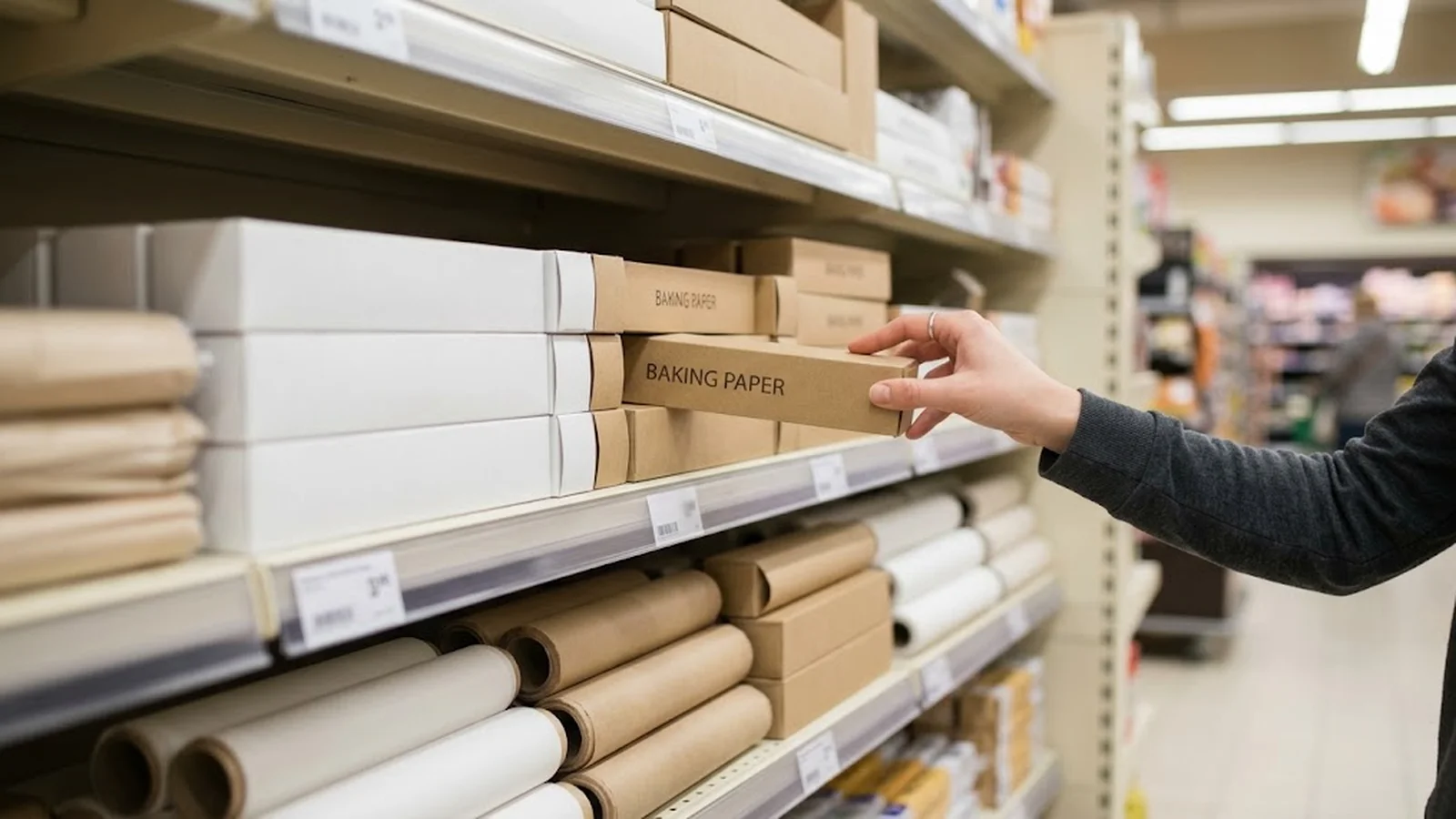
Baking paper competes in a category where the product itself is invisible: every brand on shelf sells what looks like white or brown paper, so the packaging carries the entire differentiation burden. A shopper cannot feel the release performance or compare coating weights — they read panels, compare sheet counts, and respond to colour blocking and photography. Category leaders win through clarity: a pictured end-use, an unambiguous sheet or metre count, and a single dominant claim such as non-stick or plastic-free, rather than five competing messages crowded onto one face.
The same logic applies one level up the chain. Category managers allocate shelf space by sales per facing, and a misleading pack — an overstated sheet count, a photo implying a roll when the box holds folded sheets — generates returns and delisting risk. Packaging design is therefore part of product quality: the dieline, the dispenser functionality and the accuracy of every printed claim are as contractual as the paper specification itself.
Choosing the Retail Format: Rolls, Folded Sheets, Pop-Up Boxes and Display Units
Format selection is the most consequential design decision: it locks in packaging materials, filling equipment and cost structure. Parchment rolls remain the highest-velocity format in most markets, packaged either in a carton with a serrated cutting edge or in a printed wrap with an inner core; they maximise perceived value per unit but demand robust edge design, since a ragged-tearing cutting edge drives negative reviews. Folded sheet packs — typically 20 to 100 sheets in a flat carton or printed sleeve — suit occasional bakers and smaller shelf footprints, and pack efficiently for export because their geometry wastes no carton volume.
Pop-up and interfolded dispensers occupy the premium end: sheets draw one at a time like tissue, but they require the underlying sheets to be die-cut and interfolded to tight tolerance before packing. Display-ready shippers that open into a shelf tray reduce retailer labour and win incremental facings in independent grocers. Each format implies a different board call, carton style and packing line configuration, so the format decision should be made before artwork begins, not after. For production volumes across these formats, the same construction logic applies to our custom printed baking parchment paper line, quoted per roll, sheet or die-cut format.
Print Technology, Materials and Food-Contato Rules for Retail Packaging
Once the format is fixed, print and material choices determine both shelf impact and compliance exposure. Flexographic printing dominates private-label baking paper packaging: it is economical at wholesale volumes and handles solid brand colours well, while offset and digital routes suit short runs or multi-SKU ranges sharing a design system. The board decision — kraft, folding boxboard or recycled carton board — should balance shelf presence against export durability, since ocean-freight humidity warps lightweight boards.
Food-contact labelling is where retail packaging design meets regulation. The parchment inside the pack is a food-contact material, so the outer carton must not make claims the underlying construction cannot document: the food-contact symbol or wording, the temperature suitability of the grade, and any environmental claim such as compostable or plastic-free all require the same documentary backing as the paper itself. Regulators in the EU, UK and US treat unsubstantiated claims as labelling violations, and retailers increasingly audit artwork before listing, so every consumer-facing claim must trace to a test report or declaration in the supplier's file. The factory and certificate library lists the third-party audits and test reports behind these claims. One rule keeps most programmes safe: print the pack from the specification, never the specification from the pack.
Sustainability, Structural Design and Cost Control
Sustainability is now a baseline expectation in the baking category, and packaging is where buyers can act fastest. Plastic-free positioning — replacing a poly-wrapped roll with a paper-wrapped one, or eliminating the inner poly bag in sheet packs — is usually achievable with modest engineering and gives the front panel its strongest claim. Recycled board content, soy-based inks and FSC-certified carton stock support the story, provided chain-of-custody documentation is maintained for the packaging itself, not only the parchment.
Structural design and cost control are two sides of the same dieline. Carton dimensions should be derived from the packed product's real geometry — not adjusted afterwards — because an oversized carton multiplies across thousands of units into real freight and board cost. Buyers should request a packaging-specific cost breakdown — board grade, print colours, varnish or lamination, packing labour per unit — because it exposes the levers early: a two-colour flexo design on uncoated kraft often delivers most of the shelf impact of a four-colour laminated carton at a fraction of the unit cost, and dropping a varnish layer can fund the plastic-free inner that marketing wants. The most successful programmes fix the design language once — palette, typography, claim hierarchy — and roll it across formats, spreading artwork costs over the whole range.
From Artwork to Shelf: Proofs, MOQs and Launch Timelines
The commercial workflow matters as much as the creative one. A disciplined sequence runs: format and dieline confirmed first, then print-ready artwork built to the factory's template, then a physical pre-production proof — an actual printed, glued, filled carton, not a screen render — approved before mass production. Every step skipped resurfaces as a correction later, and print corrections consume a full carton production run.
Minimum order quantities for printed packaging are usually driven by the carton run, not the parchment: a bespoke printed box typically carries a larger MOQ than the unprinted paper inside it, so buyers launching a first SKU should ask for stock-carton options with a printed label or sleeve to validate retail demand before committing to bespoke tooling. Allow realistic time for dieline iterations, proof shipping, carton production and packing when planning seasonal listings, and confirm artwork version control so a reformulated design cannot print against a superseded specification. Buyers coordinating retail roll-outs can review our pre-cut parchment paper sheets and rounds next to their carton specifications, so pack geometry and product format are engineered together.
FAQ
What packaging formats work best for a first private-label baking paper SKU?
A folded sheet pack is the lowest-risk start: small shelf footprint, simple packing and modest MOQ. Roll formats offer higher perceived value but demand proven cutting-edge quality, and pop-up dispensers require die-cut interfolded sheets to tight tolerance.
Do packaging claims on baking paper need test documentation?
Yes. Any consumer-facing claim — food-contact suitability, temperature range, compostability, plastic-free — must be backed by the supplier's declarations and test reports, because regulators and retailers treat unsubstantiated packaging claims as labelling violations, and liability normally sits with the brand owner or importer.
What MOQ should buyers expect for printed baking paper packaging?
Printed cartons usually set the MOQ rather than the parchment itself. Bespoke printed boxes require larger minimum runs than stock cartons with labels or sleeves, which is why first-time launches often validate demand on stock packaging before custom tooling.
Why is a physical proof important before mass production?
A printed, glued, filled carton reveals what a screen render cannot: board stiffness, dispenser function, colour accuracy on the actual substrate and pack fit. Approving a physical pre-production proof before the carton run is the cheapest insurance in retail packaging programmes.
Conclusion
Retail packaging design is where a wholesale baking paper programme becomes a consumer product: the format decision fixes the cost structure, the print and materials choices fix the shelf impact, and the claim discipline fixes the compliance exposure. Buyers who sequence the work correctly — format first, dieline second, artwork third, physical proof always — launch SKUs that survive the shelf, the logistics chain and the retailer audit. The winning pattern is a clear single claim, an accurate count, a pack that dispenses as promised, and documentation behind every printed word. Buyers assembling retail-ready ranges can review our food-grade die-cut parchment rounds and sheet formats alongside their carton programmes, and those verifying supplier claims can review the certificate library alongside supplier documentation requests.
CTA
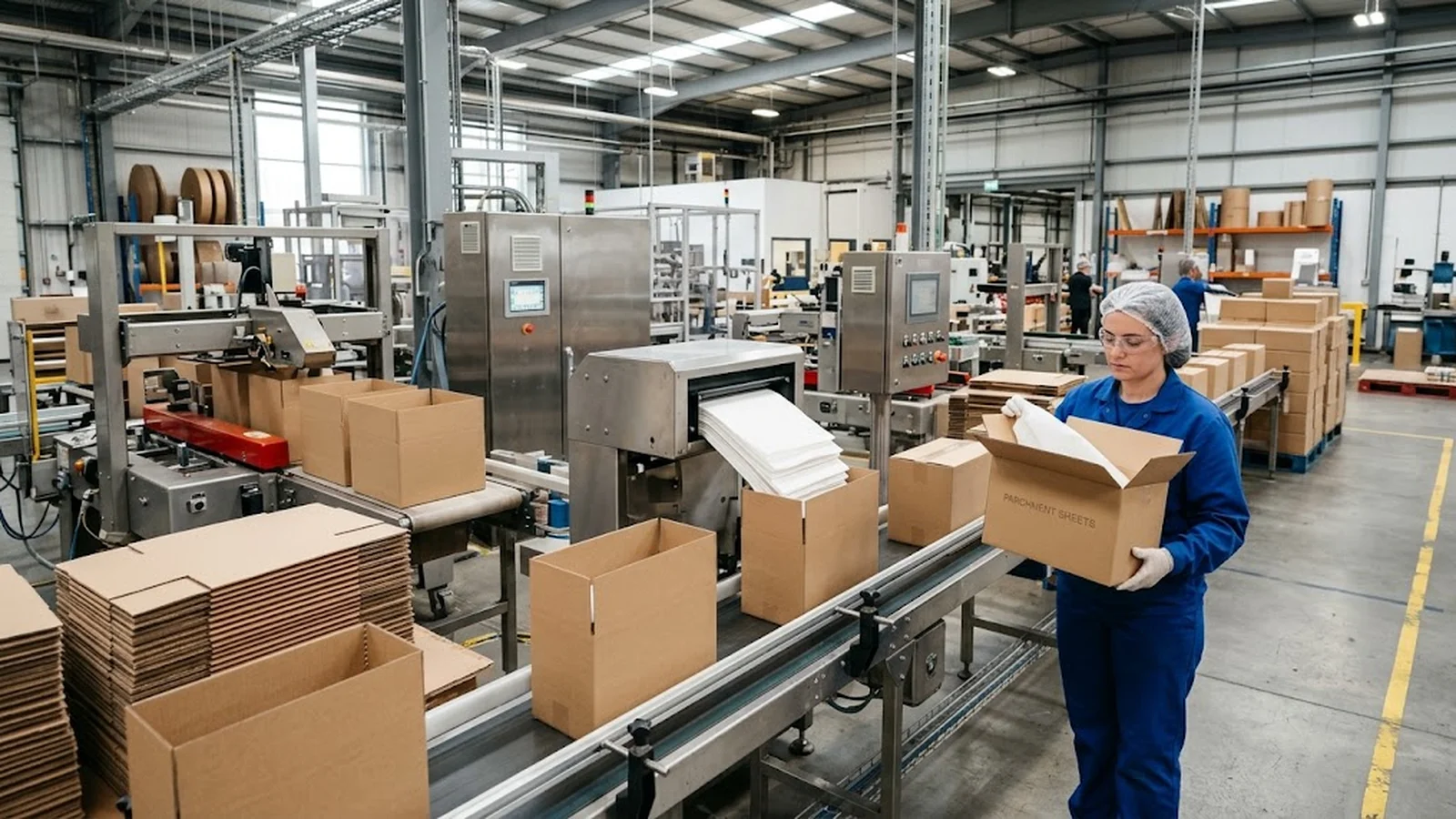
Planning a private-label baking paper launch? LANGMAI manufactures silicone-coated parchment rolls, sheets and die-cut formats and supplies retail-ready packaging programmes — dielines, printed cartons and sleeves, pre-production proofs and full compliance documentation for every consumer-facing claim. Request a quotation with artwork templates and sample packs before mass production.
Sources
- European Commission — Food contact materials: https://food.ec.europa.eu/food-safety/food-contact-materials_en
- US FDA — 21 CFR Part 176, Paper and paperboard components: https://www.ecfr.gov/current/title-21/chapter-I/subchapter-B/part-176
- GS1 — Barcode and retail labelling standards: https://www.gs1.org/standards
- FSC — Chain of custody certification: https://fsc.org/en/for-businesses
- BRCGS — Packaging Materials Global Standard: https://www.brcgs.com/
- U.S. FTC — Guides for the Use of Environmental Marketing Claims (Green Guides): https://www.ftc.gov/business-guidance/resources/guides-use-environmental-marketing-claims-green-guides