Introduction
Coffee and tea chains have quietly become some of the largest consumers of food-grade paper in foodservice. A single mid-sized cafe location moves through parchment squares under pastries, greaseproof sheets wrapping croissants and sandwiches, basket liners for trays, and baking paper for in-store ovens — every day, at volumes that multiply quickly across dozens or hundreds of stores. Yet in most chains, these papers are bought reactively: whichever format the local distributor carries, whichever brand happens to be on promotion. The result is familiar to any operations manager — inconsistent presentation between stores, papers that fail exactly at the worst moment, and no leverage on price. Buyers comparing these specifications can review our custom printed baking parchment paper programme, where coating weight, base grammage and release values are documented per construction.
This guide maps the full set of paper applications in a coffee or tea environment, explains which specifications matter for each, and shows chain buyers how to consolidate the spend into a wholesale program that protects brand consistency and unit economics. It is written for procurement managers, franchise operations teams, and distributors serving cafe and tea retailers. Buyers verifying these specifications can review the certificate library alongside supplier documentation requests.
Mapping the Aplicações: Where Paper Touches the Product
Pastry Case and Display Liners
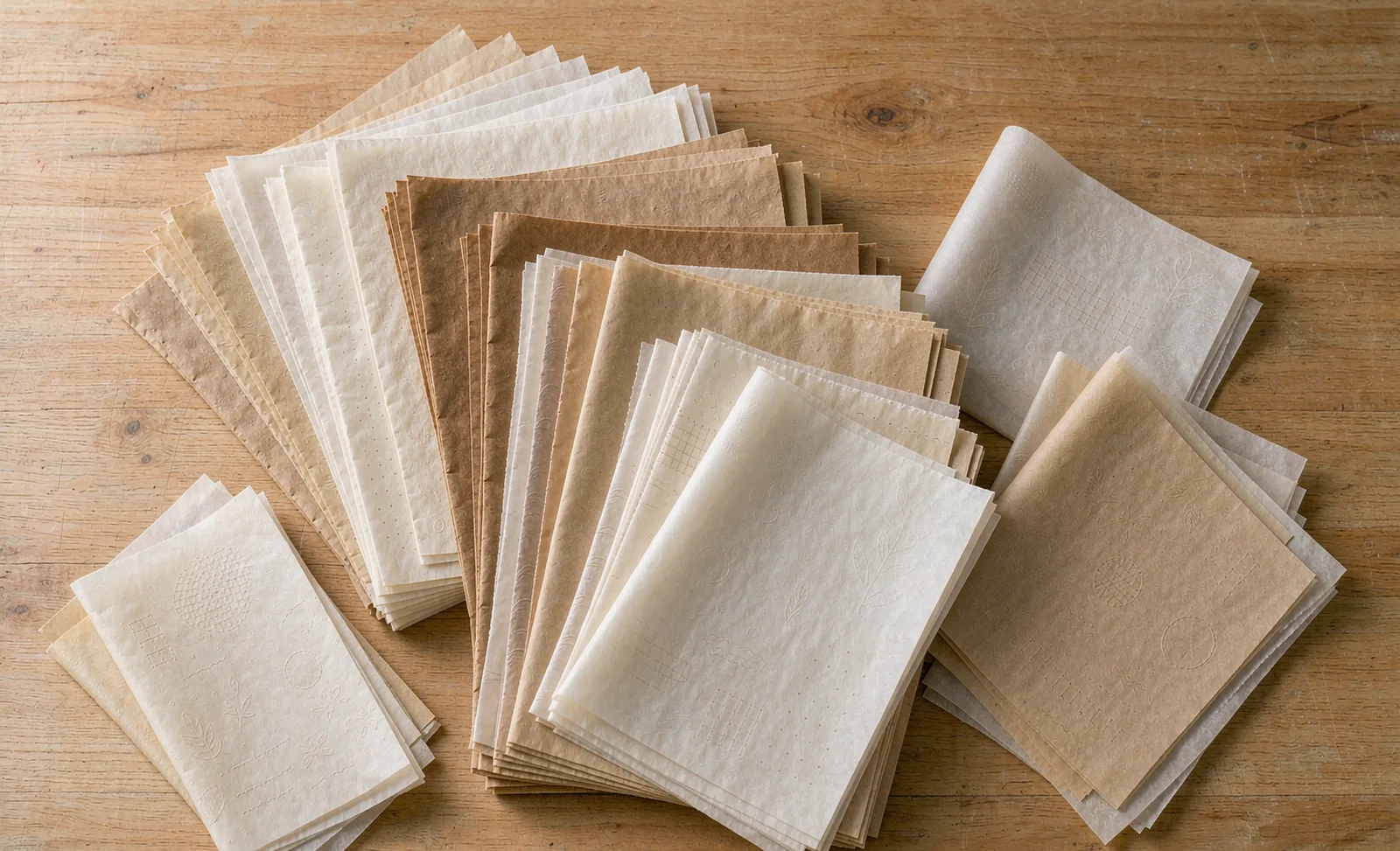
Under every croissant, danish, or slice of cake in a display case sits a liner whose job is invisible until it fails. The requirements are modest but specific: food-contact compliance for direct greasy contact, enough grease resistance to hold butter and oils overnight, dimensions matched to trays, and a clean, bright appearance under case lighting. Glassine and greaseproof papers dominate here. Chains should standardize liner dimensions per display tray type across the estate, because non-standard sizes force stores to double up sheets — doubling consumption and looking untidy. For production volumes, the same construction logic applies to our silicone-coated parchment sheets and rolls line, quoted per roll, sheet or die-cut format.
Wrap and Sandwich Papers
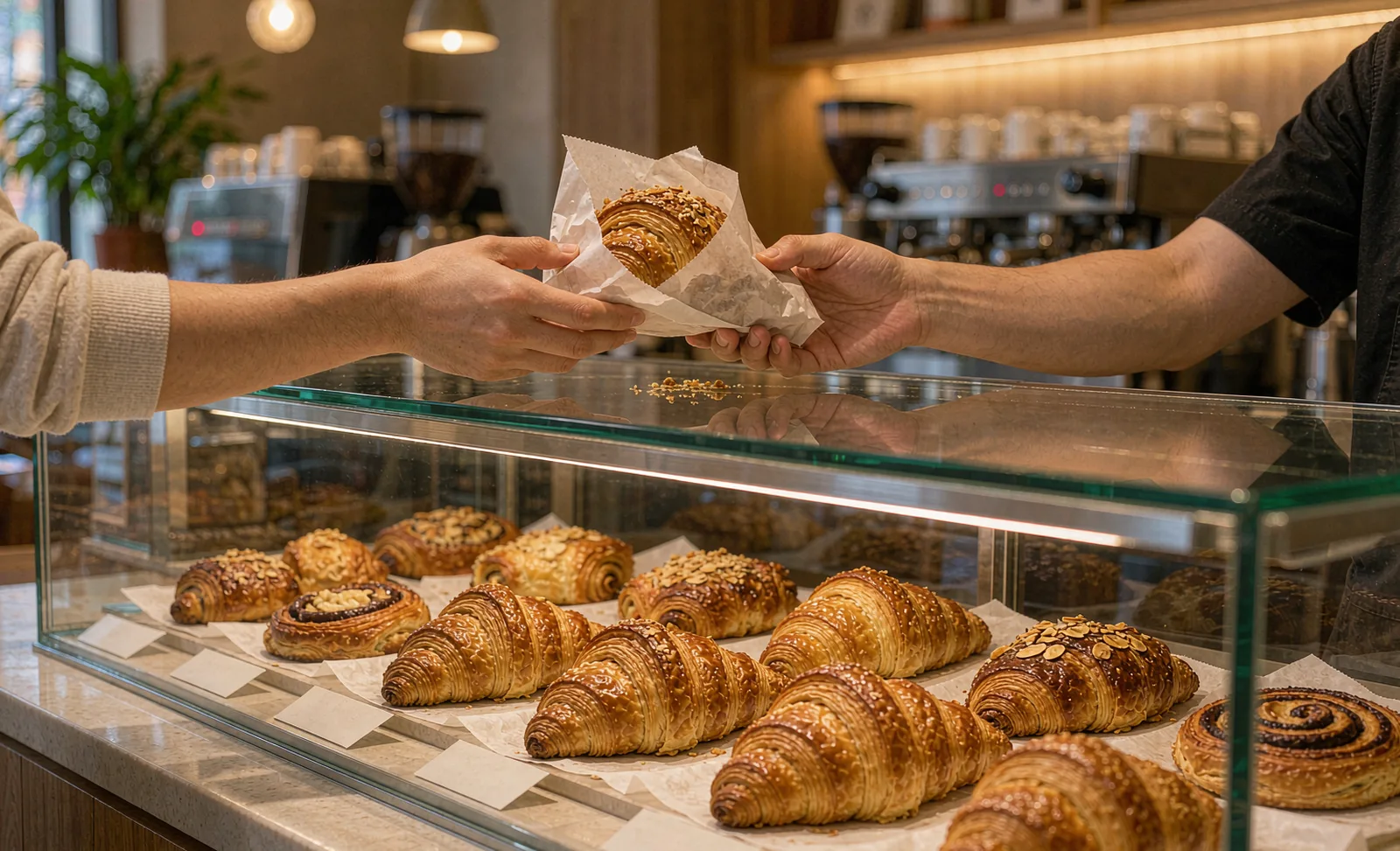
Anything handed across the counter — croissants, bagels, toasties, cookies — typically gets wrapped in greaseproof or wax-style paper. Grease resistance grade matters more here than anywhere else: a croissant that spots through the sheet in ninety seconds reads as poor quality in the customer's hands. KIT rating is the practical shorthand buyers should specify (a KIT rating around 8–12 covers most pastry and sandwich applications; higher grades cost more), alongside a decision on bleed-through time expectations for the fattiest items on the menu. The factory and certificate library lists the third-party audits and test reports behind these claims.
Basket, Tray, and Platter Liners
Open-foodservice formats — tray-line service, shared platters for meetings, basket service in tea rooms — use basket liners, usually in colors or with prints. Here presentation weight rises: the liner is part of the visual product. Chains with seasonal menus should note that custom-printed liners carry longer lead times and higher minimums than stock sheets, so the standard program should always keep a plain-stock fallback.
In-Store Baking and Reheat
Many chains bake or reheat in store: par-baked croissants, cookies, and heated pastries. That puts true baking parchment — silicone-coated, oven-safe — into a foodservice setting. Sheet sizes should match the chain's standard tray and oven format; pre-cut sheets outperform rolls in store environments because staff time is scarce and cutting errors are constant. Oven performance claims (temperature rating, release over multiple bakes where sheets are reused within a shift) belong in the specification, not in the supplier's brochure alone.
What to Specify: The Chain Buyer's Checklist
For each application, a chain should hold a written spec with these fields: dimensions and tolerance, paper type (glassine, greaseproof, silicone-coated parchment, wax paper), grammage, grease resistance level where relevant, food-contact compliance documents for the operating markets, packaging configuration (sheets per pack, packs per case), and shelf life. Two operational fields are routinely forgotten: dispensing compatibility (does the sheet fit the counter dispenser without jamming?) and pallet/logistics fit for the distribution center that serves the stores.
Franchise systems add a governance requirement: the spec and approved supplier list must be enforceable centrally, with a mechanism for franchisees to order only approved items. Otherwise specification discipline decays store by store.
Custom Printing as a Brand Channel
The wrap sheet and the basket liner are the two highest-visibility paper touches a cafe owns, and both print beautifully. Custom-printed greaseproof paper turns every wrapped croissant into brand media; the practical considerations are straightforward. Print quality depends on ink food-contact compliance — inks should be suitable for indirect or, where the design contacts food, direct food contact as required by the destination market. Artwork costs and plate or cylinder charges are one-time per design; unit premiums are modest at chain volumes. Minimum order quantities are the real constraint: printed products typically start at significantly higher minimums than plain stock, so chains should consolidate designs (one house pattern across wrap and liner) rather than fragmenting artwork by campaign.
A sensible structure for most chains: a printed "house" design for wrap and liners plus plain stock held as the fallback for supply interruptions and new-store launches.
Building the Wholesale Program
Consolidation and Standardization
The single largest saving in cafe paper programs comes from consolidation: one supplier (or one master distributor) covering wrap, liners, and baking sheets allows unified specs, better freight fill, and one compliance file. Standardization follows: reduce the number of sheet sizes to a small set that covers all tray and case formats. Chains commonly find they can cut their paper SKU count by a third without any operational loss.
Logistics and Replenishment
Cafe paper is bulky, light, and consumable — ideal for scheduled replenishment from a central DC. Buyers should agree case dimensions and pallet patterns with the supplier up front so mixed pallets (paper plus other supplies) build efficiently, and set par levels per store format rather than letting stores order ad hoc. For chains serving multiple countries, confirm the supplier's export documentation and whether the compliance file covers every operating market — a liner compliant in one region may still need paperwork for another.
Cost Management
Benchmark cost per store per week rather than case price: it captures the effect of sheet sizes, double-lining, and waste. KIT grades and silicone weights can be tuned — the highest grease resistance in the catalog is rarely needed on a shortening-heavy menu, and the lowest is almost never adequate. Re-tender or re-quote annually with volume data in hand; paper markets move, and a supplier quote older than a year is usually stale in one direction or the other.
FAQ
What grease resistance level do cafe wrap papers need?
Most pastry and sandwich applications perform well with greaseproof paper in the KIT 8–12 range. Fattier items — butter-heavy laminated doughs, oily fillings — justify the upper end of that band or a higher grade, tested against your actual menu with a bleed-through time check. Specify the grade in the contract rather than trusting a generic "greaseproof" label.
Are pre-cut sheets better than rolls for cafe kitchens?
For in-store use, pre-cut sheets are usually the right call: they are faster for staff, eliminate cutting errors, and fit dispensers. Rolls suit commissary kitchens and central bakeries with cutting equipment, where they are cheaper per sheet. Many chains use rolls at the commissary and pre-cut sheets in stores.
What are typical minimum orders for custom-printed cafe paper?
Printed greaseproof sheets and liners generally carry higher minimums than plain stock — commonly several thousand kilograms or full container quantities depending on the factory — plus one-time artwork and tooling charges. Chains manage this by consolidating to a single house design and ordering on a scheduled cycle rather than per campaign.
Do cafe papers need food-contact compliance even when they only touch pastries briefly?
Yes. Any paper in direct contact with food — however briefly — must comply with the food-contact regulations of the market where it is sold, and buyers should hold the supplier's declarations and migration test reports on file. Brief contact does not exempt the material; it only narrows which tests are relevant.
Conclusion
Paper is a small line item on a cafe P&L until you multiply it by stores, days, and every pastry handed over the counter. Chains that treat wrap sheets, case liners, and in-store baking paper as a managed category — with consolidated specs, enforceable standards, and one wholesale relationship — consistently get lower cost per store, better presentation, and fewer counter-level failures than those buying paper store by store. Start by mapping every paper touchpoint in the estate, write the spec for each, and take the consolidated program to a supplier who can hold brand consistency across the whole footprint. Our food-grade die-cut parchment rounds programme publishes the test data behind each grade so specifications can be verified before ordering.
Call to Action
LANGMAI supplies greaseproof wrap papers, pastry case liners, and silicone-coated baking sheets to coffee and tea chains, with custom printing, franchise-ready specifications, and wholesale programs across Europe, North America, and the Middle East. Request a cafe paper program quotation at https://www.lmcakecup.com.
Sources
- TAPPI — Technical Association of the Pulp and Paper Industry (KIT grease resistance testing methods): https://www.tappi.org
- U.S. Food and Drug Administration — Food Contato Substances: https://www.fda.gov/food/food-ingredients-packaging/food-contact-substances
- European Commission — Food Safety, materials in contact with food: https://food.ec.europa.eu/safety
- Specialty Coffee Association — resources for cafe operations: https://sca.coffee