
Introduction
Pre-shipment inspection for baking paper products is not about distrusting the factory. It is about turning "looks good" into a documented decision your procurement, quality and brand teams can all defend after the container is loaded. Paper-based food contact articles — from cake cups and cupcake liners to roll-mouth cups, muffin cups and air fryer paper liners — combine a paper substrate, a release coating and often a printed surface. Each layer introduces different checks, including paper integrity, release performance, print stability and formed dimensions.
For wholesale buyers, importers and private-label teams, the risk is not just a rejected pallet. It is a delayed retail launch, a complaint from a bakery chain, a food-safety query from a regulator, or a customs hold because a document does not match the goods. A clear inspection protocol, agreed before sampling begins, removes most of that risk.
This guide walks you through every stage where a buyer should set acceptance criteria: specification lock, approved sample, dimensions and forming, grease resistance, release and non-stick performance, temperature and use-condition checks (set against your own use case, not a universal number), print, colour and odour, count and packing, hygiene and foreign-matter controls, traceability, sampling plans and AQL, nonconformity handling, and the final shipment photo set that protects you after loading. Where checks differ between product types, the difference is called out explicitly.
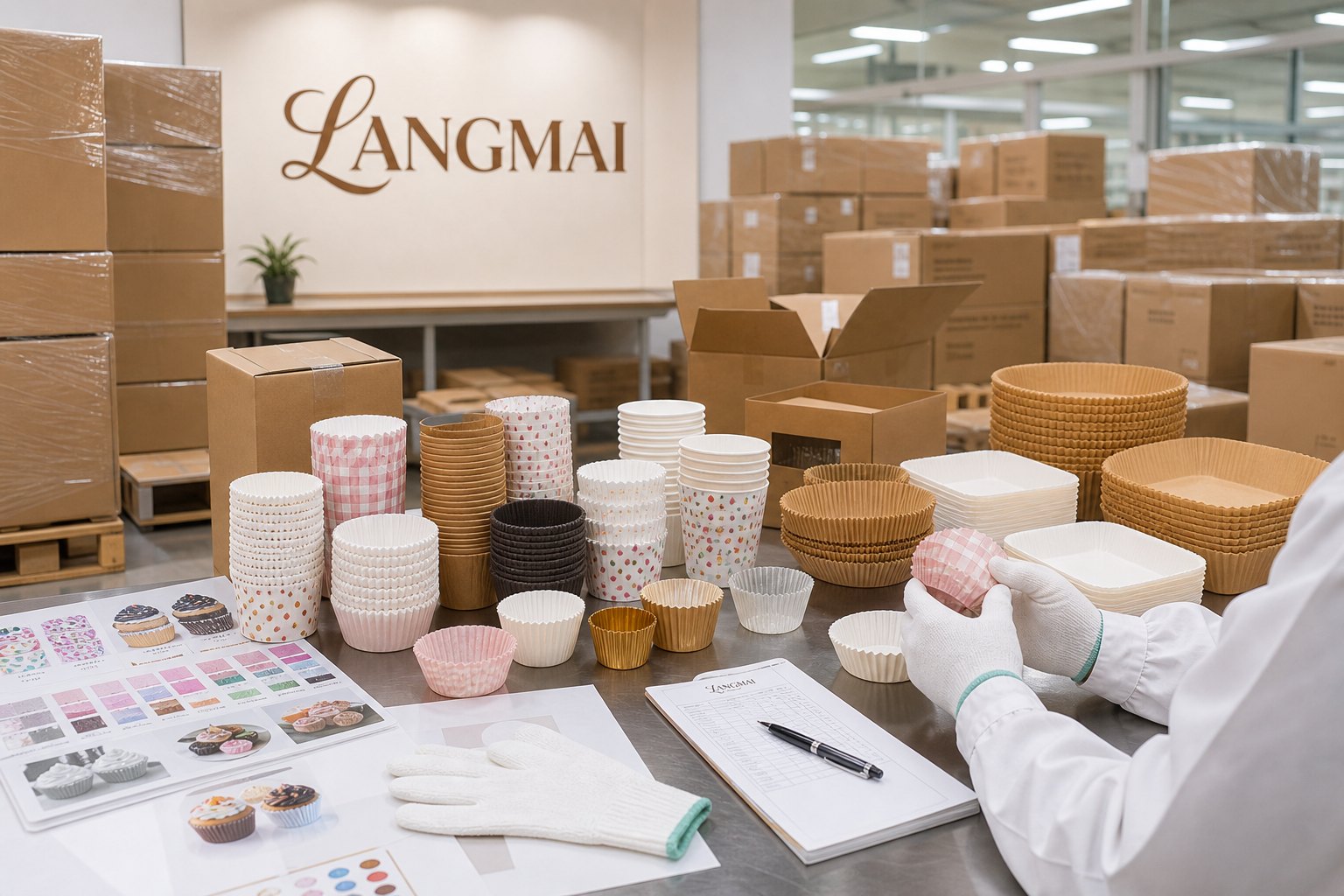
Before reading the sections in detail, browse the related ranges you'll be inspecting: cake cups, roll-mouth cake cups, muffin baking cups and air fryer paper liners.
1. Lock the Specification Before Sampling Starts
Every inspection failure starts with a specification that was never written down. Before you request a quotation from any baking paper supplier, pin down the following inputs and share them with the factory in a single PDF:
- Product type and forming method: side-wall cake cup, pleated cupcake liner, roll-mouth (continuous rim) cup, fluted muffin cup, flat air fryer liner, or perforated parchment sheet.
- Base material: virgin wood pulp, recycled-content board, glassine, parchment base or kraft — with grammage (gsm) range you will accept.
- Coating type: single-side silicone, double-side silicone, or uncoated; indicate the coating weight or gsm if you have a target.
- Colour and finish: natural white, bleached white, kraft brown, gold, black, custom Pantone; matte or glossy.
- Print: none, single colour, multi-colour, edge print, base print, water-based or soy-based ink statement.
- Dimensions: top diameter, bottom diameter, height, wall taper, base diameter tolerance, flute count and flute depth for pleated cups.
- Performance targets: grease resistance level, release performance against your test batter, intended oven type and use temperature range (you define this — see Section 5).
- Regulatory targets: markets of sale and the documentation you expect — for example, EU food contact compliance, US FDA food contact status, or both.
- Packaging: inner sleeve material, count per sleeve, count per carton, carton print, pallet pattern, pallet wrap.
Locking these into a single approved spec sheet is the first QC deliverable, and it is the document every later check refers back to.
2. Approved Sample and Retained Reference
Once the spec is locked, the buyer-side "gold sample" and the factory-side "retained sample" become the reference object for the whole order.
- Pre-production sample (PPS): signed off by you in writing before bulk production. Keep at least 5 units per SKU sealed in a clean bag with a date and signature.
- During-production sample: pulled by the factory at first-piece approval and at every colour or material change.
- Retained sample (factory side): stored for the agreed shelf life of the product so any post-shipment claim can be compared against the same lot.
- Retained sample (buyer side): pull one unit per shipped lot and store for at least 12 months, or longer if your retail customer requires it.
If a later shipment does not match the retained sample under side-by-side comparison, that is a nonconformity regardless of any numerical test result.
3. Dimensions, Forming and Structural Integrity
For formed paper cups — cake cups, cupcake liners, roll-mouth cups and muffin cups — dimensional drift can cause stacking, denesting or filling problems.
3.1 What to measure
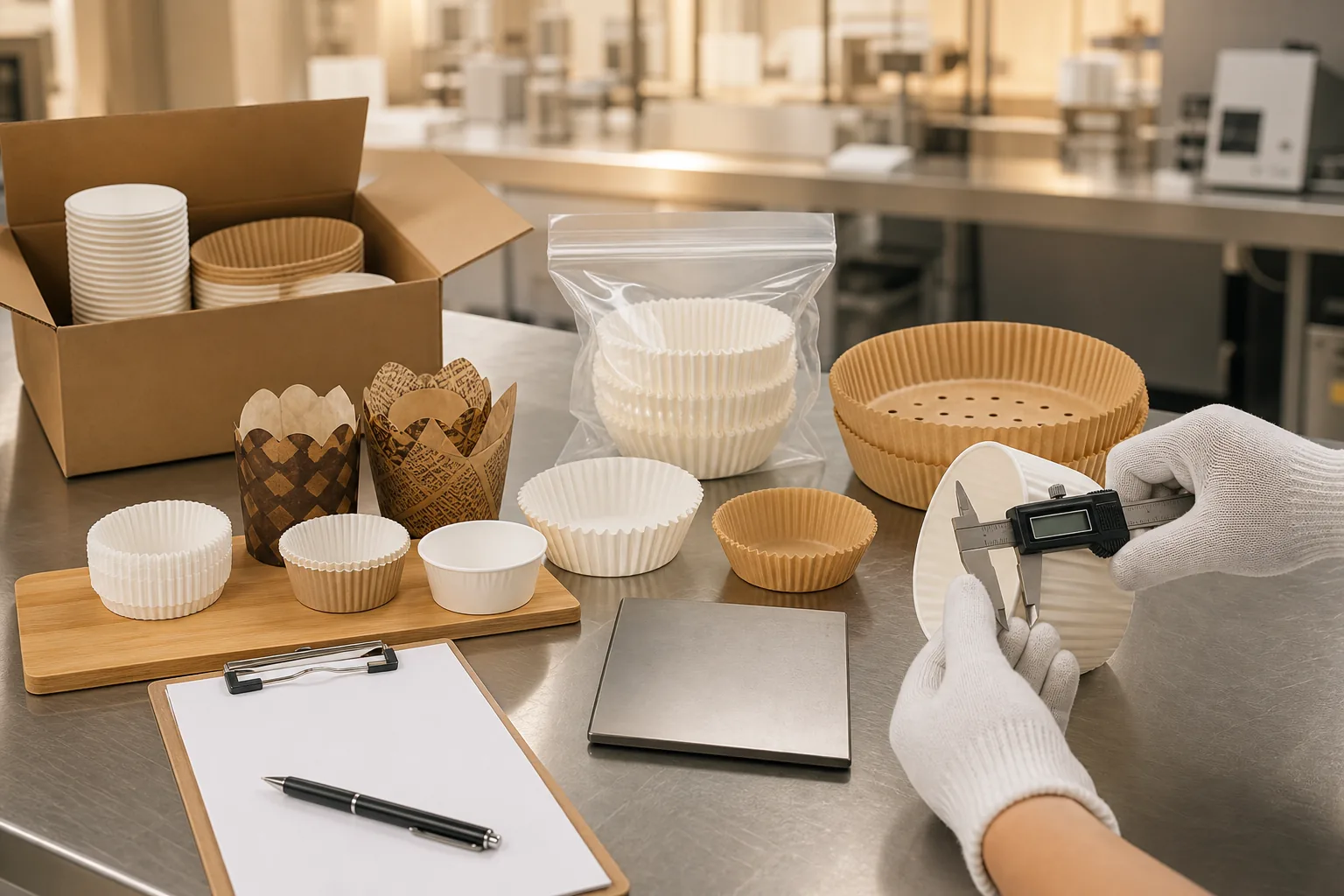
- Top diameter and bottom diameter at two perpendicular axes, using a calibrated caliper.
- Height of the cup, measured unloaded and loaded with a reference puck if your line uses one.
- Wall taper and concentricity: place the cup on a flat reference plate and look for rocking.
- Flute count and flute depth for pleated liners; missing or doubled flutes are a reject.
- Rim condition for roll-mouth cups: the rolled edge must be continuous, with no cracks, lifted paper or exposed paper edge.
3.1.1 Per-product nuances
- Roll-mouth cake cups add one specific check: the rim roll must be uniform around 360°. A flat spot will catch on automated denesting equipment.
- Muffin baking cups often run taller and rely on side-wall stiffness to hold batter weight; a crushed bottom or bowed side wall is a structural reject, not just a cosmetic one.
- Air fryer paper liners are usually flat or shallow, so flatness across the base and concentric perforation pattern (if perforated) are the key checks.
3.2 Acceptance table based on the approved specification
| Check | Method | Acceptance basis | Reject if |
|---|---|---|---|
| Top and bottom diameter | Caliper, two axes | Approved drawing and written tolerance | Outside the agreed tolerance |
| Height | Caliper or height gauge | Approved drawing and written tolerance | Outside the agreed tolerance |
| Concentricity | Flat reference plate and agreed gauge | Approved sample or written limit | Outside the agreed limit |
| Flute count and shape | Visual count and approved sample | Approved sample | Missing, doubled or outside the agreed shape |
| Rim roll | Visual and tactile check | Continuous rim matching approved sample | Crack, lift or exposed edge |
| Air fryer liner flatness | Flat reference plate | Approved sample or written curl limit | Outside the agreed limit |
Set tolerances with the supplier around the actual dispenser, oven, tray and retail pack; do not reuse generic figures without validation.
4. Grease Resistance and Barrier Performance
Grease resistance is the property that keeps a muffin cup from going translucent or leaking through to a baking tray. It depends on the substrate, the coating and the forming process, so a single number cannot cover every material.
Ask the factory which test method is used to qualify the lot and whether it matches the intended food and use conditions. A buyer may also agree a practical oil holdout or soak comparison against the approved sample. Record the oil or food simulant, amount, contact time, temperature and pass/fail rule so later shipments are judged consistently. Laboratory testing may still be needed for regulated or customer-specific requirements.
5. Release and Non-Stick Performance — Against Your Use Case
Release is a use-case property, not a universal one. A silicone-coated liner that releases cleanly from a vanilla sponge at your bakery may still need re-checking with a high-sugar brioche, with a frozen dough, or with a long steam-injected proof.
For inspection purposes, define and document:
- Batter or dough type you will test with, ideally the same SKU your retail customer bakes.
- Oven type (convection, deck, steam-injection, air fryer).
- Time and temperature profile you actually run in production.
- Release criterion: clean peel, no paper stuck to the crumb, no more than X% of the cup wall bonded to the product.
Do not let any supplier quote a single "temperature resistance" number as a universal guarantee for your product. The meaningful test is your process run, against your retained sample, with your batter.
6. Print, Colour and Odour
Visual and sensory checks catch what dimensional calipers cannot.
6.1 Print
- Edge alignment and centring within the tolerance agreed in the approved specification.
- Colour match against an approved Pantone or against a sealed colour card.
- Smear or scuff resistance: rub the print with a dry cotton pad for an agreed number of strokes.
- Heat behaviour: a printed cup run through your reference bake must not bleed, ghost or transfer colour to the product.
6.2 Colour of unprinted paper
- Whiteness / brightness target vs approved sample under D65 or natural daylight.
- Yellowing, dark spots, or uneven shade across a sleeve.
6.3 Odour
A clean paper substrate with food-grade coating should have no off-odour. Open a sleeve, hold at nose distance for 10 seconds, and compare to the retained sample. Any solvent-like, plastic, sour or mouldy note is a reject pending investigation.
7. Hygiene and Foreign-Material Checks
Hygiene checks should follow the buyer's risk assessment and the factory's documented controls. For random finished cartons, inspect under clean, well-lit conditions using clean gloves. Look for dust clusters, fibers inconsistent with the approved paper, ink smears, pests, hair, metal fragments or other foreign material. Record the carton and lot number for every finding.
Agree in advance which findings are critical and require a lot hold, and which can be handled through sorting and reinspection. If specialized detection is needed, confirm whether it will be performed by the factory, the buyer or a qualified third-party inspection provider, and document the method in the quality agreement.
8. Count, Packing and Carton Marks
Count and packing failures cause real losses: a 5,000-piece carton delivered as 4,800 stops a production line.
8.1 Inner pack
- Count per sleeve or bundle matches the spec (commonly 50, 100, 250 or 500).
- Sleeves sealed with no loose pieces, no torn paper, and no print bleeding through the wrap.
8.2 Outer carton
- Pieces per carton match the purchase order.
- Carton net weight and gross weight within tolerance.
- No crushed corners, water staining, opening damage or tear marks.
8.3 Carton marks
- Buyer name, PO number, SKU, colour, size, quantity, country of origin, batch / lot number, production date.
- Storage symbols (keep dry, keep away from heat, recyclable marks) where required by your market.
- Barcode / EAN legibility if your retail customer scans at receiving.
8.4 Pallet
- Pallet pattern matches the agreed diagram (e.g. 8 cartons per layer × 10 layers).
- Stretch wrap applied, pallet label visible, ISPM 15 mark if exporting to markets that require treated-wood compliance.
9. Traceability, Records and Document Signals
A shipment is not really finished until the paper trail matches the pallets. For every lot you should be able to retrieve, quickly:
- Raw paper supplier and reel / lot number.
- Coating material supplier and batch.
- Ink supplier and batch for printed products.
- Production date, shift, line, and first-piece approval record.
- In-process inspection results.
- Final inspection and AQL outcome.
- Retained sample location.
When the factory references certifications such as BSCI, ISO 9001, FSC (for paper fibre chain of custody), BRC Packaging Materials, or food contact documentation aligned with FDA or LFGB requirements, treat these as signals to verify, not as automatic coverage. Ask for the certificate number, the issuing body, the scope statement, and the validity dates, and confirm the certificate covers the actual product category and production site. For food contact compliance, the EU framework for food contact materials and its specific legislation set out what documentation you should expect for paper and board articles; on the US side, the FDA's guidance on food contact substances explains how regulatory status of components is determined. See our factory certificates page for the documents LANGMAI currently makes available, and confirm scope and validity with your own compliance team for each market.
10. Sampling Plans, AQL and Random Carton Selection
Sampling is a method, not a guarantee. The most widely used framework is AQL (Acceptable Quality Level) under ISO 2859-1, where buyer and supplier agree in advance on the inspection level, the AQL value for critical / major / minor defects, and the accept / reject numbers for the lot size in question.
Buyers should confirm the factory's standard inspection approach or negotiate specific sampling tables and acceptance numbers before issuing the purchase order. The selected AQL values should reflect product risk, customer requirements and the consequences of failure; there is no single default that suits every food paper article. Pull cartons from different pallet positions rather than only the top layer, and attach the completed sampling record to the lot file.
Build the agreed sampling plan into the purchase order or quality agreement up front. Retroactive sampling arguments do not survive a claim.
11. Nonconformity Handling and Rework Decisions
Even with a strong protocol, nonconformities happen. Pre-define the response so nobody improvises at the loading dock:
- Minor nonconformity: document the issue and agree whether sorting, recounting or a written deviation is appropriate.
- Major nonconformity: hold the lot while the buyer reviews root cause, corrective action, rework and reinspection options.
- Critical nonconformity: hold the lot and escalate to the buyer's quality and compliance decision-makers before shipment.
Retain enough labeled evidence samples and photos to support the agreed claim process.
12. Shipment Inspection and Quote-Ready RFQ
A short final inspection on the loaded container protects the rest of the chain: photo set of pallet pattern, stretch wrap, container interior condition, container seal number, and a final piece count against the BOL. Match these photos against the in-process and pre-shipment inspection records.
If you are at the earlier stage and still shaping the brief, structure your RFQ to LANGMAI so suppliers can quote against the same data: product type, dimensions, substrate and coating, colour and print, intended use case and bake profile, target market and required documentation, pack and pallet requirements, sample need date, and inspection level / AQL expectations. Cleaner RFQs return cleaner quotes and fewer surprises at pre-shipment.
> Mid-article CTA — Need inspection-ready specs for your next order? Send your target dimensions, use case and market. Send your target dimensions, use case and market to request a quotation and discuss available inspection options. Start your RFQ here.
FAQ
What is the most common cause of rejection in baking paper pre-shipment inspections?
Dimensional drift on moulded cups. Top diameter, height and rim roll are the three numbers that most often move between the approved sample and bulk production, and they are also the ones that cause depositor jams and stack failure at the buyer's line. Locking tight tolerances in the spec and pulling a caliper on the first 25 units of every lot catches this early.
How do I set an AQL for cupcake liner quality inspection?
Classify defects as critical, major or minor based on product risk and your customer's requirements. Then select an inspection level and AQL values with a quality professional or inspection provider, and place the agreed table and acceptance numbers in the purchase order before production.
Are BSCI, ISO, FSC, BRC, FDA and LFGB certificates enough to clear a food paper shipment?
They are useful signals but not automatic coverage. BSCI addresses social compliance, ISO 9001 covers the quality management system, FSC relates to fibre chain of custody, BRC Packaging Materials covers the production of packaging materials, and FDA / LFGB cover food contact suitability under US and EU frameworks respectively. Each has its own scope, and each certificate must be checked for product coverage, issuing body and validity. Always confirm scope and expiry against your target market before relying on any of them.
How do I test grease resistance without sending samples to a lab?
Replicate the factory's soak test on your side. Pour a measured volume of a reference oil (often coconut or vegetable oil) into a formed cup, hold at a defined room temperature for a defined time, then inspect the underside for staining or strike-through. Judge the result against your retained approved sample under identical conditions, not against a vendor brochure.
Should I accept a factory's blanket "temperature resistance" claim for baking paper?
Treat any single universal temperature number as marketing, not a specification. Real release and heat performance depend on your substrate, your coating, your oven type and your batter. Run your own reference bake with your retained sample, document the profile, and make that the acceptance criterion for the lot.
What documents should I expect with a shipment of food paper packaging?
A typical set includes the commercial invoice, packing list, bill of lading or airway bill, certificate of origin where required, food contact documentation or declarations for the destination market, and any third-party certificates referenced in the PO (BSCI, ISO 9001, FSC, BRC Packaging Materials, FDA / LFGB-related documents). Verify certificate numbers, scope and expiry independently — do not rely on PDFs alone.
CTA
Ready to run an inspection protocol that your procurement, quality and brand teams will all sign off on? Send your product mix and target markets to request a quotation and discuss available factory inspection options. Request a quotation and inspection plan.
Conclusion
A pre-shipment inspection for baking paper products is really a chain of small, written decisions: the spec, the approved sample, the dimensional tolerance, the grease soak test, the bake test against your batter, the print reference, the hygiene sweep, the AQL, the carton mark check, the document check and the final loaded-container photo. None of these steps is exotic on its own, but the order matters, and the writing-down matters more than the measuring. Bake each step into your purchase order up front, and bulk shipments become a routine acceptance decision rather than a fire drill at the loading dock.
Sources
- European Commission, Food Safety — Food Contact Materials overview: https://food.ec.europa.eu/food-safety/chemical-safety/food-contact-materials_en
- European Commission, Food Safety — Food Contact Materials legislation: https://food.ec.europa.eu/food-safety/chemical-safety/food-contact-materials/legislation_en
- U.S. Food and Drug Administration — Determining the Regulatory Status of Components of a Food Contact Material: https://www.fda.gov/food/packaging-food-contact-substances-fcs/determining-regulatory-status-components-food-contact-material