

Introduction
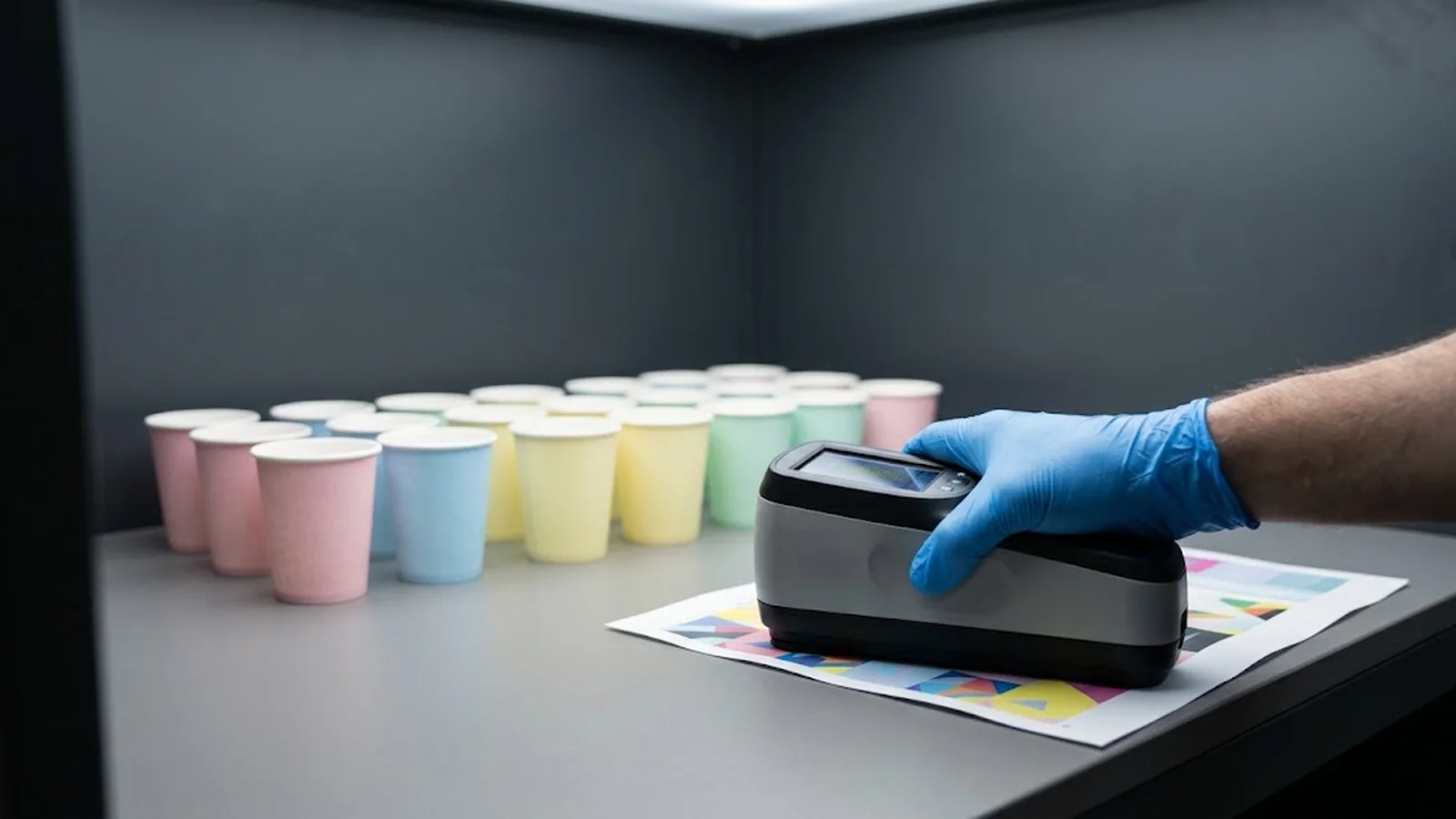
Custom printing is where packaging buyers feel quality most directly — and argue about it most often. A misregistered logo is visible to every customer; a spot color that drifts pink between shipments quietly undermines the brand. Yet most disputes trace to one root cause: nobody defined, before production, what "acceptable printing" means in measurable terms. Cup programmes usually ship alongside pan lining; our custom printed baking parchment paper specs cover the sheets and rolls that pair with them.
Print quality is one of the few areas of packaging procurement that can be made almost entirely objective. Registration has tolerances in fractions of a millimeter; spot colors have numeric targets (Pantone references and Delta E limits); proofs and drawdowns create agreed physical references. This guide explains how buyers of printed cake cups and food packaging paper should specify, verify and accept print quality. Buyers verifying these specifications can review the certificate library alongside supplier documentation requests.
1. The Two Pillars: Registration and Color
Printed paper packaging quality rests on two independently measurable properties: Where a bakery lines trays and moulds product in the same run, our silicone-coated parchment sheets and rolls are quoted with the cup programme for a single documentation package.
- Registration is the alignment of successive print units — each ink layer must land exactly where the artwork places it. Misregistration shows as fringed edges, doubled images, or a logo outline that doesn't meet its fill. On rotary presses running hundreds of meters per minute, registration is a live process variable, and its acceptability is defined by a tolerance in millimeters.
- Spot color accuracy is how faithfully a designated ink matches its reference. Brand colors are usually specified as Pantone numbers; the acceptance question is the allowed difference between the printed result and the reference, expressed numerically as Delta E (CIE Lab color difference). "Looks close enough" is a dispute; "ΔE ≤ 3.0 against the approved drawdown, measured with a calibrated spectrophotometer" is a standard.
Both properties degrade differently: registration failures are typically random within a run (a bad unit, a splice, web wander), while color drift is usually systematic (ink formulation, anilox wear, substrate change). That distinction tells you which corrective action to expect — and it is why lot-to-lot color consistency and within-run registration are checked by different methods. The factory and certificate library lists the third-party audits and test reports behind these claims.
2. Writing Print Acceptance Criteria into the Specification
Enforceable print quality starts in the specification document:
- Reference the approved artwork by version and date. Every print order points to a locked artwork file, not to "the usual design." Changes only through a change-control procedure.
- Name the color standard. List each spot color with its Pantone number and the acceptance limit — commonly ΔE ≤ 3.0 to 5.0 measured against the approved proof, tighter for primary brand colors, looser for background tints. State the measurement instrument and illuminant/observer condition (e.g., D50, 2°) so numbers are comparable.
- Define registration tolerance. Typical trade practice for paper converting allows registration deviation of roughly 0.2–0.5 mm depending on print process and artwork scale; state the number that fits your smallest design element, and how it is measured (against what reference, at what magnification).
- Set the defect vocabulary. Ghosting, set-off, streaks, voids, slurring, color variation within the sheet — each defined and assigned to defect classes in the AQL plan, so inspection results map to the same categories the supplier uses.
- Specify the substrate context. The same ink reads darker and duller on unbleached kraft than on white paper. For kraft or recycled cups, the color standard should be an approved drawdown on the actual substrate, not a Pantone chip on white paper.
3. The Proofing Workflow That Prevents Disputes
The cheapest place to fix print quality is before the production run:
- Digital proof for layout. Confirms content, positioning and structure — never for color judgment, because screens do not reproduce ink on substrate.
- Physical drawdown or ink proof. The supplier prints the production inks on the production substrate for approval. For spot colors this is the most important reference document: the physical standard against which production is measured.
- Press proof or first-article sample. For larger programs, an initial production sample closes the loop between drawdown conditions and press conditions.
- Signed references retained by both sides. The approved drawdown and first-article become reference documents in the quality agreement, retained long enough to cover the program's complaint cycle.
Buyers who skip the drawdown step to save a week almost always pay for it later — a color dispute without an agreed physical reference is unwinnable for both sides.
4. In-Production and Incoming Inspection
How the criteria get checked when it matters:
- Supplier side. A competent printer measures color at set intervals with an inline or handheld spectrophotometer, and checks registration at start-up, after splices and periodically during the run. Ask how often, with what instrument, and what happens on deviation.
- Buyer incoming inspection. Sample per the AQL plan: verify against the approved reference under a standard light booth (D50), measure spot colors with a spectrophotometer where disputes are likely, and check registration on the smallest artwork features. Random within-run defects surface through AQL sampling; systematic drift shows up immediately against the reference.
- Measurement discipline. Instruments need calibration, and color measurements need the stated geometry and illuminant. Half of all color disputes involve two numbers measured under different conditions — a standard that names the conditions ends that argument.
For private-label and retail programs, consider periodic third-party print audits — sensible for large annual volumes, unnecessary for trial orders.
5. Common Failure Modes and Their Root Causes
Knowing the typical defects and causes speeds up corrective action:
- Color drift between shipments — ink reformulated, different paper stock, or a different print house. The root cause is usually change control, not press skill; the fix is supplier notification of ink and substrate changes.
- Edge fringing on logos — registration at the edge of tolerance with a design too small for the process. Sometimes the honest fix is an artwork adjustment (trapping, line weight) agreed on both sides.
- Set-off and smudging — insufficient drying, over-stacking or ink/substrate mismatch; shows as transfer marks on unprinted surfaces and is AQL inspectable.
- Kraft color surprises — the brand color approved on white proof reads completely differently on unbleached stock. Prevented by proofing the drawdown on the production substrate.
FAQ
What Delta E tolerance should I accept for spot colors on printed cake cups?
Common practice is ΔE ≤ 3.0 for primary brand colors and ΔE ≤ 5.0 for secondary colors and tints, measured against the approved drawdown with a spectrophotometer under stated conditions (e.g., D50/2°). Tighter limits are achievable on stable white substrates; on unbleached or recycled paper the reference must be a drawdown on the actual substrate and the tolerance slightly looser.
How is print registration tolerance defined and measured?
Registration tolerance is the allowed deviation between successive print units, typically around 0.2–0.5 mm depending on process and artwork. It is checked by comparing the printed overlap of design elements — fine crosshairs, logo edges — against the approved proof, usually with a loupe or microscope at defined magnification. The specification should name the tolerance, the reference artwork version and the measurement method.
Can I use a digital proof as the color standard?
No. A digital proof is for layout and content approval only. Color must be judged against a physical drawdown printed with the production inks on the production substrate — screens render color differently from ink on paper, and a screen-approved color is the most common origin of print disputes.
Who should pay for a reprint when print quality fails acceptance?
That is what the defect classification and remedies terms in your quality agreement are for: a lot failing the agreed AQL plan or color tolerance is nonconforming, and the standard remedy ladder applies — replacement, credit or refund. If no criteria were agreed in writing, expect an unwinnable negotiation; this is exactly why acceptance criteria belong in the specification before the first order.
Conclusion
Print quality arguments are almost always process failures, not press failures — the criteria were never written down. Specify spot colors with Pantone references and numeric Delta E limits, define registration tolerance against your actual artwork, approve colors through physical drawdowns on the production substrate, and inspect incoming lots against an AQL plan with a shared defect vocabulary. Buyers who run this discipline get printed cake cups that carry the brand consistently — and suppliers who are happier to work with them. Buyers standardising on one paper supplier can review our food-grade die-cut parchment rounds next to their cup specifications.
CTA
LANGMAI produces custom-printed cake cups, muffin liners and food packaging paper under documented print acceptance standards: Pantone-matched spot colors with Delta E verification, defined registration tolerances, approved substrate drawdowns and AQL-based outgoing inspection. Contacto our team with your artwork for a print program you can specify with confidence.
Sources
- Pantone — color standards and matching system
- ISO 13660 — Image quality of printed materials
- ISO 2846 — Colour and transparency of printing ink sets
- ISO 12647 — Process control for the production of half-tone colour separations
- ISO 2859-1 — Sampling procedures for inspection by attributes
- ISO 11664 — Colorimetry (CIE standards adoption)