

Introduction
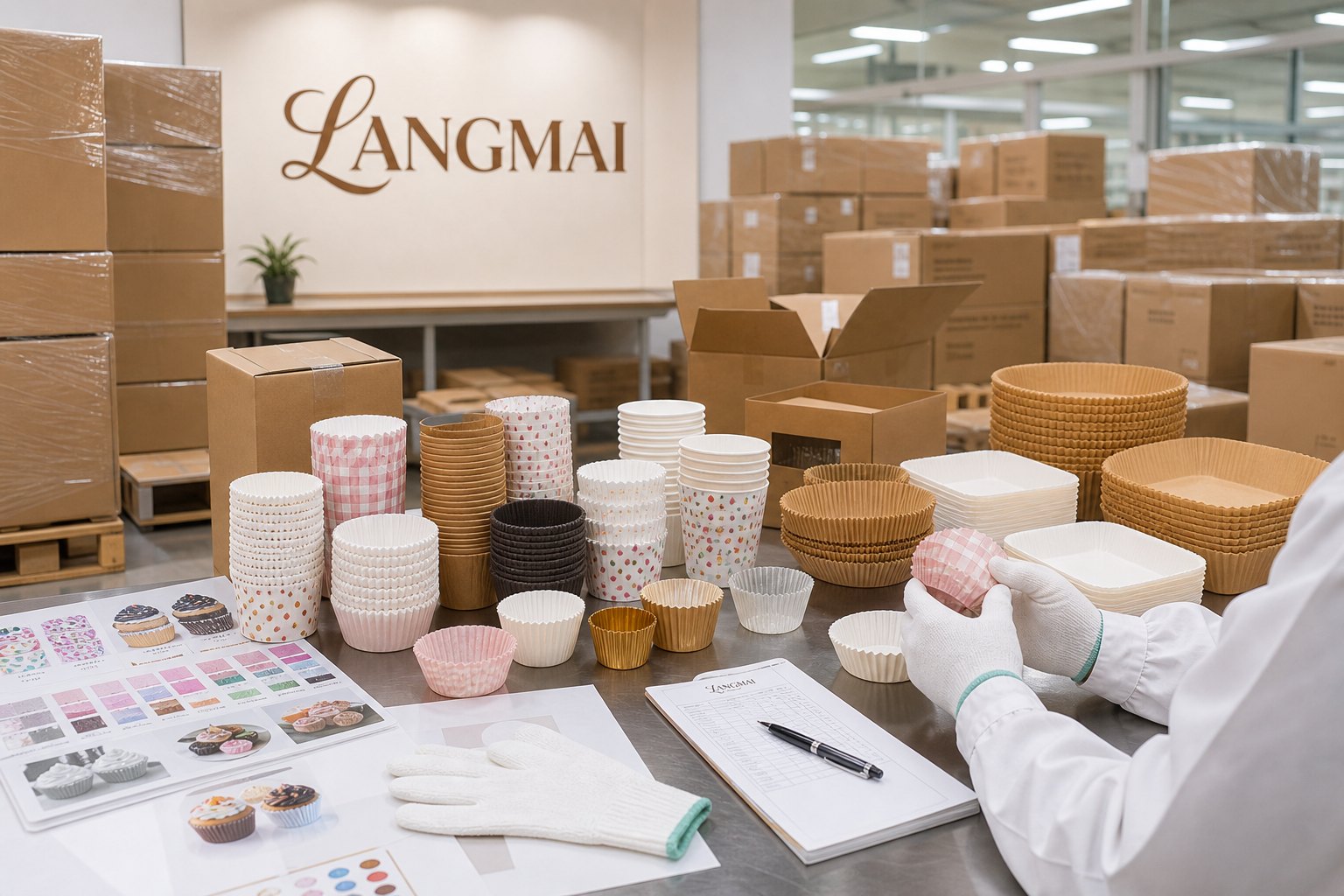
A paper baking cup packaging specification should define how cups are counted, oriented, protected, identified, packed into cartons and tested for the real distribution route. The goal is not simply to fit the most pieces into a box. Packaging must preserve cup shape, cleanliness, traceability, print condition and usable count from factory release through warehousing and customer handling.
Paper and paperboard properties can change with temperature and relative humidity. ASTM D4332-22 provides conditioning atmospheres for containers, packages and packaging components and explains that cellulosic materials change physical properties as temperature and humidity vary. Use an agreed conditioning and distribution-test plan when transport risk justifies it; do not treat a dry factory sample as proof of route performance.
1. Define the Distribution System Before the Carton
Map the shipment from factory to final user. Record transport modes, route duration, container loading, palletization, transfers, warehouse conditions, order picking, parcel delivery if used and expected stacking. Identify the points where moisture, compression, impact, vibration, contamination or misidentification can occur.
The same baking cup may need different packaging for:
- full-container bakery supply;
- mixed-SKU distributor pallets;
- private-label retail packs;
- e-commerce parcel fulfillment;
- humid or high-temperature routes; or
- long storage followed by automated denesting.
Define the acceptance point. Damage visible at the outer carton, inner pack or cup level may have different consequences, but all should have agreed defect definitions.
2. Specify the Primary or Inner Pack
For cups that are not individually retail packed, the inner pack is the main cleanliness and shape-control barrier. State the approved bag, sleeve, tray, divider or other configuration and how it closes.
Include these fields:
| Inner-pack field | Specification question | Verification |
|---|---|---|
| Cup count | How many usable cups per pack? | counted samples and declared counting method |
| Orientation | Which direction are cups nested or stacked? | visual work instruction |
| Compression | How tightly may stacks be compressed? | height or denesting check after conditioning |
| Barrier | What material and closure protect the cups? | material code, dimensions and seal inspection |
| Identification | Which SKU, lot, quantity and date appear? | label master and scan/readability check |
| Handling | How is an opened pack protected or resealed? | user trial or instruction |
Avoid over-compressing nested cups to reduce freight. It can deform rims, increase blocking, damage print, change pack height and make bakery handling slower. Approve stack height and denesting after representative storage and transit, not only immediately after packing.
For private-label retail formats, also use the cupcake liner retail packaging guide.
3. Engineer the Shipping Carton Around the Packed Product
Specify carton style, board construction, internal dimensions, closure, liners or dividers, gross-weight limit, case marks and pallet pattern. The carton should restrain movement without crushing the cups. Empty headspace, unsupported stacks and inconsistent pack orientation can concentrate loads.
Record:
- inner packs per carton and total pieces;
- carton material and supplier code;
- internal and external dimensions with tolerances;
- closure method and tape or adhesive specification;
- divider, pad or liner arrangement;
- net and gross weight limits;
- stacking direction and maximum planned load;
- label position and required marks; and
- pallet overhang, layer pattern, height and stretch-wrap rules.
Evaluate the loaded shipping unit. A carton certificate or board value alone cannot predict performance when dimensions, humidity, closures, pallet pattern and duration change.
4. Condition Samples Before Performance Tests
Agree whether conditioning is needed before inspection or distribution testing. ASTM D4332 covers standard and special atmospheres intended to simulate phases of the distribution environment and is commonly used before transit simulation. The selected condition should reflect the route and test objective.
Identify the test specimens, conditioning atmosphere, duration or equilibrium criterion, sequence and time between conditioning and test. Keep control samples where useful. If the package uses paper cartons and paper cups, both the container and product may respond to moisture.
Do not report “humidity tested” without the temperature, relative humidity, duration, specimen identity and test sequence. Results from one atmosphere should not be generalized to every season or shipping lane.
5. Build a Route-Appropriate Transit Test Plan
ASTM D4169-22 provides a uniform system for evaluating shipping units using established test methods at levels representative of distribution. It calls for sequential testing on the same unopened shipping units for performance evaluation. A competent packaging engineer should select the distribution cycle and assurance level for the actual route.
Depending on risk, a plan may address:
- manual handling and drops;
- vehicle vibration;
- warehouse and vehicle stacking or compression;
- concentrated impact;
- atmospheric conditioning; and
- pallet stability and load retention.
Do not copy a test sequence or drop height from an unrelated product. Define the shipping unit, route, mass, handling system, test level and pass/fail criteria before testing.
Open the packages only after the required sequence unless the selected method says otherwise. Then inspect carton condition, closure, labels, inner packs and cups. Count usable product and document deformation, contamination, print rub, tearing, blocking and denesting.
6. Protect Food-Contacto Cleanliness and Traceability
Packaging materials, handling and storage should not introduce contamination or confuse product identity. EU Regulation (EC) No 1935/2004 requires traceability of food-contact materials through all stages and suitable identification through labeling, documentation or information.
Connect each carton and inner pack to the finished SKU, production lot and relevant input or process records. If multiple lots share a pallet, define how they are separated and identified. Rework, partial cartons and replacement labels need controlled procedures.
For printed cups, EU Regulation (EC) No 2023/2006 also addresses handling and storage so printing substances do not transfer through the substrate or by set-off in stacks or reels at unacceptable levels. Packaging approval should therefore preserve the reviewed nesting and print orientation.
7. Write Label and Count Controls
Create an approved label master for every market and pack level. Specify text, language, barcode data, lot format, date format, quantity, product code, country-of-origin marking where required by the buyer's market assessment and any handling symbols.
Verify barcode readability on actual labels and after transit testing. Test label adhesion under relevant temperature and humidity. Do not place important labels where pallet wrap, straps, corners or abrasion make them unreadable.
Define how quantity is established. If automated counting is used, audit calibration and reconciliation. If count is derived from weight, validate the method against piece-weight variation and pack tare. Shipment inspection should independently check a justified sample of packs.
8. Set Shipment Acceptance Criteria
Separate critical, major and minor defects according to buyer risk. Examples may include:
- wrong product or artwork;
- untraceable or incorrect lot label;
- open or contaminated inner pack;
- unusable deformation or blocked cups;
- carton collapse or wet damage;
- incorrect count beyond the agreed rule;
- print abrasion or transfer;
- illegible barcode; and
- cosmetic carton marks that do not affect product protection.
Define the sampling plan and acceptance rule contractually. There is no universal AQL for every baking cup shipment. Product risk, order size, history, automation needs and customer commitments should drive the plan.
Use the paper baking cup manufacturer audit guide to verify that packing, release and change control work as a repeatable system.
9. Approve Changes Before They Reach a Shipment
Require notice before changes to inner-bag material, closure, stack count, orientation, compression, carton board, carton supplier, dimensions, closure, divider, label stock, pallet pattern or transport route. Revalidate the affected tests.
A cost-saving carton change can alter compression strength, moisture response, pallet fit and container utilization. A higher pack count can change denesting and rim deformation. Evaluate the loaded configuration and not just the replacement material's data sheet.
Keep approved packaging samples, drawings, labels, photographs and test reports under revision control. Cite them in purchase orders and inspection instructions.
FAQ
How should cupcake liners be packed for wholesale shipment?
Use a defined inner pack that protects cleanliness and shape, then a shipping carton engineered for the stack arrangement, route and pallet load. Specify count, orientation, compression, closure, labels and acceptance tests.
Why do nested baking cups stick after shipping?
Possible causes include excessive compression, forming variation, print or coating interaction, humidity, heat and long storage. Reproduce the route conditions and inspect the approved material, stack height and pack configuration.
Is carton compression strength enough to approve packaging?
No. Loaded-package performance also depends on dimensions, closures, humidity, stacking time, pallet pattern, transport and the product's support. Test the representative shipping unit.
Should paper baking cup packages be humidity conditioned?
Conditioning is appropriate when it supports the defined test objective and route risk. State the method, temperature, relative humidity, duration and sequence. Do not use one condition as proof for every route.
What traceability belongs on baking cup cartons?
At minimum, use an identification system that connects the product, SKU and production lot to relevant manufacturing and shipment records. Exact label fields depend on the buyer, market and pack level.
When should packaging be retested?
Retest when a change can affect protection or distribution performance, including carton construction, dimensions, inner pack, count, pallet pattern, route, supplier or product geometry, and after relevant damage trends.
Conclusion
Paper baking cup packaging should be treated as a controlled system. Define the route, inner pack, carton, labels, pallet and usable-count criteria; condition and test representative shipping units; preserve traceability and print orientation; and require approval before packaging changes.
CTA
Send LANGMAI your baking cup format, stack count, retail or bakery use, destination, route, pallet limits, label requirements, barcode data and damage criteria. Request a proposed pack specification, production-representative samples and route-appropriate test plan.