
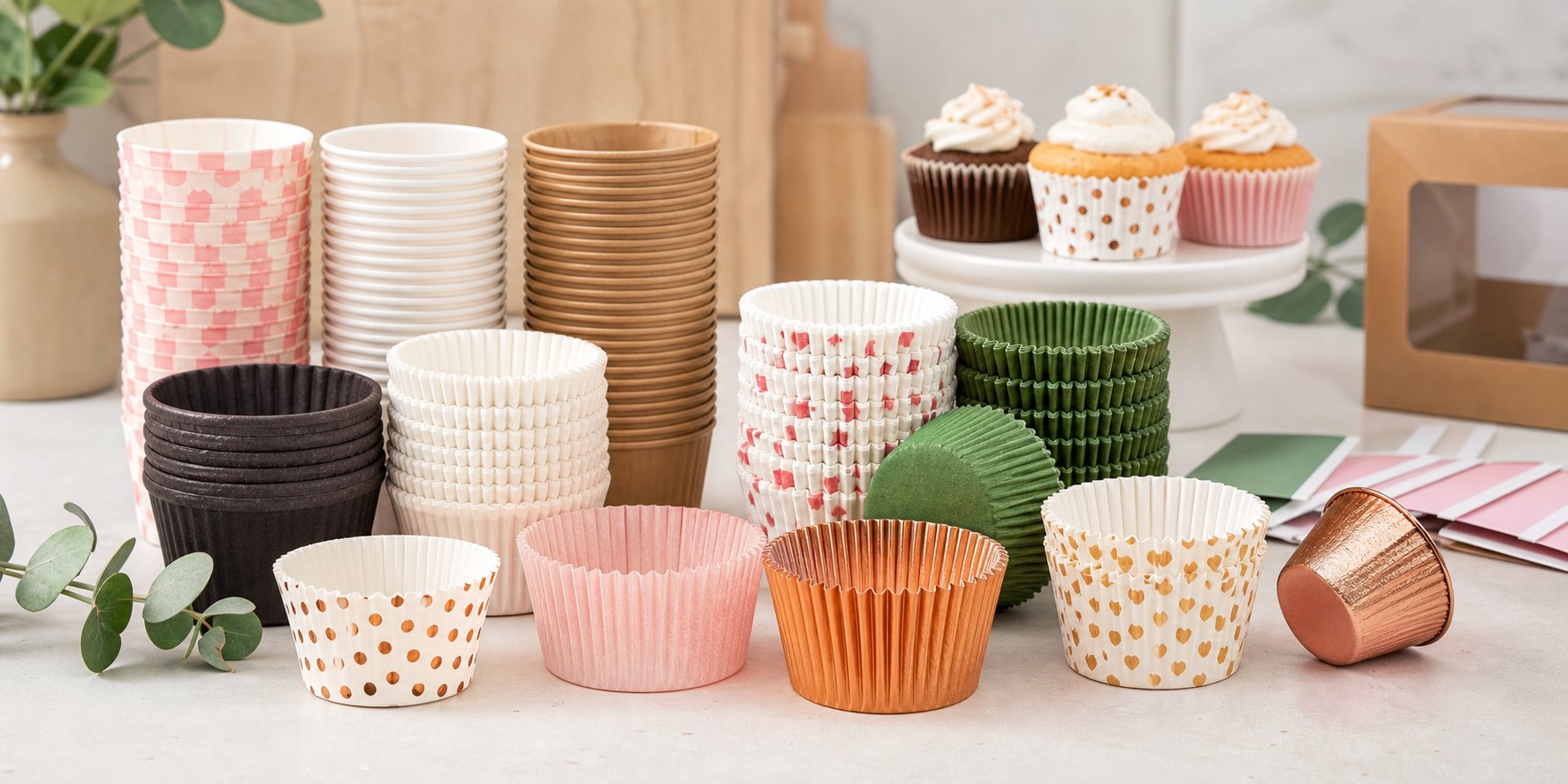
Introduction
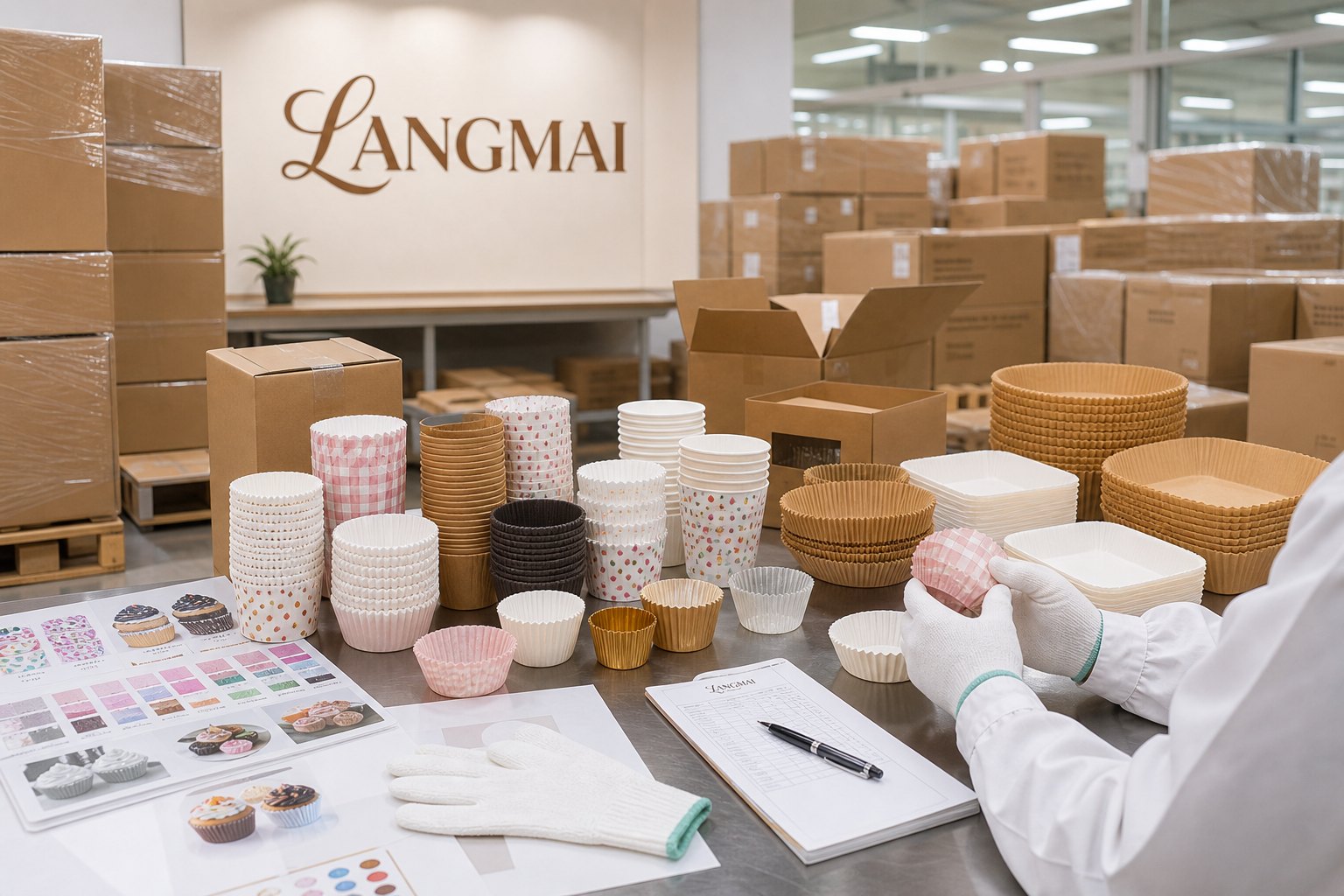
Mini cupcake liners look simple, but bulk buying is not just a smaller version of standard cupcake liner sourcing. The smaller base, lower wall height and tighter pack counts make size tolerance, denesting, grease appearance, color control and carton protection more visible. A bakery may use mini liners for bite-size cupcakes, petit fours, tasting portions, frozen dessert cups, catering trays, children-focused retail packs or seasonal party ranges. Each use creates different requirements for cup size, material, release, presentation and packing.
The direct answer: buyers sourcing mini cupcake liners wholesale should approve a written size specification, test samples with the real recipe and tray, verify the food-contact document scope for the destination market, confirm inner-pack counts and carton protection, and inspect bulk production against retained approved samples. Do not approve a supplier only from catalogue photos, a generic "food grade" label or a single loose courier sample.
This guide is for B2B buyers who need mini baking cups in bulk and want a practical RFQ, testing and supplier-evaluation framework.
1. Define What "Mini" Means in the Buyer Specification
"Mini" is a commercial description, not a complete specification. One supplier may call a 30 mm base cup mini, while another may use the term for a slightly larger candy or petit-four cup. The buyer specification should state the base diameter, top diameter, wall height, paper weight range or construction, cup shape, color, fluting style, pack count and intended use.
Start with the application. A mini cupcake baked in a rigid tray needs the liner to fit the cavity without folding, tilting or leaving excess wall above the batter. Retail assortments need color consistency and count accuracy; foodservice packs need fast denesting, low dust and stable stacks.
Use a dimensional drawing whenever possible. At minimum, list:
- base diameter measured at the bottom contact area;
- top diameter measured across the open rim;
- vertical wall height;
- flute depth and approximate flute count if appearance matters;
- nested stack height for a defined number of cups;
- color or print reference;
- tray cavity, fill weight and baking process;
- pack count, inner pack type and carton quantity.
If the project is still choosing between small and standard sizes, review the cupcake liner size guide before sending RFQs. If custom decoration is involved, pair the size discussion with the custom cupcake liner artwork checklist.
2. Match Material Choice to the Food and Channel
Mini cupcake liners can be made from different food-paper constructions, including standard baking paper, greaseproof paper, glassine-style paper, colored paper or printed paper, depending on the supplier's process and the buyer's intended use. The material name should not be treated as a performance guarantee. Test release, color change, grease appearance, odor, stacking and pack handling under realistic conditions.
For dry sponge-style mini cupcakes, a standard or light greaseproof construction may be sufficient. For richer butter, oil, chocolate, nut or filled recipes, buyers should test whether fat marks become visible after baking, cooling and display. For private-label retail packs, visual consistency matters; for foodservice and bakery operations, denesting speed and tray fit can matter more than decoration.
Do not request "the cheapest mini liner" without explaining the food and channel. Lower-cost paper may work for one use but fail in another. A small liner has less structure, so weak paper, inconsistent forming or over-compressed packing can show up quickly as tilted cups, distorted rims or difficult separation.
3. Build a Quote-Ready RFQ Table
A complete RFQ helps suppliers quote the same product instead of guessing. It also makes price comparison more meaningful because the buyer can separate material, printing, packing, sampling and inspection requirements.
| RFQ field | What to send | Why it matters |
|---|---|---|
| Product name | mini cupcake liner, mini muffin liner, candy cup or mini baking cup | prevents suppliers from quoting the wrong shape |
| Dimensions | base diameter, top diameter and wall height | controls tray fit and finished presentation |
| Intended food | sponge cake, muffin, chocolate, oily batter, mousse or dry confectionery | affects grease, release and document review |
| Process | oven temperature, baking time, cooling time, freezing or display | samples must be tested in real use conditions |
| Material goal | white, natural, greaseproof, glassine-style, colored or printed | narrows realistic construction options |
| Pack format | bulk inner bag, retail box, tube, blister, header bag or dispenser | affects handling, count control and landed cost |
| Quantity | trial order, repeat monthly volume and SKU count | changes tooling, carton planning and unit economics |
| Destination | EU, US, UK, Middle East, Latin America or other market | food-contact and label review depend on market |
| Evidence needed | sample record, food-contact documents, specification, carton marks and inspection photos | avoids late compliance or receiving disputes |
Ask suppliers to state what is stock, what requires tooling or print setup, and what is confirmed only after sample approval. For mini liners, even small dimensional changes can affect tray fit, so quote revisions should be traceable to a drawing or approved sample.
4. Verify Food-Contact Scope Without Overstating Claims
Mini cupcake liners are food-contact articles when they are intended to touch food. For EU buyers, Regulation (EC) No 1935/2004 sets general requirements for food-contact materials and articles, including safety, composition and organoleptic considerations under normal or foreseeable use. Regulation (EC) No 2023/2006 covers good manufacturing practice for food-contact materials and articles.
For US projects, the FDA explains that food-contact substance authorization depends on identity, intended use and conditions of use; its 21 CFR inventory and component-status guidance should be checked for relevant paper and paperboard components. The FDA's 21 CFR food-contact substance inventory and component-status guidance are useful starting points for buyer document review. For paper and board benchmarks in Europe, buyers often review the German BfR's Recommendation XXXVI for paper and board, while remembering that the English PDF is an unofficial translation and the German version is binding.
The buyer should ask for documents that match the finished article and intended use. A paper mill statement alone may not cover printing, colorants, treatments, forming aids, packaging contact or the finished mini liner. Do not accept broad claims such as "FDA approved," "EU certified" or "safe for all food" without a document trail showing product identity, material construction, test basis, intended food type, temperature and contact conditions.
5. Test Samples With the Real Mini Tray and Recipe
Mini liners are sensitive to fit. A slight mismatch between liner base and tray cavity can cause wrinkles, leaning, uneven batter spread or poor finished shape. Before approval, test enough samples from each supplier to see normal variation, not only the best single piece.
Run a practical application trial:
- place empty liners into the actual mini cupcake or mini muffin tray;
- check whether the base sits flat and the wall follows the cavity;
- fill with the buyer's normal batter weight;
- bake using the buyer's oven, time and temperature;
- cool using the normal rack, tray or conveyor process;
- evaluate release, grease marks, rim shape, color change and odor;
- repeat after storage or freezing if the product will be held before sale;
- record photos and weights for the approval file.
For bakery groups and contract manufacturers, include operators in the test. A liner that looks acceptable in a small office trial may slow production if stacks separate poorly or cups cling together. For automated or semi-automated lines, use the denesting principles in the paper baking cups for automated bakery lines guide and add a specific mini-cup handling check because smaller cups can shift more easily.
6. Control Color, Printing and Shelf Presentation
Mini cupcake liners are often sold in colorful retail assortments, party themes or seasonal ranges. Color can help the SKU sell, but it also creates approval risks. Buyers should approve color under real lighting, after baking and after packing. Some colors look strong when empty but darken, fade or show grease marks after use. Dark colors can also make small print less legible.
For printed mini liners, request artwork templates that show trim, flute distortion, repeat direction and the visible area after forming. Small cups leave less printable area, so designs that work on standard liners may become crowded. Keep barcodes, regulatory text and retail claims on the outer packaging unless the liner itself has enough readable area.
Approve:
- paper color or printed color reference;
- acceptable color tolerance method;
- odor check after opening the pack;
- ink coverage and rub resistance expectations;
- position and orientation after forming;
- appearance after baking with the real recipe;
- retail pack front, back and side-panel text.
If the buyer needs private-label packaging, use the private label cupcake liners guide to align outer packaging, label copy, barcode, count claims and carton marks with the mini-liner specification.
7. Plan Pack Counts and Carton Protection Early
Mini liners usually have high unit counts per inner pack and carton. That makes counting, compression and stack protection important because retailers and foodservice customers expect declared counts to match delivered usable pieces.
State whether the buyer needs 100, 150, 200, 500, 1,000 or another count per pack. Confirm how the supplier counts cups, how stacks are separated, and whether the pack can be opened and resealed. For retail packs, the outer pack should protect the rims from crushing while still presenting the colors or product image clearly. For bulk packs, the inner bag should protect cleanliness and shape during warehouse handling.
Mini cups can deform if stacks are over-compressed to save space. Ask for a packed sample, not only loose samples. Review inner bag tightness, carton fill, top protection, pallet pattern, carton labels and mixed-SKU identification. For long routes or humid seasons, agree whether conditioning or transit simulation is needed. ISO 187:2022 specifies standard atmospheres and procedures for conditioning and testing paper, board and pulps, as summarized by ISO.
8. Inspect Bulk Production Against a Retained Sample
The approved sample should become the reference for production, but only if it is clearly identified. Keep a signed retained sample or sample photos with the specification, date, supplier name, material, dimensions, color, pack count and project code. Inspect the bulk order against that reference.
Useful inspection checkpoints include:
| Checkpoint | What to verify | Evidence to keep |
|---|---|---|
| Dimensions | base, top, height and stack height | measurement photos and record sheet |
| Appearance | color, fluting, rim shape, cleanliness and obvious defects | sampled photos by carton or lot |
| Function | tray fit, separation and sample bake if required | application-test notes |
| Count | inner-pack count and carton quantity | counted sample packs |
| Packaging | bag seal, retail pack condition, carton strength and labels | pack photos and carton-mark record |
| Documents | specification, food-contact evidence and change-control note | PDF file set tied to SKU |
For paper and board lots, ISO 186:2002 describes representative sampling for determining whether average quality complies with specifications. Avoid judging a shipment from one convenient top-carton sample.
Mid-Article CTA: Send a Mini Liner Brief Before Quoting
If you are comparing mini cupcake liner suppliers, send LANGMAI your target base diameter, wall height, tray photo, recipe type, color or print plan, pack count, destination market and estimated quantity. The team can review whether the request is a stock sample, a production-style sample or a custom project that needs artwork and packing approval before bulk pricing.
Request a mini cupcake liner quotation
9. Compare Suppliers Beyond Unit Price
The lowest unit price can be misleading when suppliers quote different sizes, paper constructions, pack counts or carton densities. Compare the landed usable cost, not just the quoted piece price. A slightly cheaper mini liner that arrives crushed, separates poorly, causes visible grease rings or triggers document questions can cost more than a controlled specification.
Score suppliers on:
- ability to quote from a drawing and real use case;
- sample quality and consistency across pieces;
- clear explanation of material and process limits;
- document set matched to destination and intended use;
- willingness to provide packed samples;
- pack-count accuracy and carton-mark control;
- change-control process for paper, color, tooling and packaging;
- responsiveness to factual technical questions.
Avoid asking suppliers to guarantee performance for every recipe or market. A stronger supplier will define what has been tested, what still needs buyer approval and what document scope applies.
10. Common Mistakes in Mini Cupcake Liner Sourcing
One common mistake is approving the liner while empty. Mini liners should be evaluated after filling, baking, cooling and packing because that is when tray fit, release, grease and shape issues become visible. Another mistake is treating mini muffin liners, candy cups and cupcake liners as interchangeable. They may look similar in photos but differ in paper, depth, forming and intended use.
Buyers also underestimate packing. Mini liners can be vulnerable to rim distortion because many pieces are nested tightly. If retail presentation matters, approve an actual retail pack and shipping carton. If bakery handling matters, test how quickly staff can separate the stacks.
Finally, do not overclaim sustainability, compostability, PFAS status or food-contact compliance unless the exact finished product and document basis support the statement. If a retail pack needs environmental wording, review claim rules and substantiation before printing. It is better to use precise, verifiable language than broad marketing phrases that create importer risk.
FAQ
What sizes are common for mini cupcake liners wholesale?
Common mini cupcake liners are much smaller than standard cupcake liners, but there is no single global "mini" size. Buyers should specify base diameter, top diameter and wall height rather than relying on a name. The correct size depends on the tray cavity, fill weight, finished cake height and pack presentation.
Are mini cupcake liners and mini muffin liners the same?
They can overlap, but buyers should not assume they are identical. A mini muffin liner may be selected for deeper batters or bakery trays, while a mini cupcake liner may prioritize decorative presentation. Confirm dimensions, material, wall height, tray fit and intended baking conditions before comparing quotes.
What should be tested before approving mini baking cups?
Test tray fit, filling behavior, baking shape, release, grease marks, odor, color change, denesting and pack handling. If the product will be chilled, frozen or displayed for a long time, include that condition in the sample trial before approval.
What documents should a mini cupcake liner supplier provide?
Ask for a written specification, food-contact evidence matched to the destination market and intended use, material or finished-article statements where applicable, packing details, carton marks and a change-control note. For printed or colored liners, include information relevant to inks or colorants used in the finished article.
How should retail packs of mini cupcake liners be approved?
Approve the outer pack together with the liner. Check declared count, barcode, label copy, pack opening, stack protection, color presentation, carton quantity and receiving marks. A loose liner sample does not prove that the retail pack will survive storage, shipment and shelf handling.
How can buyers compare mini cupcake liner suppliers fairly?
Send every supplier the same drawing, tray details, food application, pack count, destination market and document requirements. Compare sample results, document scope, packing quality, change-control discipline and landed usable cost instead of judging only the lowest quoted unit price.
Conclusion
Mini cupcake liners wholesale purchasing works best when the buyer treats the liner as a controlled food-contact packaging component, not a small commodity item. Define the size, test with the real tray and recipe, confirm food-contact document scope, approve packed samples and inspect bulk production against a retained reference. That process helps importers, bakery distributors, foodservice buyers and private-label teams reduce fit problems, visual complaints, count disputes and late compliance surprises.
For a quote-ready review, send LANGMAI your mini liner dimensions, application, destination market, color or print plan, pack count and target order volume. Submit your mini cupcake liner requirements and ask for a sample route before approving bulk production.