Introduction
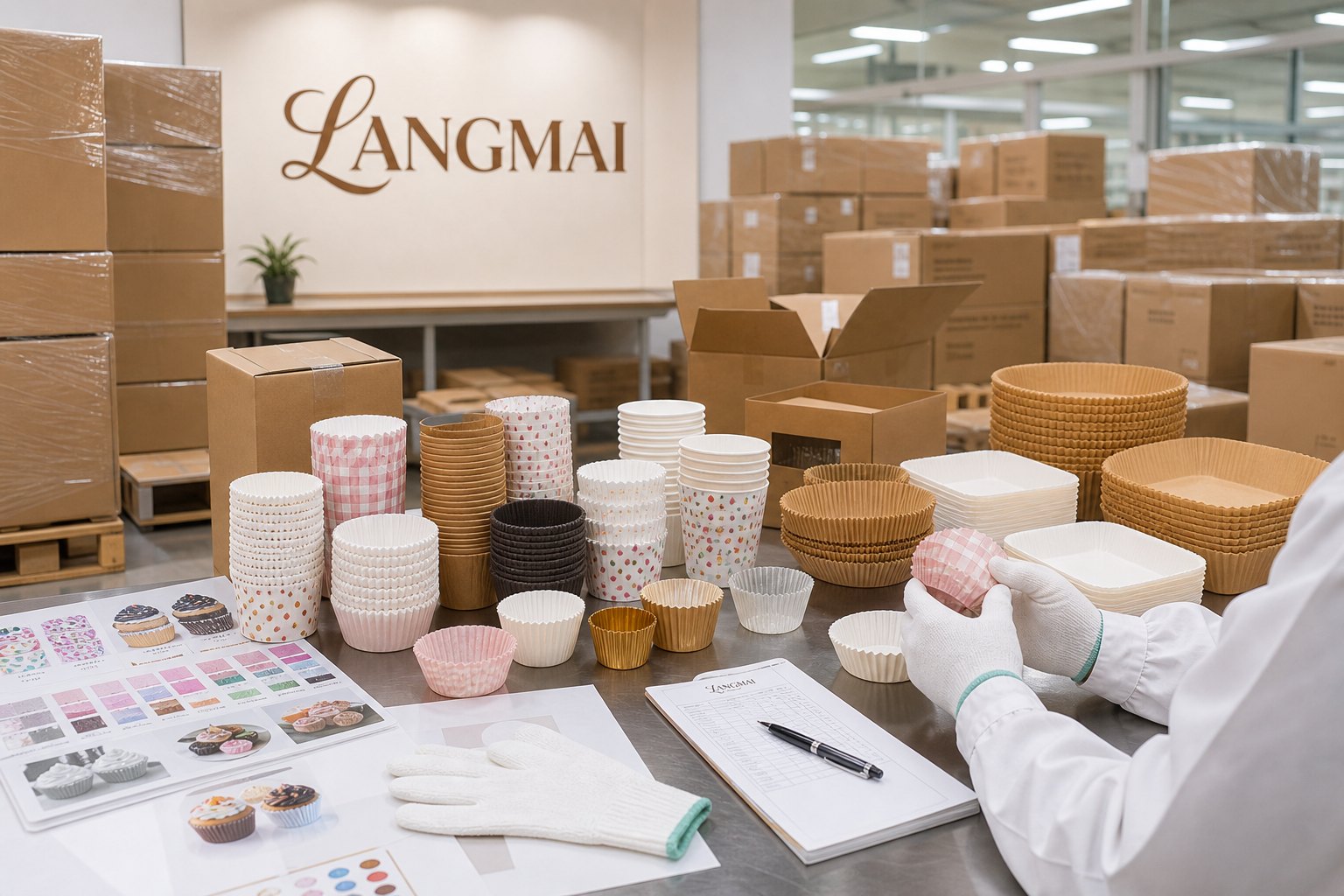
Precut parchment paper sheets wholesale orders look simple until the first carton reaches a bakery line, dispenser shelf or private-label warehouse. A sheet may be the right material but the wrong size for a tray. It may release well in a short cookie trial but curl badly after humidity exposure. It may be acceptable as a plain bakery pan liner but need a different review when printed, folded, packed in a retail box or sold into a regulated destination market.
The direct answer: a quote-ready purchase file for precut parchment sheets should define sheet dimensions and tolerances, paper color, grammage, release treatment, coating side, food type, temperature and time of use, pack count, retail or foodservice packaging, food-contact evidence, sample approval tests, carton marks and inspection criteria. Buyers should approve the actual finished sheet, not only a material swatch or roll sample.
This guide is for global B2B buyers comparing suppliers for bakery, foodservice, private-label, frozen food, confectionery and converter programs.
1. Confirm Why Sheets Are Better Than Rolls
Precut parchment paper sheets are usually selected when speed, portion control and repeatable pan coverage matter more than roll flexibility. Commercial bakeries reduce tearing time, foodservice distributors stock boxed sheets for prep stations, and retail buyers offer flat or folded convenience packs.
Rolls still make sense when the customer needs variable length, consumer kitchen use or downstream converting. For that comparison, review LANGMAI's baking parchment paper rolls wholesale guide together with this sheet guide. The practical question is not whether sheets or rolls are better. It is which format matches the labor, tray, dispenser, shelf, label and inspection route for the SKU being purchased.
| Buying scenario | Why precut sheets may fit | What to verify before approval |
|---|---|---|
| Commercial bakery sheet pans | Faster loading and consistent pan coverage | Pan size, sheet overhang, curl, release and grease marks |
| Foodservice prep stations | Staff can pull one sheet at a time | Box opening, sheet separation, count accuracy and hygiene |
| Frozen dough or pastry | Repeatable interleaving and release | Freezer handling, sticking, cracking and thawing behavior |
| Retail private label | Clear consumer format and barcode-ready pack | Fold pattern, pack count, label claims, carton protection |
| Confectionery and chocolate | Smooth handling and clean separation | Surface smoothness, odor, transfer and grease exposure |
| Converter or kit packer | Ready pieces for assembly or tray packs | Dimensional tolerance, stacking, dust and lot traceability |
If the supplier quotes only "parchment sheet" without intended use, the buyer is still at the sample stage, not the purchasing stage.
2. Build the Sheet Specification Before Comparing Prices
A low unit price can hide a smaller sheet, lighter paper, different coating side, looser tolerance, weaker box, lower inner count or missing document scope. Start with a specification table and ask every supplier to quote against the same file.
| Specification field | Buyer decision | Why it matters |
|---|---|---|
| Sheet size | Width, length and tolerance in millimeters or inches | Controls pan fit, waste, dispenser fit and landed cost |
| Shape | Rectangle, square, round, oval or custom die-cut | Affects die cost, packing and nesting behavior |
| Paper color | White, natural brown or custom printed | Changes visual presentation, claims and print review |
| Grammage | Target g/m2 and tolerance | Influences stiffness, curl, release, cost and packing weight |
| Release treatment | Single-side or double-side release, subject to confirmed construction | Affects food release, orientation and price |
| Food use | Food type, fat, moisture, contact time and temperature | Drives sample testing and document review |
| Packaging | Bulk flat pack, folded retail pack, dispenser box or inner bag | Controls labor, shelf use, hygiene and carton cube |
| Labeling | SKU, barcode, language, lot code and warnings | Prevents customs, retail and receiving disputes |
| Inspection | Dimensions, count, appearance, odor, release, cartons and labels | Connects mass production to the approved sample |
Ask for the finished product drawing or pack layout, not just a quotation line. A 400 x 600 mm sheet is not automatically equivalent to a 16 x 24 inch sheet. For private label, the box, fold and count are part of the product.
3. Match Parchment Construction to Real Use Conditions
"Food grade" is not a complete technical specification. Buyers need to describe the food, contact conditions and destination market. In the United States, food-contact substances are reviewed by identity and intended conditions of use. For paper and paperboard, buyers often check whether the supplier's basis references relevant parts of 21 CFR 176.170 for paper in contact with aqueous and fatty foods or 21 CFR 176.180 for dry food contact, when applicable to the product.
For the European Union, Regulation (EC) No 1935/2004 sets the general food-contact safety framework, and Regulation (EC) No 2023/2006 covers good manufacturing practice. Paper and board are not covered by one single EU harmonized material measure in the same way as plastics, so buyers may also review national measures, product-specific declarations and references such as BfR Recommendation XXXVI where relevant.
The buyer should request documents that match the finished sheet construction and intended use. A test report for a base paper, a different coating, a different color or a different finished article may not answer the question the importer actually has. For a printed sheet, include ink and print-side controls in the review. For a folded retail pack, review inner bag or box contact where relevant.
Use-condition examples
| Application | Main purchasing risk | Sample test to run |
|---|---|---|
| Cookies on sheet pans | Release failure, grease spots or edge curl | Bake with the real recipe, pan and oven profile |
| Croissants or laminated pastry | Fat migration, sticking and sheet darkening | Test high-fat dough through proofing and baking |
| Frozen dough interleaving | Cracking, sticking or poor separation | Freeze, store, thaw and separate production-style stacks |
| Pizza or savory bakery | Higher oil and moisture exposure | Check release, staining, odor and sheet strength |
| Retail kitchen sheets | Consumer usability, fold memory and instructions | Pull, unfold, place on trays and confirm label wording |
| Printed parchment sheets | Odor, rub-off, set-off and wrong contact side | Run ink rub, stack storage and sensory comparison |
Avoid unsupported universal claims such as "oven safe for every temperature" or "approved for all food." Confirm the intended temperature, time and contact conditions for the selected SKU.
4. Sample Approval Should Copy the Workday, Not the Catalog
The sample route should reproduce the buyer's actual workday. A small lab square can show basic release, but it cannot prove sheet count, dispenser behavior, carton strength, retail fold quality or line handling. Ask for representative finished samples after the specification is agreed: actual size, actual material, actual pack count if possible, actual fold direction, actual print if relevant and carton labeling that resembles bulk shipment.
Run three practical checks: an application test with the real food and equipment; a packaging test covering opening, pulling, folding, counting and handling; and a document match review connecting the label, lot code, declaration and report to the same product.
For bakeries, keep one approved sample pack as the reference. During the first bulk shipment, compare random sheets against it for color, hand feel, sheet size, odor, release and packaging. For distributors and retailers, add shelf and warehouse checks. A folded retail pack may pass a bake test but fail because the box crushes, the sheets tear at the fold or the barcode is on the wrong panel.
Mid-article CTA: If your team is preparing a parchment sheet RFQ, send LANGMAI the tray size, food type, pack format, destination market and annual volume. We can help turn that information into a sample-ready specification.
Request a Parchment Sheet Quote
5. Packaging Choices Change the Buying Economics
Precut sheet packaging affects labor, hygiene, freight cube, warehouse handling and customer perception. The same sheet can be sold as a bakery bulk stack, foodservice dispenser box, folded retail carton, polybag refill, tray kit insert or private-label multipack. Each choice changes the cost structure.
Bulk flat packs are efficient for commercial bakeries, but they need good stack alignment, clean inner wrapping and carton protection against bending. Dispenser boxes reduce handling time but require a tested opening, controlled sheet separation and box board that survives repeated use. Folded retail sheets need crease control, consumer instructions, barcode accuracy and clear count declaration. Private-label packs also need artwork version control and approval of carton marks, master case labels and pallet patterns.
Use GS1 traceability guidance when planning identification across consumer units, inner packs, cases and logistic units. Packaging levels may need different identifiers depending on how buyers sell, scan and receive them. Decide barcodes and case labels before production.
Packaging checklist for buyers
- Confirm pieces per pack, packs per inner and inners per master carton.
- Define whether sheets are flat, half-folded, quarter-folded or interleaved.
- Check carton dimensions, gross weight, pallet pattern and humidity protection.
- Approve retail artwork, barcode, country language and any caution statements before mass production.
- Require lot code placement on the consumer unit, inner label or case label as needed.
- Test opening, pulling and sheet separation with staff who will use the pack.
- Keep a signed reference sample for both sheet and packaging.
6. Inspection Criteria Should Be Written Before Production
Pre-shipment inspection works best when the purchase order already defines what must be checked. Do not rely on a generic visual inspection. Precut parchment sheet quality is measurable: dimensions, count, color, sheet alignment, edge dust, holes, wrinkles, odor, coating appearance, release behavior, packing accuracy, carton marks and pallet condition.
A practical inspection plan can include incoming raw-material document review, in-process cutting checks, finished sheet count checks, sample bake or release checks, packaging line checks and final carton review. The buyer should avoid claiming a fixed AQL rule unless it is actually written into the contract and accepted by both sides. Instead, define critical, major and minor defects in plain language.
| Inspection point | What to check | Buyer action if out of range |
|---|---|---|
| Sheet size | Width, length and diagonal where squareness matters | Hold shipment or request sorting/rework |
| Count | Sheets per pack, packs per carton and carton quantity | Recount affected lots and correct labels |
| Appearance | Dirt, holes, edge tears, wrinkles, fold damage and dust | Separate affected cartons and compare to sample |
| Odor | Unusual paper, ink, carton or storage odor | Quarantine and investigate source before release |
| Release | Food release or practical handling test | Retest with retained sample and supplier reference |
| Packaging | Inner bag, box, barcode, carton mark and pallet condition | Correct before shipping or document concession |
| Traceability | Lot code, production date and document match | Do not ship until records connect to the batch |
For first orders, buyers should ask for photos or video from production and packing, then confirm with a third-party or buyer-side inspection when risk is high. Repeat orders can use a lighter route only after stable performance is proven.
7. Supplier Evaluation Questions for Parchment Sheet Programs
A good supplier conversation should sound specific. Ask how sheets are cut, stacked, packed, protected and traced. Ask whether the quoted construction has already been used for your food type and pack format. Ask what changes trigger a new sample: base paper, release treatment, grammage, print ink, print coverage, folding, carton board, inner bag or production site.
Use the paper baking cup manufacturer audit as a broader supplier-screening framework, then adapt it to parchment sheets. The most useful supplier is not always the lowest quote. It is the team that can explain the construction, produce consistent samples, control artwork and packaging revisions, provide relevant documents and keep bulk shipments aligned with the approved sample.
Buyer requirements to include in the RFQ:
- Intended food, temperature, contact time and application.
- Sheet dimensions, tolerance, shape and paper color.
- Release side, grammage and construction to be confirmed by supplier.
- Plain or printed finish, including print side and ink coverage.
- Pack type, count, barcode, label language and carton marks.
- Destination market and required food-contact evidence.
- Sample quantity, sample tests and approval deadline.
- Inspection criteria, retained sample rules and change-control expectations.
FAQ
What is the best size for precut parchment paper sheets?
The best size is the one that fits the buyer's tray, pan, dispenser or retail pack with the least waste. Commercial bakeries should measure usable pan area, required overhang and loading method before asking for quotes.
Are parchment paper sheets and baking paper sheets the same product?
The terms are often used loosely, but buyers should not rely on the name alone. Confirm the finished construction, release treatment, intended food contact, temperature use, documents and sample performance for the exact sheet being purchased.
Should buyers choose single-side or double-side release?
It depends on the application and supplier construction. Single-side release can work when orientation is controlled. Double-side release may help when staff handling or interleaving makes orientation difficult. Buyers should test both with the real food and packing method.
What documents should an importer request?
Request product-specific declarations, food-contact test reports or regulatory basis, material descriptions, lot traceability records and packaging information that match the finished sheet and destination market. A generic certificate is not enough by itself.
Can precut parchment sheets be private label packed?
Yes, when the artwork, pack count, barcode, language, box strength, fold pattern, carton marks and pallet plan are approved before mass production. The private-label pack should be sampled as a finished retail unit, not only as loose sheets.
How should buyers test parchment sheets before a bulk order?
Test the actual sheet size with the real food, oven or freezer conditions, handling process, dispenser or retail pack and storage route. Keep the approved sample as a reference for first-shipment inspection.
What causes price differences between suppliers?
Common drivers include sheet size, grammage, release construction, color, die-cut shape, pack count, folding, retail carton, print, document scope, inspection requirements and shipment packing. Make quotes comparable before selecting by price.
Conclusion
Precut parchment paper sheets wholesale sourcing is a specification task, not a generic paper purchase. Buyers should define the application first, then connect sheet size, construction, release performance, food-contact evidence, packaging, sample testing and inspection into one purchasing file. That discipline makes supplier quotes comparable and protects the buyer from surprises in bakery production, foodservice distribution or retail private-label programs.
For the strongest first order, approve a finished sample pack, keep a retained reference, write clear inspection criteria and require change control for any material, coating, print or packaging revision.
CTA
Planning a parchment sheet program for bakery, foodservice or retail private label? Send LANGMAI your sheet size, food application, pack format, destination market, quantity and document requirements. We can help prepare samples and a quote-ready specification for review.
Send Parchment Sheet Requirements
Sources
- eCFR: 21 CFR 176.170 components of paper and paperboard in contact with aqueous and fatty foods
- eCFR: 21 CFR 176.180 components of paper and paperboard in contact with dry food
- European Commission: food contact materials legislation
- BfR recommendations on food contact materials
- GS1 Global Traceability Standard