
Introduction

A cake cup sold across a counter performs one job: hold a portion attractively until it is eaten. The same cup sold online performs three more jobs before the customer ever sees it. It has to survive stacking under other parcels in a courier hub, absorb the vibration of a full day in a delivery van, and hold its shape through humidity swings between an air-conditioned kitchen and a doorstep in the rain.
This is why dessert brands moving from local delivery to national e-commerce frequently discover that their existing cup specification fails quietly. The cup that looked flawless at packing arrives with a collapsed sidewall, a separated base or a grease shadow on the outer carton — and every one of those failures lands on the brand, not the courier. Cup programmes usually ship alongside pan lining; our wholesale parchment paper rolls and sheets specs cover the sheets and rolls that pair with them, but the cup itself remains the primary package and needs its own transit logic.
This guide breaks parcel distribution into its actual stresses — compression, vibration, moisture and time — and maps each one to a cup and packing decision for brands shipping baked desserts in paper cake cups direct to consumers.
What Parcel Transit Actually Does to a Paper Cake Cup
Compression is the dominant stress. Parcels in courier networks are stacked in trailers and sorting frames, and a cup near the bottom of a consolidated shipment may carry several kilograms of static load for hours. A lightweight flared-wall cup rated for display under a cloche will buckle at that load, and the failure is progressive: the wall creases, the rim loses its circle, and the dessert inside shifts and tears the base seal. Wall grammage and pleating geometry determine compression behaviour far more than the paper's food-contact properties do.
Vibration is the second stress, and it works differently. Hours of road vibration cause the dessert to micro-shift inside the cup, wearing the base liner and working moisture and fat to the outside of the base seam. A tightly crimped or heat-set base resists this; a loosely formed base shows grease ringing on the insert below it within a single long-haul leg. Humidity then compounds both failures, because paper loses rigidity as it takes up moisture, and a cup that passed a dry compression test in the packing room may not pass the same test after a humid night in a courier warehouse.
The practical conclusion for buyers is that a cup specified for e-commerce is not a display cup with a thicker rim. It is a different acceptance test: compression and vibration behaviour after conditioning at elevated humidity, not appearance at the counter. The factory and certificate library lists the third-party audits and test reports behind these constructions, so buyers can verify how a grade is tested before committing volume.
Specifying Cup Construction for Courier Distribution
Three construction variables separate a parcel-grade cup from a counter-grade one. The first is base attachment. For shipped desserts, the base must be mechanically locked to the wall — crimped, rolled or heat-set with full circumference contact — because base separation under vibration is the most common outright failure. Buyers should ask how the base is formed and judge from a conditioned sample, not a flat-pack photo.
The second variable is wall structure. Parallel-wall and pleated constructions behave differently under load: pleats act as stiffening ribs and generally hold a circle better under compression, while smooth parallel walls present a cleaner print surface but need more grammage to reach the same rigidity. For frosted or filled desserts, the wall also has to resist fat migration at the fill line, where grease-resistant grades earn their premium on e-commerce routes even when the same recipe never needed them for counter service.
The third variable is dimensional discipline with the insert or tray the cup sits in. A loose cup rattles within its moulded cell, transferring vibration energy into the dessert; a tight one becomes impossible to remove without crushing. Tolerance on cup diameter and insert cell size should be specified together, and where a bakery lines trays and moulds product in the same run, our pre-cut parchment paper sheets and rounds are quoted with the cup programme for a single documentation package.
Packing Configuration: Cups, Inserts and the Outer Carton
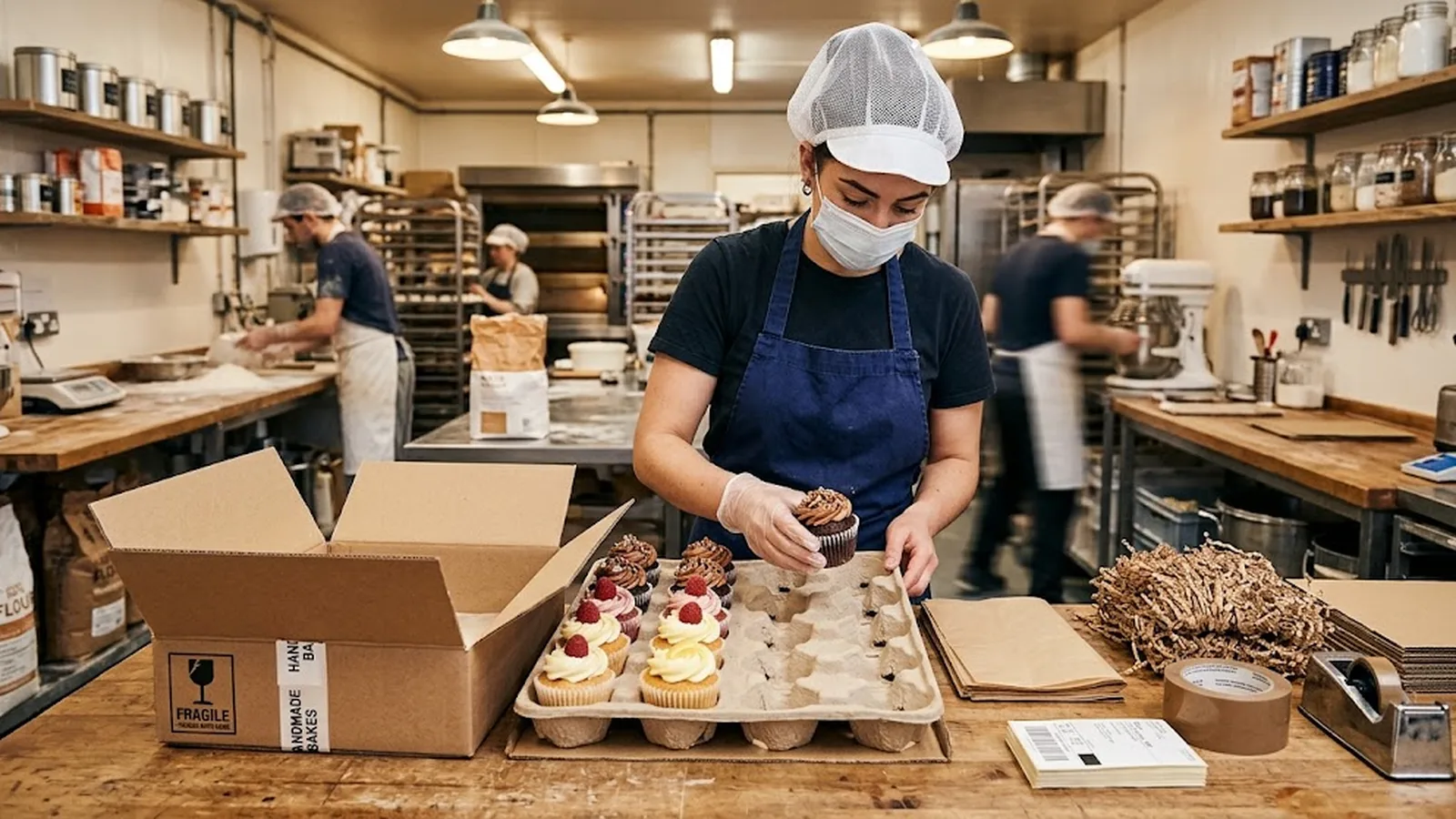
Cup construction sets the ceiling on transit survival, but the packing configuration decides how much of that ceiling is reached. The first decision is unit containment: cups ship either in moulded pulp or corrugate inserts with one cup per cell, or in nested stacks with interleaving. Inserts cost more per order but isolate each cup — the right answer for decorated, high-value desserts — while nested stacks are economical for undecorated business-to-business volumes.
The second decision is the outer carton. E-commerce dessert parcels usually travel in single-wall corrugate, and the carton's compression rating has to be read against realistic stack heights in courier networks, not against the packing bench. Undersize cartons transfer crush directly to the cups; oversize cartons let the inner pack shift, converting the void into a percussion problem at every sort. Void fill should lock the insert in place rather than pad it loosely.
The third decision is sealing and labelling discipline: tape patterns, carton orientation markings and humidity-sensitive declarations should be written into standard work the same way they are on a production line, because the best-specified pack still fails if the bench varies. For brands consolidating the whole pack — cup, liner, insert and carton — from one supplier, mismatch between cells and liners is removed by quoting food-grade die-cut parchment rounds alongside the cup programme.
Moisture, Fat and Time: Acceptance Testing Before the First Bulk Order
Parcel failures are cheap to simulate and expensive to discover in reviews. A pre-order acceptance test needs only courier-realistic conditioning and three checks: condition packed samples at elevated humidity overnight, then run a compression check against the expected stack load and a sustained vibration check — a road trip in the back of a van is an acceptable substitute. Inspect for base separation, wall creasing, grease transmission to the insert and rim deformation.
Fat migration deserves its own window because it is time-dependent: a cup that is dry on arrival may still show a grease shadow after the parcel sits on a doorstep in warm weather, so test the full transit duration plus the consumer's realistic holding period, not just the courier leg. Documented acceptance criteria — conditioning, loads, durations and pass thresholds — give both sides an agreed definition of "arrived intact" and something to hold reorders to.
FAQ
Do thicker cups always survive shipping better?
Not automatically. Compression behaviour comes from wall structure and base attachment as much as grammage, and an over-thick cup adds cost and complicates insert fit. Specify by conditioned compression and vibration performance, not by weight alone.
Should decorated and undecorated desserts ship in the same cup specification?
Usually not. Decorated desserts need the isolation of individual-cell inserts and stiffer walls; undecorated or business-to-business volumes can often travel nested at lower pack cost.
How does grease resistance interact with parcel transit?
Vibration and time work fat to the base seam, so grease performance matters on e-commerce routes even for recipes that never showed shadows in counter service. Test for grease transmission to the insert after the full transit-plus-holding duration.
Can one supplier cover cups, liners and cartons?
Cups and paper liners commonly come from the same paper programme, while corrugate often comes from a local converter. Specify cell dimensions, liner diameters and carton internals in one drawing so the three components are procured against the same tolerance chain.
What should an e-commerce buyer put in the RFQ?
Cup diameter and depth with tolerances, base attachment method, wall construction, grease-resistance grade, conditioned compression and vibration acceptance criteria, and the pack configuration including insert and carton. Quote against the pack, not the cup alone.
Conclusion
Shipping cake cups by courier turns a display item into a structural package, and the specification has to follow. Compression and vibration failures trace back to base attachment and wall structure; humidity and fat failures trace back to the grease-resistance grade and the acceptance test never simulating the full journey. Packing configuration — inserts, carton and void discipline — decides how much of the cup's tested performance survives contact with the courier network.
The buying method is the same as any packaging programme: define the transit scenario honestly, write conditioned acceptance criteria into the RFQ, run the pre-order test on the finished pack rather than the cup alone, and hold reorders to the same records. Buyers verifying these specifications can review the certificate library alongside supplier documentation requests before placing the first bulk order.
CTA
Send us your dessert types, pack configuration and destination markets. We will match a cake cup construction for courier distribution — wall structure, base attachment and grease-resistance grade — supply pre-production samples, and quote the matching liners and die-cut rounds so the whole pack is specified against one tolerance chain.
Sources
- ISTA transit testing procedures (compression and vibration): https://www.ista.org/
- ASTM packaging performance test standards: https://www.astm.org/
- FDA food-contact substances framework: https://www.fda.gov/food/food-ingredients-packaging/food-contact-substances-fcs
- European food-contact materials framework (EC 1935/2004): https://eur-lex.europa.eu/legal-content/EN/TXT/?uri=celex%3A32004R1935