
Introduction
Ask a bakery buyer what they need from a cake cup supplier and the answer is often "standard size." In practice, that phrase hides more variation than any other specification in the order. Two suppliers can both ship a "standard cupcake cup" and the finished products can look and bake differently, because the capacity of the cup, the depth of the sidewall, and the way batter rises against paper all change the result. For wholesale buyers, capacity is not a detail — it is the core functional specification, and getting it wrong shows up as overflowing batter in the oven, undersized portions on the retail shelf, or a mismatch between the cup and the filling equipment downstream. Cup programmes usually ship alongside pan lining; our baking parchment paper manufacturing programme specs cover the sheets and rolls that pair with them.
This guide explains how cake cup capacity is measured, what the common ml and oz ranges are, how fill ratios and batter rise should shape your choice, and how to run a sizing conversation with a supplier so the sample you approve is the carton you actually receive. Buyers verifying these specifications can review the certificate library alongside supplier documentation requests.
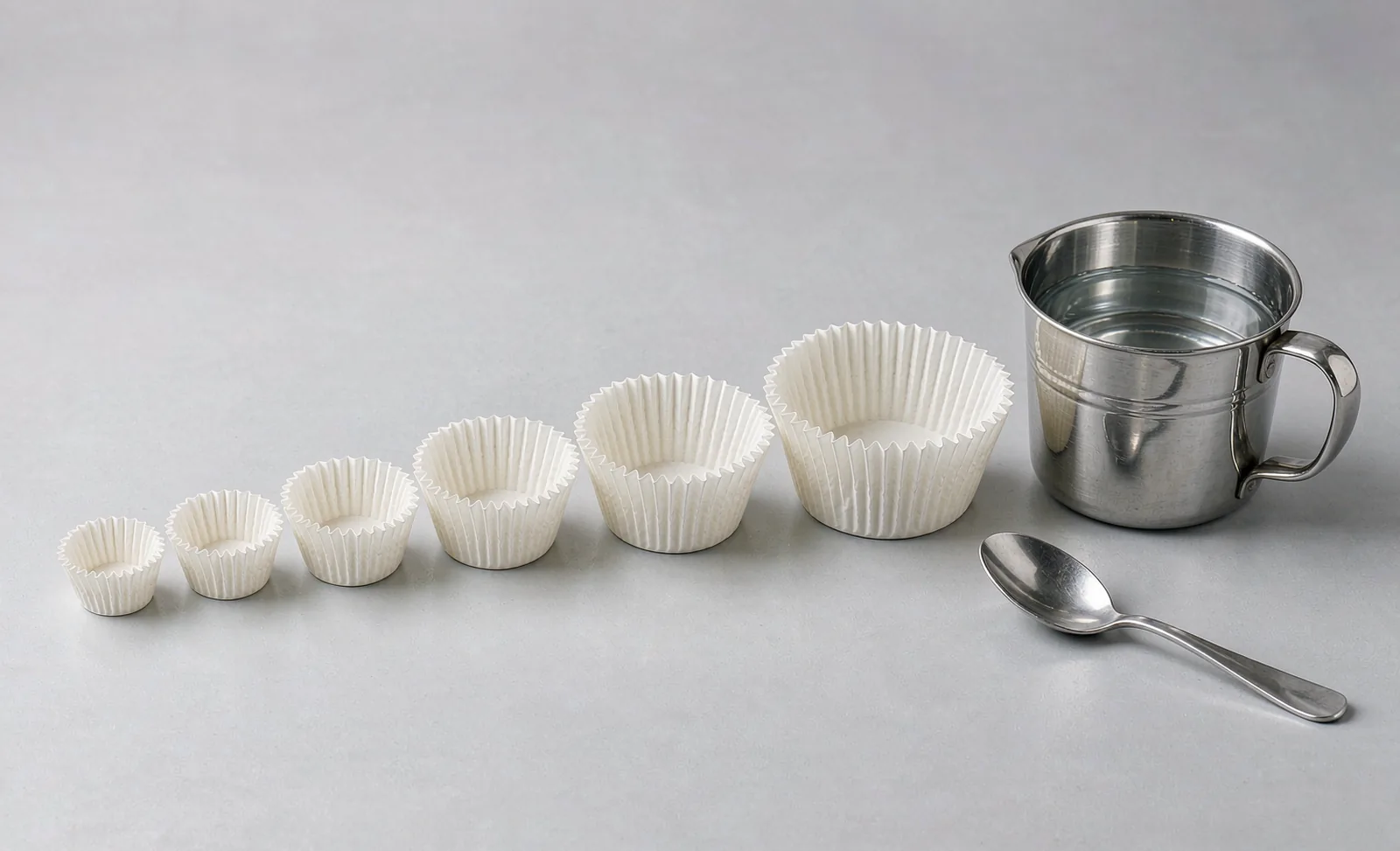
How Cake Cup Capacity Is Measured: ml and oz Ranges
Cake cup capacity is the volume the cup holds when filled level to its rim, usually stated in milliliters, with fluid ounces given for US buyers. A useful rule of thumb for converting: 1 fl oz is approximately 29.6 ml. Suppliers normally state capacity as a nominal figure with a tolerance, and the tolerance matters as much as the number. A cup listed at 60 ml ± 5% behaves very differently from one listed at 60 ml ± 15% when your depositor is set to a fixed shot. Where a bakery lines trays and moulds product in the same run, our private-label parchment paper supplier are quoted with the cup programme for a single documentation package.
Typical ranges you will encounter in wholesale catalogs:
- Mini cups and petite fours: roughly 15–30 ml (0.5–1 fl oz), used for bite-size desserts, tasting portions, and confectionery.
- Standard cupcake and muffin cups: roughly 60–90 ml (2–3 fl oz). This is the workhorse size for retail bakeries and in-store bakery departments.
- Jumbo muffin and tulip cups: roughly 120–180 ml (4–6 fl oz), common for café muffins, brunch menus, and premium gift assortments.
- Dessert and pudding cups: roughly 100–250 ml (3.5–8.5 fl oz), used for chilled desserts, mousses, and no-bake products where the cup is the serving vessel.
When comparing quotes, always ask whether the capacity quoted is measured to the rim or to a practical fill line, and whether it was measured with water or with a typical batter. Paper sidewalls flex, so the same flat blank can measure differently depending on how the cup is flared during the test. The factory and certificate library lists the third-party audits and test reports behind these claims.
Fill Ratios and Batter Rise: Why the Rim Is Not the Limit
The single most common sizing error is treating capacity as the fill volume. Cake batters rise during baking, sometimes by 30–50% depending on leavening, sugar content, and recipe structure. If you fill a cup to its measured capacity, you are planning an overflow.
Commercial bakers work with fill ratios — the share of the cup's capacity that is actually filled with batter:
- Dense batters and brownies: 70–80% fill is usually safe, because rise is modest.
- Standard cake and muffin batters: 50–66% fill is typical; a 60 ml cup takes roughly a 35–40 ml batter deposit.
- High-rise or high-sugar batters: 45–55% fill, with headroom reserved for doming.
The paper itself changes the equation. Batters release steam against the sidewall, and a grease-treated or double-pressed paper cup holds its shape during rise better than a lightweight single-wall cup, which can bow outward and spill at a lower fill than the specification suggests. When you test samples, run them with your own recipe at your own fill setting rather than judging the cup by its catalog capacity alone.
Matching Cup Size to Product and Equipment
Capacity is only half of the sizing decision. The cup also has to fit everything around it:
- Product positioning. A 90 ml cup filled to a 55% ratio delivers roughly a 50 ml portion. If your nutrition panel or menu states a portion weight, work backwards: portion weight in grams divided by batter density (roughly 1.0–1.1 g/ml for most cake batters) gives the batter deposit volume, and the cup should sit 1.5 to 2 times above that figure.
- Baking trays and pans. Check the base diameter and the flared rim diameter against your pans. A cup with too wide a rim blocks adjacent cavities; a base that is too small tips in shallow trays.
- Depositors and filling lines. Volumetric depositors are set in ml or grams. Agree the fill volume with the supplier at the same time as the capacity so the sample approval covers the full filling setup.
- Retail and packaging. Cup height determines how many units fit in a clamshell or flow-wrap and whether the finished product stands above the film. Always trial packed units, not just baked ones.
Running the Sizing Conversation with Your Supplier
Wholesale buyers get better outcomes when sizing is discussed as a set of numbers, not a name. A productive specification conversation covers:
- Nominal capacity and tolerance, measured to rim and to practical fill line.
- Base diameter, rim diameter (flared and unflared), and wall height.
- Paper grammage and any grease-resistance treatment, since these affect how the cup holds shape under wet batter.
- Intended fill ratio and the buyer's recipe type, so the supplier can recommend wall strength and construction.
- Sample baking protocol: the buyer's recipe, the buyer's fill setting, and a defined number of bake cycles.
Ask the supplier to confirm all five points in writing on the specification sheet. If a supplier cannot state a tolerance on capacity, treat that as a risk signal for batch-to-batch consistency.
Common Sizing Mistakes Wholesale Buyers Should Avoid
- Confusing capacity with fill volume, which leads to overflow and wasted batter.
- Specifying by product name ("cupcake size") instead of by dimensions, because names vary between suppliers and regions.
- Ignoring tolerance. A ±15% tolerance on a 60 ml cup means batches could legally range from 51 to 69 ml.
- Testing samples with a different recipe than production. Sugar and fat levels change rise behavior dramatically.
- Forgetting post-bake shrinkage of paper. Some lightweight cups pull in slightly after baking, changing the packed presentation.
- Ordering a new size without a pilot run. Always bake and pack at least one full production shift's worth of samples before committing to volume.
FAQ
Q: What capacity is a standard cupcake cup?
A: Most standard cupcake and muffin cups fall between 60 and 90 ml (2–3 fl oz) measured to the rim. Actual batter deposit is usually 35–55 ml depending on the recipe and desired doming, so confirm the fill ratio with your supplier before approving a size.
Q: How full should I fill a paper cake cup?
A: As a starting point, fill standard cake batters to 50–66% of stated capacity, dense batters to 70–80%, and high-rise batters to 45–55%. Then adjust based on a trial bake with your own recipe, since leavening and sugar content drive how much the batter rises.
Q: Are ml and oz capacities interchangeable when importing?
A: Convert using 1 fl oz ≈ 29.6 ml, but never rely on conversion alone. Ask the supplier for the measured nominal capacity and tolerance in the unit your production team uses, and record both units on the specification sheet to avoid rounding errors between markets.
Q: Why do two cups with the same capacity bake differently?
A: Capacity is one dimension of performance. Wall height, base diameter, paper grammage, and grease treatment all affect how the cup holds batter and heat. Two 60 ml cups with different sidewall construction can produce visibly different dome shapes and edge browning.
Conclusion
Cake cup sizing is a chain of connected numbers: capacity and tolerance, fill ratio, batter rise, tray fit, and pack presentation. Wholesale buyers who specify each link explicitly — and validate them with a production-recipe trial bake — avoid the overflow, portion drift, and packaging surprises that come from ordering "standard" sizes. Treat capacity as a documented specification with a tolerance, not a catalog label, and your sampling rounds will shrink and your first shipments will match what you approved. Buyers standardising on one paper supplier can review our pre-cut parchment paper sheets and rounds next to their cup specifications.
Call to Action
LANGMAI supplies wholesale cake cups and baking cups in a full range of capacities, from 15 ml minis to 250 ml dessert cups, with documented tolerances and sample support for trial bakes. Send us your recipe type, fill volume, and tray layout, and our team will recommend the right size and paper construction for your line. Request samples and a quotation at https://www.lmcakecup.com.
Sources
- King Arthur Baking Company — Ingredient Weight Chart (batter and ingredient weights): https://www.kingarthurbaking.com/learn/ingredient-weight-chart
- AIB International — Baking production and food safety resources: https://www.aibinternational.com/
- FDA — Food Ingredients and Packaging (background on food-contact paper considerations): https://www.fda.gov/food/food-ingredients-packaging