
Introduction
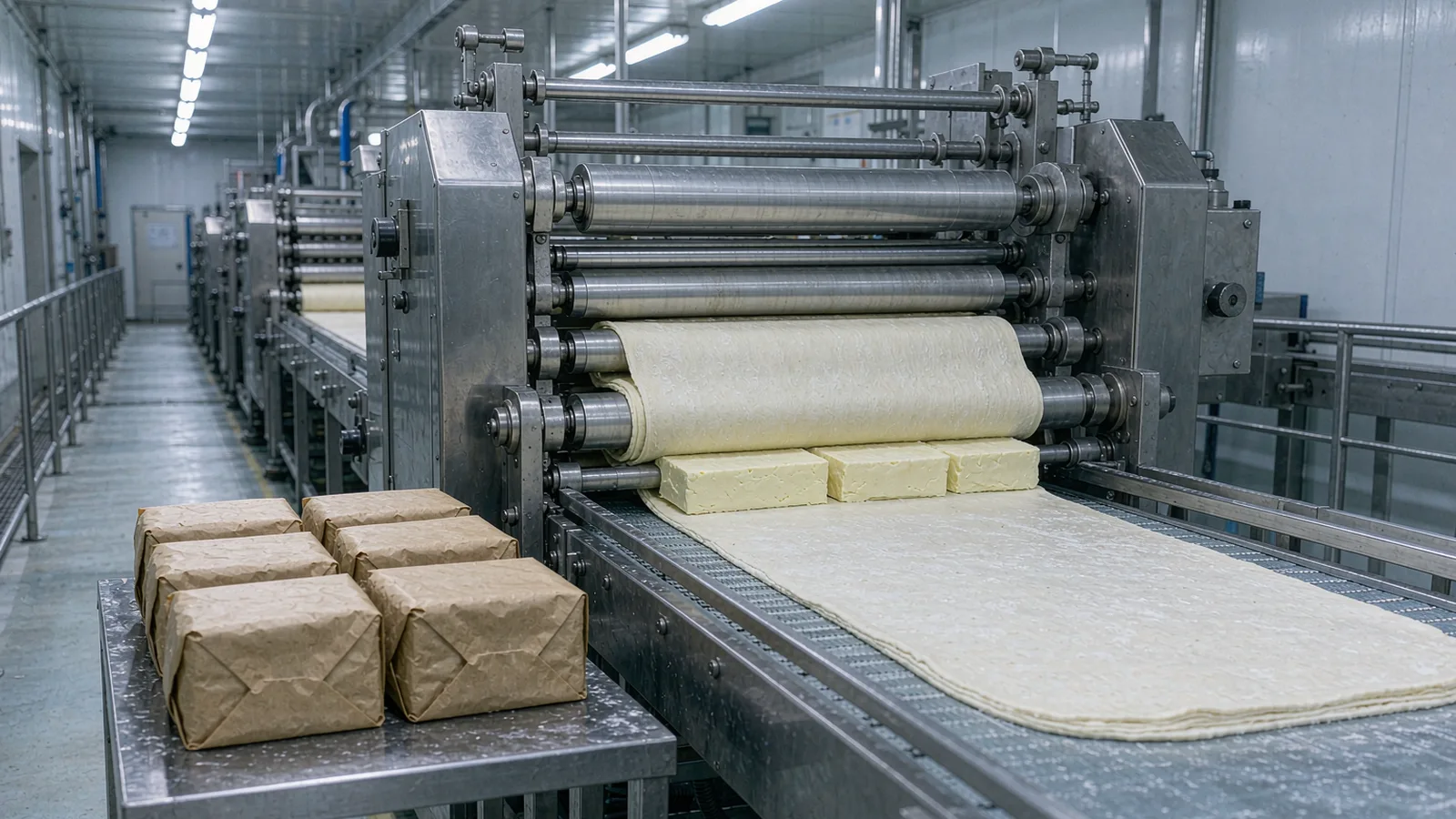
Every laminated pastry line — croissant, puff pastry, danish — starts with a block of butter or margarine, and that block arrives wrapped in paper. The wrap looks like a minor consumable next to sheeters, proofers and tunnel ovens, but it decides whether the fat reaches the line at the right consistency and condition. A wrap that lets grease bleed through stains cartons and leaves butter surfaces oxidising where the paper has soaked through; a wrap that unfolds in the cold room forces hand re-folding and slows the staging area that feeds the lamination line.
Buyers therefore specify butter block wrapping paper on two properties above all: grease penetration resistance under sustained fat contact, and fold integrity at chill temperatures. Construction options range from dense greaseproof and glassine bases to silicone-coated parchment, in the same 35–45 gsm range used across baking parchment, with coating weights from 0.7 g/m² upward depending on fat contact time. For production volumes, the same construction logic applies to our wholesale parchment paper rolls and sheets line, quoted per roll, sheet or die-cut format.
Why the Butter Wrap Matters to Lamination Line Output
Lamination depends on butter behaving as a plastic sheet: firm enough to stay distinct from the dough, soft enough to spread without fracturing. The wrap protects that state from the moment the block leaves the butter printer or margarine depositing head until it is unwrapped at the hoist, and three failure modes trace back to the paper.
First, grease penetration. Butter fat migrates into any porous surface it touches; a wrap with insufficient resistance wicks fat to its outer face within days of chilled storage, producing translucent patches, carton staining and blocks that stick together in the case. Second, fold failure. Blocks are wrapped with tight folds that must hold through palletising, chilled distribution and cold-room staging; a paper too stiff for the fold gauge springs open and exposes the fat surface to air and odour pick-up. Third, dimensional drift. Butter printers cut and fold at machine speed against fixed fold plates, so a sheet outside the agreed width or squareness tolerance jams the wrapper — the same tolerance discipline buyers already apply to pre-cut dough interleaves.
Because the wrap sits at the head of the chain, its defects propagate downstream and get blamed on the pastry process. Specifying it deliberately removes one of the quieter variables in lamination yield.
Grease Penetration Control: Comparing Constructions
The construction choice for butter contact comes down to three families. Dense greaseproof and glassine bases resist fat through refining — the fibres are beaten until the sheet is nearly pore-free — with resistance measured by the Kit rating used across greaseproof specifications. Silicone-coated parchment resists through surface chemistry: a silicone layer on a 35–45 gsm base releases fat on the surface instead of absorbing it, with coating weights from 0.7 g/m² up to 1.5 g/m² for sustained contact. Laminated or polymer-coated wraps offer the highest barrier but complicate repulping and food-contact documentation.
For butter block work, the practical comparison is fat contact time. Blocks stored for days under sustained, full-surface contact punish any patchy barrier, which is why coating uniformity matters as much as total coating weight — a defect the size of a fingerprint will bleed while the rest of the sheet stays clean. Ask suppliers for grease-resistance data on the actual construction at chilled storage durations matching your distribution model, rather than accepting a generic "greaseproof" label. Where a PFAS-free declaration is required, our PFAS-free baking paper programme documents the transition grade by grade, since grease barriers historically relied on fluorochemical treatments that several markets now restrict.
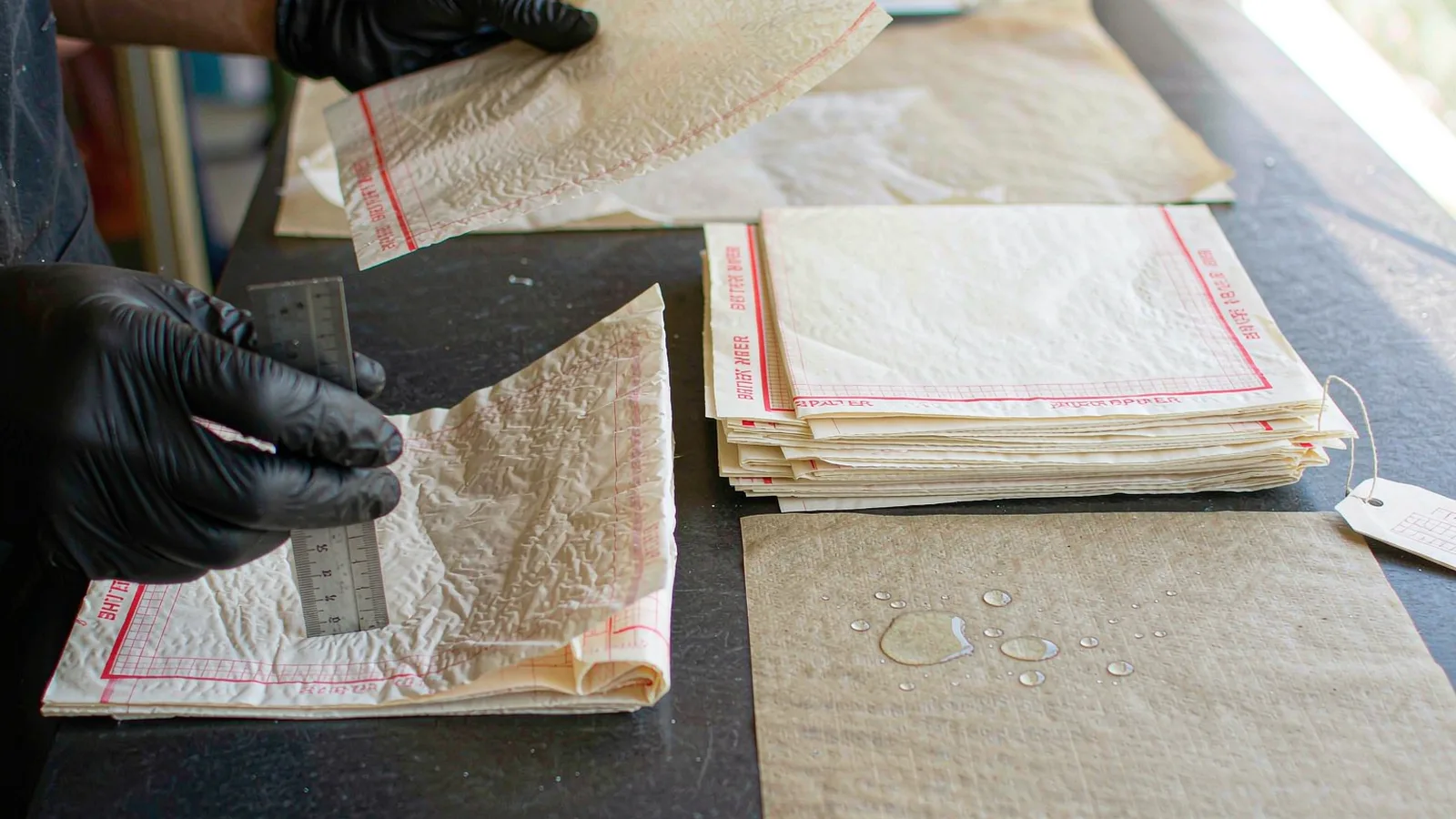
A useful acceptance test is simple: wrap a conditioned fat block, hold it at chill temperature for the longest realistic transit time, then inspect the outer face for wetting and weigh the sheet for fat pick-up.
Cold-Room Behaviour: Fold Integrity and Surface Condition
The wrap spends most of its life below room temperature, and paper behaves differently there. Moisture from the fat and from chilled air condenses on surfaces as blocks move between temperature zones; a wrap that takes up that moisture softens, and a softened fold crease relaxes. Fibre stiffness also rises as temperature falls, so a fold that forms cleanly at the converter can spring partially open at deep-chill storage.
Testing therefore has to reproduce the cycle, not a single condition: form the fold at wrapping temperature, hold at chilled and deep-chill storage, then inspect fold retention and outer-face condition after the full holding period. Suppliers should be able to produce the cold-holding data behind each grade on request, alongside the coating and grammage values already documented for the construction. Surface condition matters to the pastry plant as much as the fold: a wrap that releases cleanly from the fat — as silicone-coated constructions do — leaves the block surface intact, so the butter enters the sheeter with its plastic consistency undisturbed rather than with a fat-skinned outer layer stuck to torn paper fibre.
Custom Sizes, Folds and Buying at Wholesale Volume
Butter wrapping is a cut-to-machine business. Wrapper fold plates, butter printer formats and block weights vary by plant and by market — 250 g, 500 g and 1 kg blocks each carry their own sheet dimensions — so the RFQ should state the finished sheet size, fold pattern, wrapping-machine model and storage duration together. Supplied as jumbo rolls for printer-fed lines or as pre-cut folded sheets for hand-wrap and semi-automatic stations, the same construction serves both; our pre-cut parchment paper sheets and rounds programme publishes the test data behind each grade so specifications can be verified before ordering.
MOQ follows width utilisation: a sheet width that cuts efficiently from a standard jumbo roll prices very differently from an off-standard width that strands trim. Print adds plate cost and minimum run lengths, which is why brands often start with unprinted wrap for the fat-contact face and reserve printed wrap for outer layers. Buyers verifying these specifications can review the certificate library alongside their supplier documentation requests before committing to a volume.
Lead-time planning should treat the wrap like any other line-critical consumable: agree a specification and an approved sample, then hold rolling stock against the wrapper's consumption rather than rebuying against each butter campaign.
FAQ
Can one construction both wrap butter blocks and line the sheeter?
Often yes. A silicone-coated parchment in the 35–45 gsm range that releases cleanly from fat works as both a butter wrap and a release liner at the make-up table. Validate both uses in the same trial, since contact time and temperature profiles differ.
Is greaseproof paper or silicone-coated parchment better for butter contact?
Greaseproof and glassine resist fat through fibre density and suit shorter contact periods; silicone-coated parchment resists through its surface and suits sustained, multi-day contact. The deciding test is outer-face wetting after your longest realistic chilled storage.
What sheet dimensions do butter printers require?
Dimensions follow the block weight and the wrapper's fold plates — 250 g, 500 g and 1 kg formats each use a distinct sheet size. State finished width, length, fold pattern and the wrapper model so tolerance is set where jams happen.
Does the wrap need different behaviour in the cold room than at ambient?
Yes. Folds formed at wrapping temperature must hold after chilled and deep-chill holding, and condensation during temperature transitions softens paper that has taken up moisture. Specify a cold-holding test as part of acceptance.
What MOQ applies to custom widths or printed butter wrap?
MOQ depends on width utilisation from the jumbo roll, print plate costs and minimum run length. Efficient widths quote lowest; off-standard widths and short print runs carry premiums that shrink at annual volumes.
Conclusion
Butter block wrapping paper earns its specification at the head of the lamination chain, where its failures are cheapest to fix and its defects are most expensive to trace. Grease penetration control decides whether blocks arrive clean; fold integrity at chill decides whether the wrap is still doing its job when the case is opened; dimensional accuracy decides whether the butter printer runs or jams. None of these properties is exotic — they are documented construction characteristics of greaseproof, glassine and silicone-coated bases in the standard 35–45 gsm band.
The buying path mirrors the testing path: define contact time and temperature history, compare constructions with a chilled holding trial, lock the sheet dimension to the wrapper, and approve a physical sample before the first campaign. Buyers comparing these specifications can review our silicone-coated parchment sheets and rolls programme, where coating weight, base grammage and release values are documented per construction.
CTA
Send us your butter block weights, wrapper model and chilled storage duration. We will match a wrap construction — greaseproof or silicone-coated, rolls or pre-cut folded sheets, plain or printed — and supply pre-production samples for a cold-holding trial against your current wrap.
Sources
- Silicone coating and paper release mechanisms: https://www.sciencedirect.com/topics/food-science/silicone-coating
- Grease resistance and Kit rating background: https://www.tappi.org/
- FDA food-contact substances framework: https://www.fda.gov/food/food-ingredients-packaging/food-contact-substances-fcs
- European food-contact materials framework (EC 1935/2004): https://eur-lex.europa.eu/legal-content/EN/TXT/?uri=celex%3A32004R1935
- Baking and pastry industry production references: https://www.bakingbusiness.com/