Introduction
Release is one of those unglamorous specification decisions that quietly shapes cost, hygiene and quality in every commercial baking operation. Two systems dominate: silicone-coated baking parchment laid into trays, pans and tins, and fat-based pan sprays or liquid greasing applied directly to the metal. Industrial bakeries rarely run a pure programme of either — bread plants may grease tins and line oven trays with parchment, while pastry and cookie lines may rely on coated sheets alone. The right answer depends on product geometry, tray turnover and the cost structure of the line, not on habit. This guide compares both methods across release performance, cost per bake, hygiene and compliance, so wholesale buyers and bakery operations teams can specify the correct system per product family. Buyers comparing release systems can review our baking parchment paper manufacturing programme, where coating weight and release values are documented per construction.
How Release Works: Silicone Coating vs Fat-Based Release Agents
Silicone-coated parchment releases by surface chemistry. A cured silicone layer, typically applied at 0.7–1.5 g/m² depending on the grade, creates a low-surface-energy barrier between dough and pan that does not transfer to the product. Release is consistent from sheet to sheet because the coating weight is controlled in production and verified by test data — which is why a buyer can approve a pre-production sample and expect the same result across a container load.
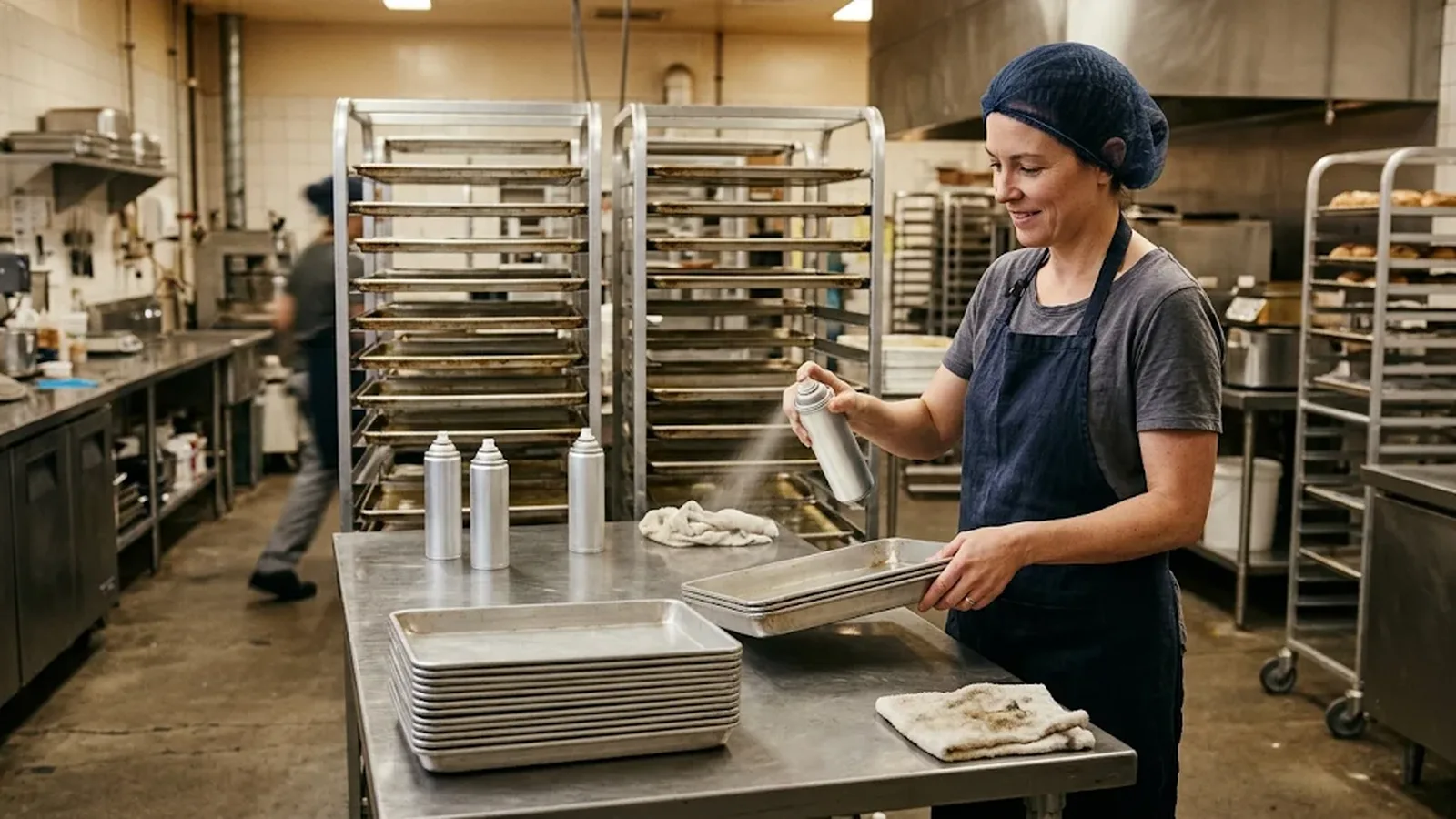
Fat-based sprays and liquid greasing work differently: oil fills the microscopic texture of the pan and physically separates dough from metal. Release quality depends on the operator or sprayer covering the full surface every cycle, and it degrades as oil pools, migrates or polymerises under repeated bake cycles — the dark lacquer that builds up on poorly cleaned pans is polymerised oil, and it is itself a release variable. High-sugar and high-moisture doughs stress both systems in different ways: caramelising sugars can bond to metal through a thin or patchy oil film, while the same dough releases cleanly from a uniform silicone surface. Sticky applications are usually the first to migrate from spray to lined trays.
Cost per Bake: Lining Economics vs Spray Consumption
A single sheet of 40 gsm parchment costs a few cents; a second of spray oil costs less. But cost per bake must be counted across the whole line, and that is where the comparison inverts for most volume products. A lined tray releases on the first bake with no rework, needs no cleaning between cycles in continuous tray flow, and drops into waste or compostable streams at the end of its life. Spray systems carry hidden costs: rework when release fails and product tears on de-panning, pan-washing labour and detergent consumption, oven downtime for periodic carbon removal, and the housekeeping burden of aerosol application — overspray coats floors, walls and extraction hoods, creating slip risks and cleaning regimes that food-safety audits notice.
Sprays also consume faster than buyers expect in high-volume operations, because every pan in circulation needs re-application each cycle. For volume lines running the same product all day — cookies, scones, sheet cakes, par-baked bases — the lined-tray cost curve flattens with scale, which is why distributors quote wholesale parchment paper rolls and sheets on per-pallet terms for exactly these applications. Where product geometry is irregular — bundt tins, loaf moulds, deep artisanal shapes — cut-to-shape liners or greasing remain the practical choice, and hybrid lines running both systems are common.
Line Hygiene, Food Safety and Compliance
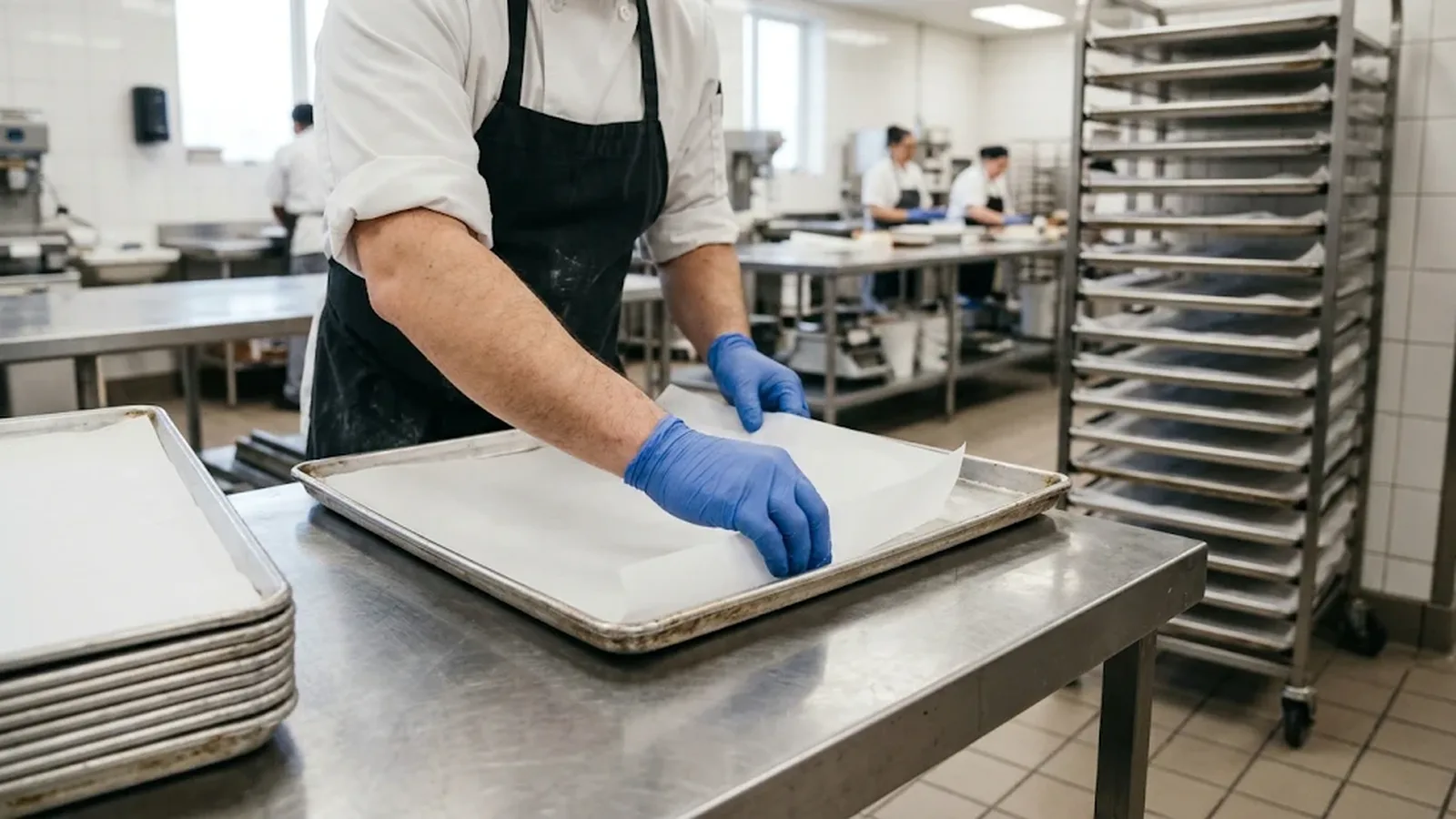
Lining with parchment changes the hygiene profile of a bake line. Because dough never contacts the metal, trays stay cleaner between cycles, pan-washing frequency drops, and the allergen-changeover question narrows: a fresh liner per run removes one cross-contact pathway, provided liners are stored sealed and handled with clean gloves. Spray systems invert the logic — every pan in circulation carries an oil film that collects airborne flour, crumb and caramelised residue, so cleaning validation and carbon-removal schedules carry more weight in the food-safety plan.
Compliance differs too. Silicone-coated parchment is a finished food-contact article: FDA 21 CFR 176 and EU Regulation (EC) No 1935/2004 define the documentation set, and a reputable factory supplies declarations and migration test reports per construction. Aerosol release agents are formulated food ingredients rather than packaging, so they import their own labelling, allergen and storage requirements into the bakery's ingredient system. The factory and certificate library lists the third-party audits and test reports behind these claims, and buyers consolidating documentation should confirm the paper declarations match the grade actually shipped.
Where Pan Sprays Still Win
A balanced comparison has to give sprays their due, because parchment does not fit every mould. Spray or brush greasing wins where geometry defeats a flat liner: bundt and kugelhopf moulds, decorative tins, deep loaf forms and flexible silicone moulds where a cut liner leaves exposed corners. Sprays also suit short-run, high-variability kitchens — hotel and restaurant pastry sections, R&D kitchens, pilot plants — where keeping ten liner shapes in stock costs more than a case of spray. In some artisanal bread processes, greased tins are part of the crust identity: the oil contributes colour and texture the baker wants, not just release.
The practical conclusion most operations reach is hybrid rather than either-or: flat and semi-flat products on lined trays, irregular moulds on grease or spray, and the choice documented per product family with a cost-per-bake justification. What buyers should avoid is drifting into spray-by-default because liners were out of stock — release failures and pan build-up quietly return the cost the liner would have saved.
FAQ
Is parchment paper or pan spray cheaper in commercial baking?
For high-volume flat products, lined trays usually win once rework, pan washing and cleaning are counted; sprays look cheaper per application but are consumed on every pan, every cycle. Irregular moulds and short-run kitchens are often cheaper on spray, because liner stock and die-cutting are not justified.
Can you use pan spray on top of baking parchment?
Usually unnecessary. A correctly specified silicone coating at the right weight for the application releases on its own, and adding spray adds oil transfer to the product and residue build-up. If release fails on lined trays, the first step is a coating-weight and release test on the grade, not more oil.
What documentation should a wholesale buyer request for release performance?
Coating weight per construction, release test results (dry and wet methods where relevant), food-contact declarations under FDA 21 CFR 176 or EU Regulation (EC) No 1935/2004, and retained samples tied to the shipment. Buyers can then judge release on data rather than catalogue claims.
When should a bakery switch from spray to lined trays?
When volume justifies it: consistent product geometry, multiple bake cycles per shift, and measurable rework or cleaning cost from spray systems. A bake trial on the actual product — comparing de-panning yield, tray turnaround and cleaning interval — settles the economics faster than any spreadsheet.
Conclusion
Release method is a per-product specification, not a plant-wide habit. Silicone-coated parchment wins on consistency, hygiene and scaled cost for flat and semi-flat bakes; sprays and greasing keep the win where geometry, short runs or crust character demand it. Buyers who specify both per product family, document the food-contact file behind the chosen liner, and validate with a bake trial before converting the line get predictable de-panning and audit-clean documentation. Commercial programmes can be specified from our silicone-coated parchment sheets and rolls with samples approved before mass production, and buyers verifying specifications can review the certificate library alongside supplier documentation requests.
CTA
Running a release-method conversion on a bake line? LANGMAI manufactures silicone-coated baking parchment in sheets, rolls and die-cut formats, supplies release test data and food-contact documentation per construction, and supports bake trials with pre-production samples before mass production. Request samples and a quotation for your product families.
Sources
- US FDA — 21 CFR Part 176, Paper and paperboard components: https://www.ecfr.gov/current/title-21/chapter-I/subchapter-B/part-176
- European Commission — Food contact materials: https://food.ec.europa.eu/food-safety/food-contact-materials_en
- EFSA — Food contact materials scientific evaluations: https://www.efsa.europa.eu/en/topics/topic/food-contact-materials
- US FDA — Food Additive & Ingredient Assessment (GRAS): https://www.fda.gov/food/food-additives-petitions