
Introduction
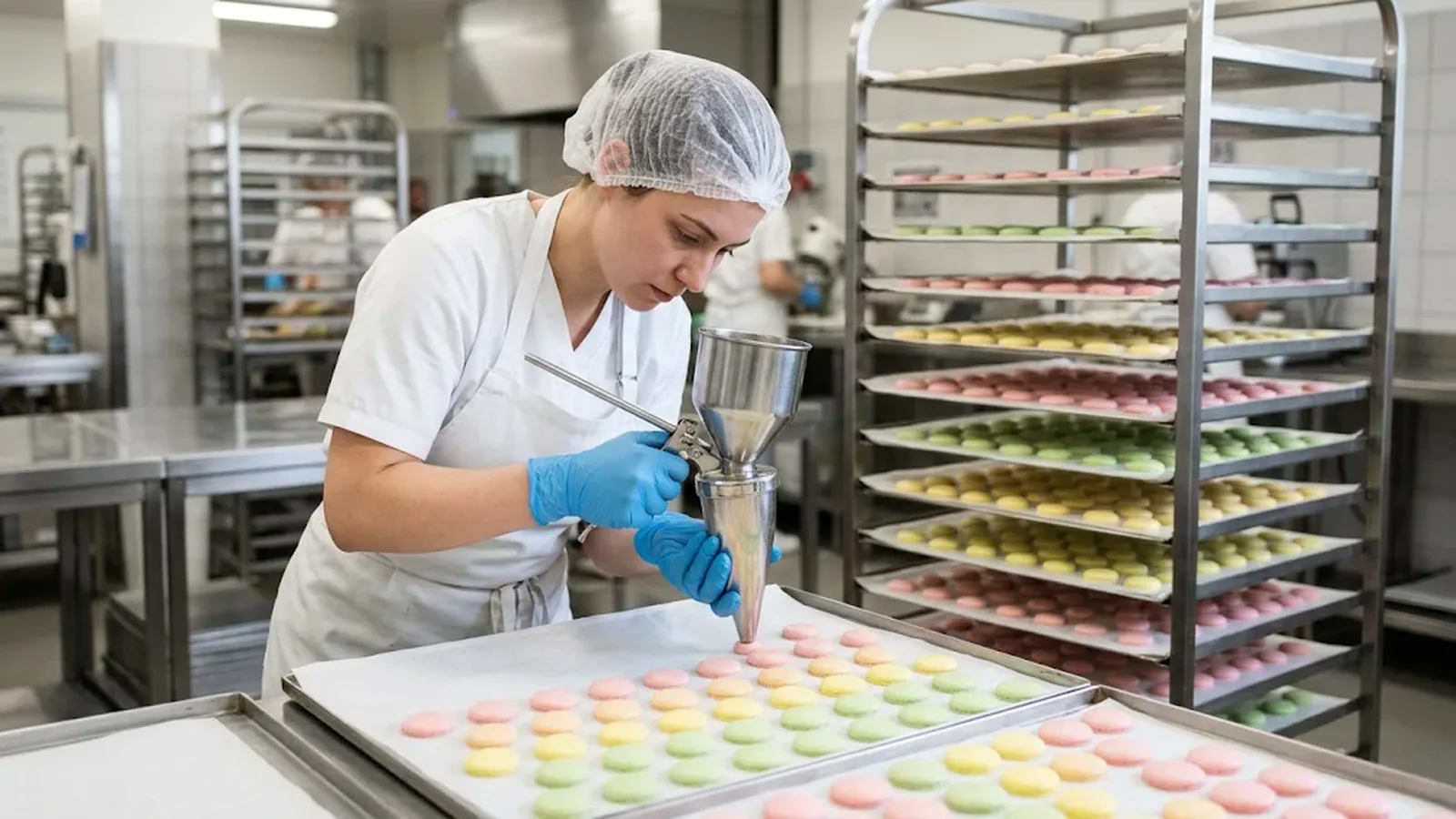
Macarons and meringue-based products are among the most specification-sensitive applications an industrial patisserie can run on a lined tray. The batter is high in sugar and low in moisture, is deposited as precisely counted rounds, and develops its entire commercial value in a thin, fragile shell whose foot, colour and surface finish are graded before filling. A lining system that works for cookies or bread can fail here: under-specified release shows up as shells that lift incompletely and hollow out, while a liner that curls or shifts under the piping head moves every deposit target on the tray. This guide covers how silicone-coated parchment behaves under high-sugar, low-moisture deposits, how to choose sheet formats and alignment aids for piping lines, what repeated batch baking demands from the paper, and which documents a wholesale buyer should collect before committing a patisserie programme. Buyers comparing these specifications can review our silicone-coated parchment sheets and rolls, where coating weight, base grammage and release values are documented per construction.
Why Macarons and Meringues Stress a Lining System
The properties that make these products distinctive are the same ones that make them hard on liners. First, the deposit is almost pure sugar and albumen: before the shell sets, it sits on the paper as a viscous, glossy bead, and the release interface has to hold until the structure forms, then let go without pulling the foot away from the sheet — the same high-sugar release condition parchment is validated for before shipment. Second, the bake itself is gentle compared with bread or pizza: shells dry and set at moderate oven temperatures, so the liner never benefits from the aggressive heat that forces release in other categories, and coating quality has to do the work instead. Third, dimensional discipline is absolute. Macaron diameter drives filling weight, count per pack and retail box fit, and piped meringue nests or kisses are sold by shape and height; a liner that waves, curls or shifts under the depositor moves the shell centre and produces off-spec rounds that no decorating step can recover.
Coating uniformity matters as much as the average coating weight here. A grade with an inconsistent silicone distribution will release the middle of the sheet and grip the edges, exactly where the outer rings of a piped tray sit, and the defect pattern will be mistaken for batter formulation problems. This is why the acceptance gate for a macaron programme is a bake trial on the actual deposit — resting, piping and baking the real formulation on candidate liners — rather than a catalogue sample or a generic release claim.
Sheet Formats, Templates and Deposit Alignment
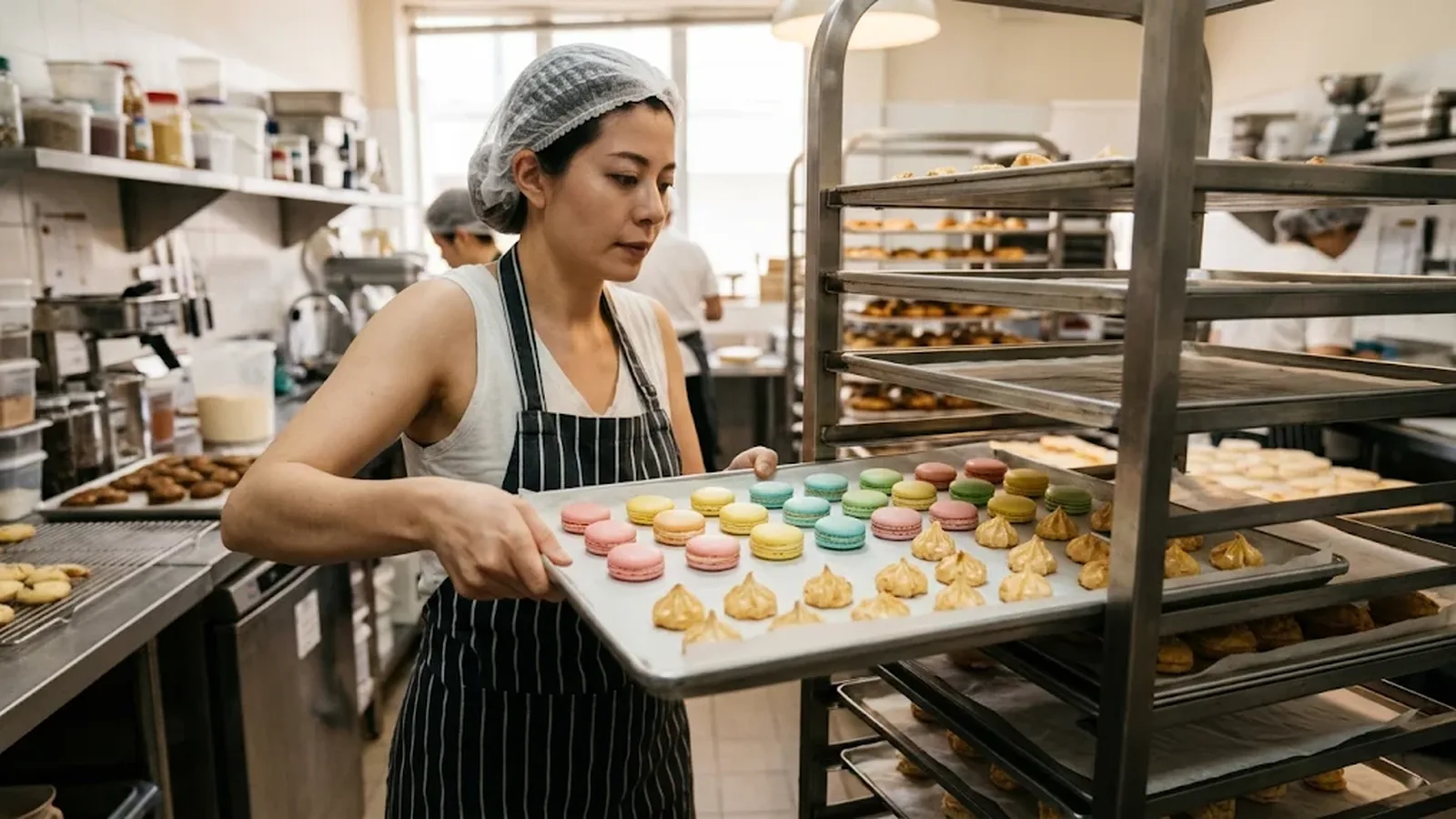
Macaron and meringue production is tray-based, so format decisions start from the tray and the depositor. For hand-piped artisanal lines and pilot batches, pre-cut parchment paper sheets and rounds sized to the tray with a small undercut let decorators lay the liner flat in one motion and position it identically every cycle; consistent sheet placement is itself part of deposit alignment. For lines that pipe by machine or rely on printed guides, buyers can specify blank sheets or request faint template marking within agreed ink-migration limits, so piping targets are visible without contacting food directly. Where die-cut rounds matched to the tray diameter are preferred, die-cutting tolerance should be confirmed against the tray so the round sits flat and does not ride up on the tray lip during loading.
Two habits worth testing in the trial: double-panning, where a second tray is stacked over the liner to insulate delicate shells, and liner rotation between tray positions. Both change how heat reaches the shell bottom, and both should be run with the candidate construction rather than assumed, because flatness and heat response are documented properties of the base paper and coating system, not accidents of the sheet.
Batch Consistency, Anti-Curl Behaviour and Documentation
Patisserie programmes are judged batch to batch, so the liner has to perform identically across hundreds of tray cycles, not once in a demonstration. Anti-curl behaviour is the first specification to document: a liner that has curled after its first bake slows the next piping cycle and lifts shell edges on contact, and curl is a measurable property tied to base grammage and coating system. Release consistency follows — the buyer should require release data generated on a high-sugar deposit and repeated-bake test results matching the actual tray-turnaround pattern, because the gentle, low-moisture conditions of meringue work are precisely where under-specified coatings degrade first. For products chilled, frozen or shipped on the same paper after filling, odour neutrality and low-temperature behaviour should be confirmed as well.
On the documentation side, food-contact declarations for the finished article should be tied to the exact construction quoted, covering FDA 21 CFR 176 and EU Regulation (EC) No 1935/2004 for the destination market, with retained samples held against the pre-production trial so any later batch dispute has a physical reference. Every document in our compliance library is tied to a specific construction; see how the factory and certificate library aligns test reports with the exact grade supplied, and buyers verifying these specifications can review the certificate library alongside their supplier documentation requests.
FAQ
Can the same baking paper be used for macarons and meringues?
Usually yes, because both need clean release on a high-sugar, low-moisture deposit at gentle bake temperatures. The difference is dimensional: macaron shells demand tight deposit alignment for count and box fit, while meringue nests and kisses tolerate more spacing. Format choice — sheets, rounds or roll width — follows the tray and depositor, not the product family.
Should macaron parchment be printed with piping templates?
Template marking helps hand-piped and semi-automatic lines keep shell diameter consistent, and it can be supplied within agreed ink-migration limits for food contact. Machine-piped lines often run blank sheets instead. Run both variants in the bake trial and lock the choice into the specification before volume orders.
How many bakes can one macaron liner survive?
A correctly specified grade releases across the repeated tray cycles a production shift generates, but the count depends on deposit sugar load, tray turnaround and handling. Require repeated-bake release data per construction and validate on the line with the actual formulation rather than accepting a generic multi-use claim.
What tests should a macaron and meringue liner specification include?
High-sugar release, repeated-bake release, anti-curl after bake, dimensional tolerance against the tray, and food-contact migration testing per the destination market. Retained samples tied to the approved trial let production shipments be compared against the reference whenever a batch question arises.
Conclusion
Macarons and meringues turn a liner into a quality component: the paper carries a high-sugar, low-moisture deposit through a gentle set phase, holds piped dimensional targets tray after tray, and still has to release a fragile shell cleanly at the end of the bake. Buyers who specify high-sugar release and repeated-bake data, choose sheet format from the tray and depositor backwards, and document food-contact compliance per construction get consistent shells and audit-clean files instead of rejected batches. Commercial patisserie programmes can be specified from our food-grade die-cut parchment rounds alongside sheets and rolls, with pre-production samples approved before mass production. Buyers aligning retailer food-contact requirements can also confirm our PFAS-free baking paper position before finalising the specification.
CTA
Running a macaron, meringue or fine-patisserie programme? LANGMAI manufactures silicone-coated baking parchment in sheets, rolls and die-cut rounds, supplies high-sugar release and repeated-bake test data per construction, and supports bake trials with physical samples before mass production. Request samples and a quotation for your product families.
Sources
- US FDA — 21 CFR Part 176, Paper and paperboard components: https://www.ecfr.gov/current/title-21/chapter-I/subchapter-B/part-176
- European Commission — Food contact materials: https://food.ec.europa.eu/food-safety/food-contact-materials_en
- EFSA — Food contact materials scientific evaluations: https://www.efsa.europa.eu/en/topics/topic/food-contact-materials
- Code of Federal Regulations — Food for human consumption, paper guidance: https://www.govinfo.gov/app/details/CFR-2023-title21-vol3