Introduction
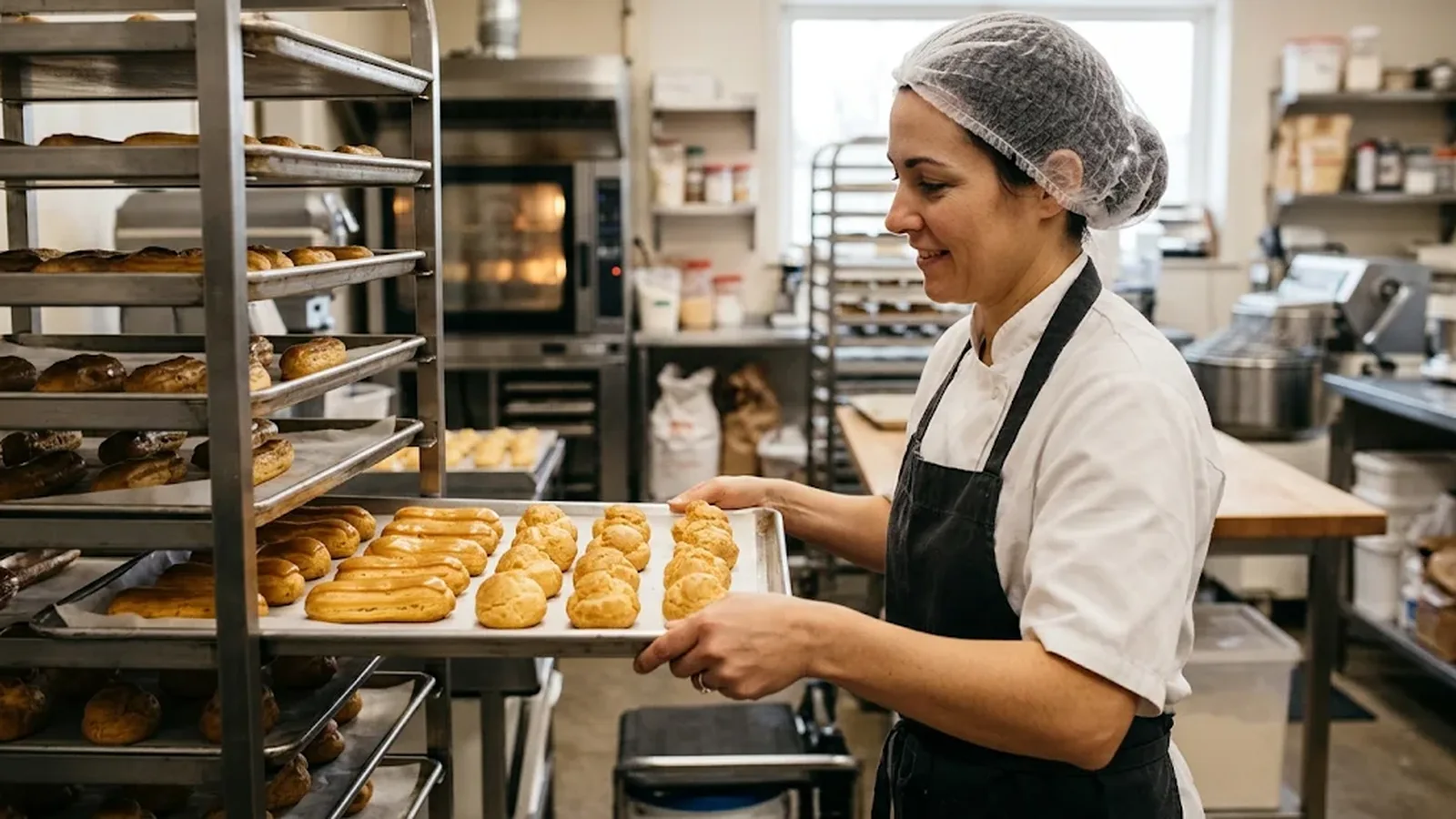
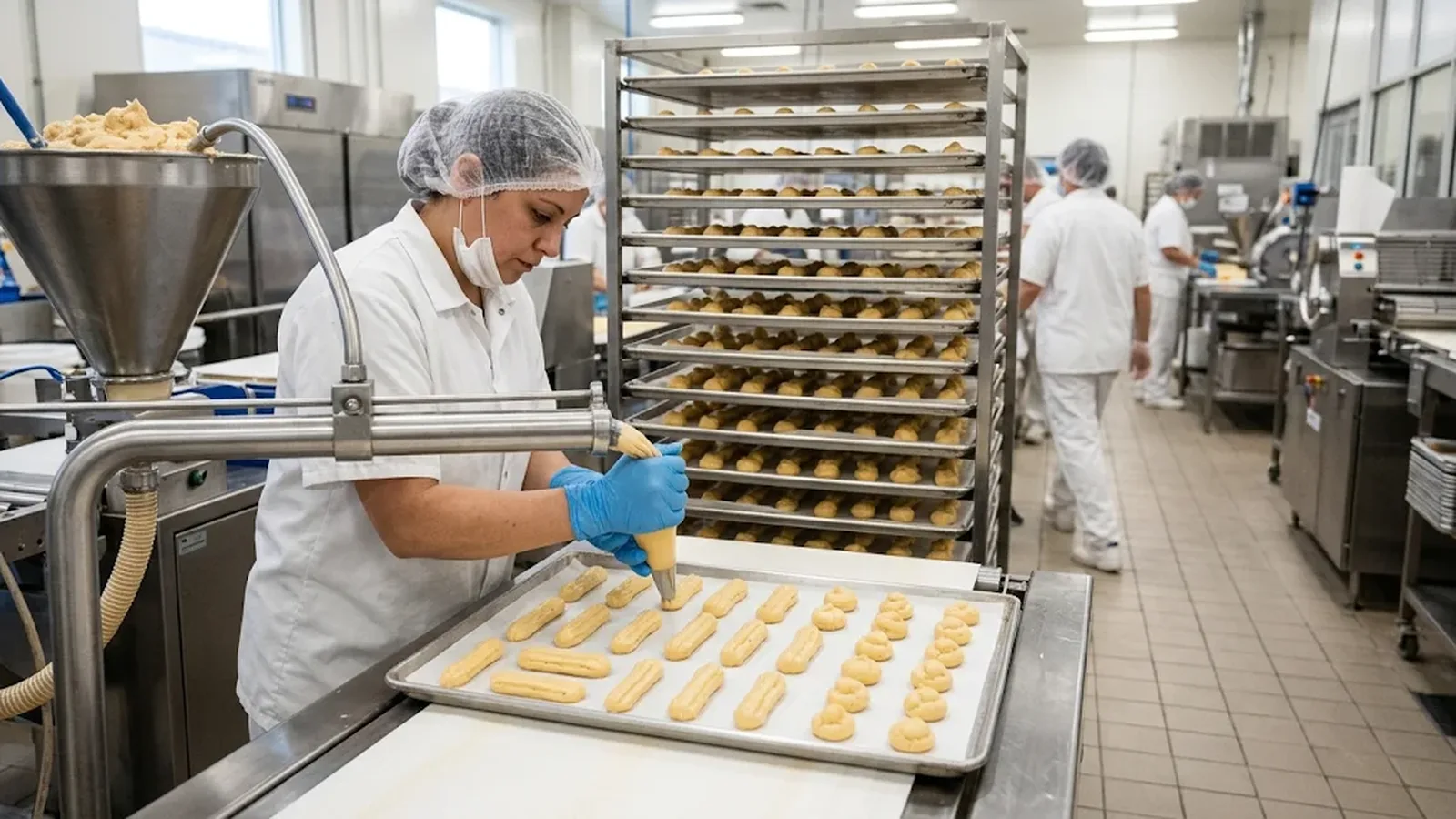
Choux pastry is one of the most unforgiving products an industrial bakery can put on a lined tray. The dough leaves the mixer as a wet, egg-rich paste, is deposited by piping or extrusion in defined shapes, and only sets into a stable structure partway through the bake — which means the lining system under an éclair or cream puff has to release a sticky, high-moisture mass at its most vulnerable stage, then survive tray turnaround for the next deposit cycle. Buyers who specify choux programmes therefore cannot reuse the liner specification they chose for cookies or sheet cakes. This guide covers how silicone-coated baking parchment behaves under choux deposits, how to choose sheet formats for piping lines and tunnel ovens, what changes when trays turn over several times per shift, and which documents a wholesale buyer should collect before converting a choux line. Buyers comparing these specifications can review our baking parchment paper manufacturing programme, where coating weight, base grammage and release values are documented per construction.
Why Choux Stresses a Lining System
Three properties of choux dough make it harder on liners than most baked goods. First, release has to happen while the deposit surface is still gelatinised and tacky: a liner with an insufficient or uneven silicone layer bonds to the bottom crust, and tearing the base of a cream puff at de-panning destroys the product twice over, once visually and again at the filling stage, where injectors need an intact shell. Second, the water content of the dough is high enough that condensed steam collects under and around each deposit early in the bake, so the liner operates in a damp contact zone for part of every cycle — the same wet-release condition that parchment is tested for before shipment. Third, choux is usually piped to tight dimensional tolerances, because éclair length and puff diameter drive filling weight and count per pack; a liner that curls, waves or shifts under the piping head moves the deposit target and produces rejects that no oven setting can recover.
Coating uniformity matters more here than headline coating weight. A grade averaging a mid-range silicone application but with poor distribution will release the centre of the sheet and grip the edges, exactly where piped rings and finger-shaped deposits sit. This is why a bake trial on the actual deposit — not a catalogue sample — is the acceptance gate, and why choux lines are among the first applications to move onto higher-coat, heavier-base constructions when release complaints appear.
Sheet Formats: Rounds, Sheets and Rolls for Piping Lines
Choux production splits into three format decisions. For tray-based piping of cream puffs, chouquettes and Paris-Brest rings, food-grade die-cut parchment rounds matched to the tray diameter remove trimming waste and give the depositor a consistent landing zone; die-cutting tolerance should be confirmed against the tray so the round does not ride up on the tray lip during loading. For full-sheet éclair programs, cut sheets sized to the tray with a small undercut let operators lay the liner flat in one motion and keep the piped fingers inside the sheet edge, where residual moisture leaves the paper most exposed. For lines feeding tunnel ovens or high-volume deck rotations, roll width should be justified by yield maths across the product mix rather than by catalogue default, since a mismatched width converts directly into trim waste every shift. For production volumes, the same construction logic applies to our wholesale parchment paper rolls and sheets line, quoted per roll, sheet or die-cut format.
Perforated liners are a legitimate variant worth testing on choux. Perforation lets steam escape from beneath the deposit during the set phase, which can sharpen bottom-crust definition on crisp-shell products such as chouquettes, while solid liners suit applications where a softer base is acceptable and the shell is scored or filled anyway. The decision is product-specific: run both in the bake trial, score de-panning yield and base appearance, and lock the choice into the specification.
Tray Turnaround, Steam Handling and Filling-Stage Integrity
Choux lines typically reuse trays continuously through a shift, so the liner has to perform on bake after bake rather than on a single demonstration cycle. A well-specified silicone construction releases cleanly across the multiple-bake sequences a choux shift generates, but the buyer should require the multi-bake release test data rather than assume it, because the damp contact zone described above is precisely where release degrades first on an under-specified grade. Flatness adds a second requirement: a liner that has curled after its first bake slows the next piping cycle, and anti-curl behaviour is a documented property of the base paper and coating system, not an accident.
After the bake, the liner keeps working. Éclairs and puffs travel on the same paper into cooling and often into the filling line, where the injector pierces the shell while the base rests on the sheet; a liner that has linted or softened loses fibres onto the product at exactly the point a quality inspector will look. Moisture- and wet-strength data therefore belong in the choux specification file alongside release results. For operations freezing par-baked shells for later finishing, the same liner usually stays with the product into the freezer, so low-temperature behaviour and odour neutrality should be confirmed as well. Documentation scope is confirmed per SKU and destination market, as outlined on our factory and certificate library page, where the audits and test reports behind these claims are listed.
Specification and Sourcing Checklist for Choux Programmes
Before committing a choux line to a liner grade, wholesale buyers should close out five items. One: release data generated on a wet, high-sugar deposit — dry-release results alone will not predict choux performance. Two: multi-bake release and anti-curl results matching the tray-turnaround pattern of the actual line. Three: wet and tensile strength figures that cover handling from oven to filler. Four: food-contact documentation for the finished article under FDA 21 CFR 176 and EU Regulation (EC) No 1935/2004, with declarations tied to the exact construction quoted. Five: retained samples from the pre-production trial, held against the shipment so any later dispute has a physical reference. Every document in our compliance library is tied to a specific construction; see how the silicone-coated programme aligns test reports with the exact grade supplied, and buyers verifying these specifications can review the certificate library alongside their supplier documentation requests.
FAQ
Can the same baking paper be used for éclairs and cream puffs?
Often yes, but not automatically. Cream puffs and rings deposit on rounds or sheets with generous spacing, while éclairs are length-critical and punish any liner movement under the piping head. Both need the same wet-release and multi-bake performance; the format difference — rounds versus sheets versus roll width — is decided by the depositor and tray geometry.
Are perforated parchment liners better for choux pastry?
For crisp-bottom products like chouquettes, perforation helps steam escape and firms the base; for soft-baked applications it makes little difference. Test both constructions on the actual product, because shell style and filling method determine whether a drier base is an improvement or a defect.
How many bakes can one choux liner survive?
A correctly specified grade releases across the multi-bake sequences typical of a shift, but the count depends on deposit moisture, tray turnaround and handling. Require multi-bake release test data per construction and validate with a bake trial on the line rather than relying on a generic claim.
What tests should a choux liner specification include?
Wet and dry release, multi-bake release, anti-curl after bake, wet tensile strength, and food-contact migration testing per the destination market. Retained samples should be tied to the trial so production shipments can be compared against the approved reference.
Conclusion
Choux pastry turns a liner from an accessory into a process component: the paper carries a wet, dimensionally critical deposit through a steam-heavy set phase, survives repeated tray turnaround, and still has to present an intact base at the filling injector. Buyers who specify wet-release and multi-bake data, choose sheet format from the depositor backwards, and document food-contact compliance per construction get predictable de-panning and audit-clean files instead of rework. Commercial choux programmes can be specified from our silicone-coated parchment sheets and rolls with pre-production samples approved before mass production.
CTA
Running an éclair, cream puff or viennoiserie programme? LANGMAI manufactures silicone-coated baking parchment in sheets, rolls and die-cut rounds, supplies wet-release and multi-bake test data per construction, and supports choux bake trials with physical samples before mass production. Request samples and a quotation for your product families.
Sources
- US FDA — 21 CFR Part 176, Paper and paperboard components: https://www.ecfr.gov/current/title-21/chapter-I/subchapter-B/part-176
- European Commission — Food contact materials: https://food.ec.europa.eu/food-safety/food-contact-materials_en
- EFSA — Food contact materials scientific evaluations: https://www.efsa.europa.eu/en/topics/topic/food-contact-materials
- Code of Federal Regulations — Food for human consumption, paper guidance: https://www.govinfo.gov/app/details/CFR-2023-title21-vol3